
Introduction
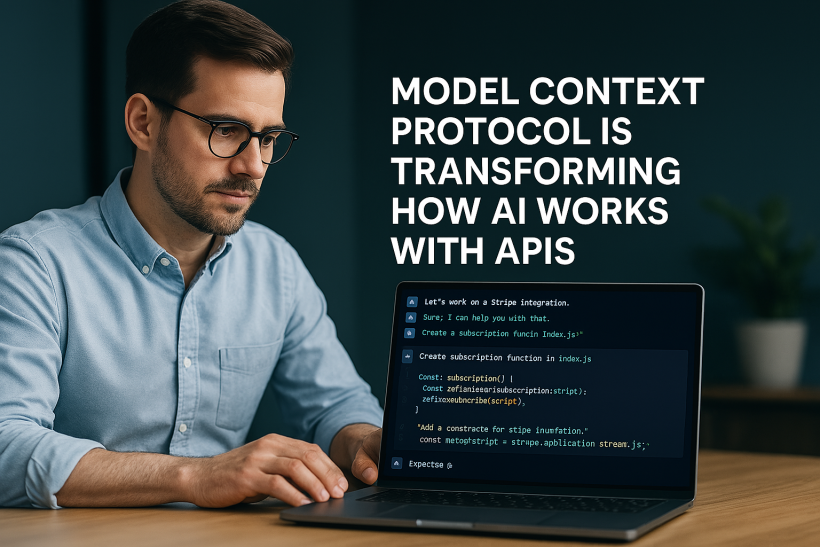
Picture this: an engineer builds a Stripe integration just by chatting with their dev environment. No code. Just conversation. This is possible with Model Context Protocol (MCP)—a new open-source protocol created by Anthropic. It enables large language models (LLMs) to instantly understand and interact with any API.
What Is MCP and Why Does It Matter?
MCP works like a universal connector for AI. However, instead of linking hardware, it connects knowledge and tools. Think of it as USB for AI. When a company exposes its documentation and logs through an MCP server, any LLM can instantly learn how to use that service. For example, Stripe did just that. As a result, the AI could build subscription logic simply by listening and responding to natural language prompts.
The Demo That Changed the Game
In a recent demo, an engineer built a Stripe integration through conversation. They spoke to their code. The AI understood what they needed. This was possible because Stripe made its API ecosystem available via MCP. Therefore, the AI could access all relevant docs and logs instantly. It was like watching Neo download kung fu in The Matrix. But instead of martial arts, the AI downloaded expert-level knowledge of Stripe’s tools.
Why MCP Is a Breakthrough
This changes everything. For one, it removes the need for custom integrations. Any LLM can now “plug in” and use an API without being retrained. In addition, it creates a universal language for APIs. As a result, AIs can work with multiple tools at once. Moreover, MCP is open source. Anyone can create a server for their product, making it AI-ready from day one.
How MCP Works: Architecture in Plain Terms
Understanding MCP requires a quick look at its architecture. The protocol defines three core components: a host (the AI application, such as Claude or your IDE), an MCP client (built into the host, which establishes the connection), and an MCP server (a lightweight program that exposes tools, resources, and prompts from a specific service).
When you open an AI coding assistant that has an MCP client, it can connect simultaneously to multiple MCP servers—your GitHub repository, your Stripe dashboard, your company’s internal knowledge base, and a cloud database. The AI does not need to be retrained on any of these. It simply reads the server’s declared capabilities and starts working. Communication happens over a standardised JSON-RPC protocol, meaning any language or platform can implement an MCP server. This is what makes the ecosystem explode in scale.
The MCP Ecosystem: Who Is Already On Board
Since Anthropic open-sourced MCP in late 2024, adoption across the developer tooling industry has been rapid. The list of companies shipping MCP servers now reads like a who’s who of developer infrastructure:
- Stripe — payment processing tools, subscription management, webhook logs
- GitHub — repository access, issue tracking, pull request review
- Slack — channel messaging, notification routing, workspace data
- Google Drive and Google Maps — document retrieval and location services
- Atlassian (Jira and Confluence) — project management and documentation lookup
- PostgreSQL and SQLite — direct database querying through natural language
- Cloudflare — edge network management and DNS tooling
- Sentry — error monitoring and incident analysis
On the client side, MCP is supported by Claude Desktop, Cursor, Windsurf, GitHub Copilot, and a growing number of open-source agent frameworks including LangChain and AutoGen. The result is a protocol-level interoperability layer that did not exist 18 months ago.
MCP vs. Traditional API Integration: What Actually Changes
To understand why developers are excited, it helps to compare MCP to the status quo. Traditional API integration follows a well-worn path: a developer reads API documentation, writes authentication code, maps request and response schemas, handles errors, and ships. This process takes hours for simple integrations and days or weeks for complex ones. Every new API means starting again from scratch.
MCP inverts this model. Instead of a human reading documentation and writing glue code, the AI reads the MCP server’s capability declaration directly. The AI knows what tools are available, what parameters they accept, and what they return—without any custom prompting or fine-tuning required. Developers still write the MCP servers (the services still need to expose their capabilities), but once a server exists, any MCP-compatible AI client can use it immediately.
The practical implication: the cost of a new integration drops from days to minutes. An AI agent connected to 10 MCP servers can orchestrate complex workflows across all 10 simultaneously—something that would previously require a dedicated engineering team to build and maintain.
What This Means for African Developers
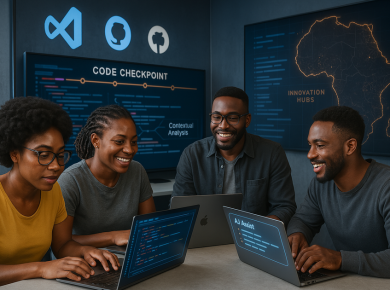
For the developer ecosystem across Africa, MCP arrives at a critical inflection point. African tech teams have historically faced a compounding disadvantage: smaller engineering headcounts, fewer senior developers to review integrations, and limited time to build the tooling that larger, better-resourced teams take for granted. MCP directly addresses this gap.
Consider a fintech startup in Lagos building on top of Paystack, Flutterwave, and a local KYC provider. Previously, integrating all three required dedicated sprints and careful API documentation work. With MCP servers for each provider, an AI-assisted developer can instrument all three services in a single session—querying payment logs, triggering KYC checks, and reconciling transactions through natural language commands.
African cloud providers and developer platforms are beginning to take notice. As more global developer tools ship MCP servers by default, African developers working with those tools gain access to AI-assisted workflows that were previously only viable for large teams. The levelling effect is real: a two-person startup in Nairobi using MCP-enabled tooling can operate with the integration velocity of a ten-person team in San Francisco.
There is also a creation opportunity. African SaaS companies—those building ERP tools, logistics platforms, HR software, or payment infrastructure—can publish MCP servers for their own products. Doing so signals to the developer community that the product is AI-ready, which increasingly matters as AI coding assistants become the primary interface through which developers evaluate and adopt new tools.
The Future of AI-Driven Development
MCP sets the stage for a new kind of software development. AIs will soon combine knowledge from multiple services. For example, one might pull payment data from Stripe and update customer records in Salesforce—all in a single session. Software can now be built by conversation, not code. This lowers the barrier to innovation and speeds up delivery. As agentic AI systems—those that execute multi-step tasks autonomously—mature, MCP will serve as the connective tissue that lets AI agents act reliably across real-world systems.
Conclusion
Model Context Protocol is more than a technical milestone. It’s a shift in how we build and interact with software. As more APIs adopt MCP, we’ll see faster, smarter AI development everywhere. For African developers in particular, MCP is an equaliser—a way to operate at global velocity without global headcount. The companies that invest in MCP-ready infrastructure now, whether building servers for their products or building on top of MCP-compatible AI clients, are positioning themselves for the next phase of the AI development era. And just like Neo in the Matrix, your AI won’t need training—it’ll just download what it needs and get to work.


 Joseph Busari
 UphivaBETAR