
 UphivaBETAR
Browsing Category
Creative Economy
48 posts
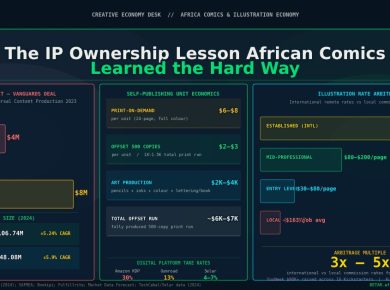
The IP Ownership Lesson That African Comics Learned the Hard Way
When Comic Republic sold its Vanguards IP for television, the production house earned nearly twice what the Nigerian publisher made. The gap between those two numbers is the central economic lesson of Africa’s comics and illustration industry.
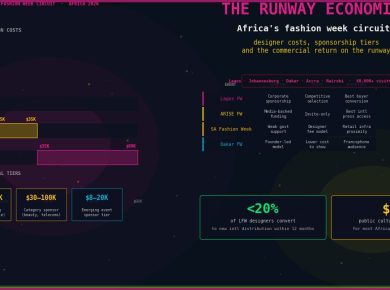
Africa’s Fashion Week Economics: Who Pays, Who Profits, Who Converts
Lagos Fashion Week just won the Earthshot Prize. South Africa Fashion Week just announced a strategic pause. Both events tell the same economic story: Africa’s fashion week circuit sits at the intersection of cultural prestige and structural fragility.

Africa’s Reality TV Format Economy: Inside the Business of Big Brother Naija, Format Fees, and the Sponsor Arms Race
When MultiChoice paid N4 billion for a single Big Brother Naija headline sponsorship, it confirmed what the numbers already showed: Africa’s reality TV format economy is a systematically monetised business generating margins that dwarf scripted television.

Africa’s Global Music Export Premium: The Revenue Map Behind Afrobeats and Amapiano’s International Breakthrough
Africa’s two most commercially successful music exports generated an estimated .1 billion in international revenue in 2025 — but how much returns to Africa? BETAR maps the royalty structures, label deal economics, and Amapiano’s distinct distributor-led model.

The Afrobeats Export Premium: How Africa’s Biggest Music Movement Monetises Abroad — and What Artists Actually Keep
When Afrobeats became a global force, the question wasn’t whether African music could travel — it was who would profit when it did. BETAR maps the streaming royalty gap, label deal structures, sync economics, and touring revenue flows.

Africa’s Reality TV Format Economy: Inside the Business of Big Brother Naija, Format Fees, and the Sponsor Arms Race
Big Brother Naija Season 9 headline sponsorship: N4 billion. Production cost: N5.5 billion. Implied margin: 50%. We map Africa’s reality TV format economy — who owns the IP, how sponsorship tiers work, and what the Idols SA cancellation signals.

The Merch Gap: Why African Creators Leave Money on the Table With Physical Products
African creators command audiences that rival mid-tier Western creators. Yet physical merchandise revenue consistently underperforms. We map the cost stack: production MOQs, Shopify take rates, DHL shipping premiums, and the diaspora fulfilment problem.

Building a Game Studio in Africa Costs $3,000 a Month. Publishing One Game Costs Three Times That.
Africa has 349 million gamers. It has fewer than 200 commercially active game studios. The gap is a unit economics problem — app store fees, ARPU, bandwidth costs, and publisher deal structures all working against African developers.

The Afrobeats Export Premium: How Africa’s Biggest Music Movement Monetises Abroad — and What Artists Actually Keep
Africa generates 16% of global streaming volume but earns just 3.4% of revenues. How Afrobeats artists are navigating label deals, sync fees, and touring economics in the international market.

Africa’s Film Festival Circuit: The Economics Behind the Red Carpet
Africa hosts 30+ international film festivals annually, but the commercial economics are rarely examined. BETAR maps FESPACO’s operating costs, filmmaker submission fees, co-production market deal flow, and whether the circuit generates real ROI for filmmakers.

