
Africa’s $4.45 Billion Social Commerce Economy: TikTok’s Monetisation Gap and WhatsApp’s Retail Dominance
By BETAR.africa Creative Economy Desk
When Amara Okafor goes live on TikTok from her Lagos flat every Saturday evening — showing her followers how to layer ankara prints with contemporary Western cuts — she is participating in a market worth $1.55 billion in Nigeria alone. For every sale she closes via an affiliate link clicked during the session, she earns a 10 to 15 percent commission. Last month, she cleared roughly ₦280,000 — about $185 — across three two-hour sessions. It is not a salary. But it is a market that, two years ago, did not exist.
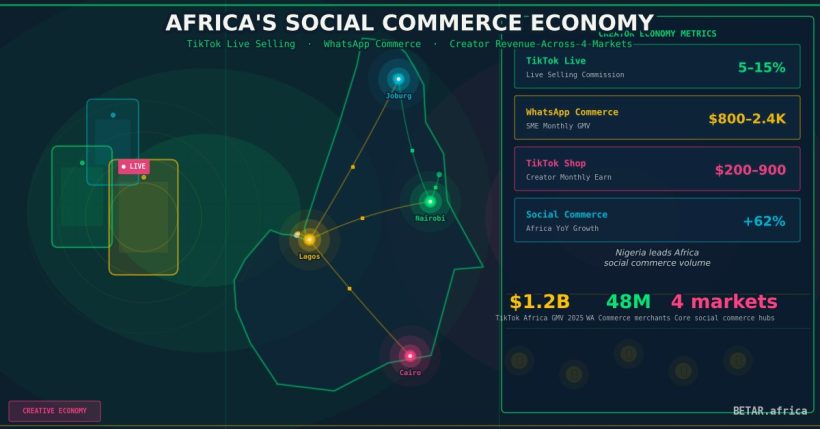
Okafor is one of thousands of creators driving Africa’s social commerce economy, now valued at $3.51 billion continent-wide in 2024, projected to reach $4.45 billion in 2025 — a 26.7 percent annual growth rate against an 8.5 percent expansion for traditional e-commerce over the same period, according to ResearchAndMarkets data published in Q2 2025. The CAGR between 2021 and 2024 was 38.4 percent — among the fastest retail growth trajectories on the continent.
Yet beneath that market size sits a structural tension: African creators are generating platform growth for TikTok while being systematically excluded from its direct monetisation infrastructure. And the platform that actually dominates Africa’s social commerce is not TikTok at all — it is WhatsApp.
TikTok’s African Paradox: Growth Without Pay
TikTok does not publish Africa-specific GMV figures for TikTok Shop. Globally, the platform’s shopping function hit $33.2 billion in 2024 — a 202 percent year-on-year increase — with H1 2025 alone reaching $26.2 billion, according to Momentum Works. Southeast Asia accounts for the overwhelming majority of that volume. Africa is at early-stage expansion: merchant sign-ups on TikTok Shop in Nigeria tripled in mid-2024, but a formal storefront launch has not been confirmed. Egypt remains the continent’s most advanced TikTok Shop market. South Africa and Kenya are on the roadmap.
The monetisation exclusion problem is more concrete. TikTok’s Creator Rewards Program — the successor to the Creator Fund — is available in seven countries: the United States, United Kingdom, Germany, France, Brazil, Japan, and South Korea. Not a single African country is included. The Effect Creator Rewards programme extends to 53 regions, of which only Morocco, Egypt, and South Africa qualify in Africa. Nigeria, Kenya, Ghana, Tanzania, and Ethiopia — combined home to roughly 700 million people — are excluded from all direct payment pathways.
“I rely on brands. That is the only way I have made money,” Charity Ekezie, a Nigerian TikTok creator with 3.5 million followers, told OkayAfrica, in a piece examining TikTok’s monetisation exclusion across sub-Saharan Africa — a structural reality for creators across the region locked out of TikTok’s direct revenue programmes.
The practical income model for most African TikTok creators is a patchwork: brand partnerships paying ₦100,000 to ₦500,000 (~$65–$330) per collaboration for mid-tier Nigerian creators; affiliate commissions of 5 to 20 percent per sale on products promoted through TikTok Live; and Live Gifts from viewers, converted to Diamonds and cashed out at rates the platform controls. Kenyan comedian 2Mbili noted publicly that “even if you go live daily, there’s no guarantee you’ll get gifts” — an accurate description of an earnings floor that does not exist.
The Commission Structure Opportunity
Where TikTok’s potential economic advantage for African commerce is clearest is in fee compression. Where TikTok Shop has formally launched, it charges merchants a standard 5 to 6 percent commission — rising to 8 to 9 percent in some Western European markets.
Compare that with Africa’s established e-commerce incumbents. Jumia’s commission rates by category range from approximately 6 percent on mobile phones to as high as 29 percent on grocery and household goods in its Nigerian and Kenyan markets. Takealot, South Africa’s dominant platform, charges 8 to 15 percent depending on category, plus a R400 monthly seller fee and additional fulfilment, storage, and payment processing charges.
For a merchant selling a ₦30,000 fashion item, the difference between a 6 percent TikTok Shop rate and a 20 percent Jumia fashion rate is ₦4,200 per transaction — material at scale. If TikTok Shop formalises its rollout in Nigeria and South Africa, it introduces the most significant fee disruption to African e-commerce since Jumia’s IPO in 2019.
That rollout, however, remains contingent on infrastructure and regulatory conditions that vary by market. Nigeria’s logistics gap, intermittent payment infrastructure, and the regulatory complexity of cross-border product returns all complicate a simple transplant of TikTok Shop’s Southeast Asian playbook.
WhatsApp Commerce: The Invisible $1.5 Billion Engine
The platform that actually powers Africa’s social commerce economy operates without a feed algorithm, a shop tab, or a creator rewards scheme. WhatsApp, with approximately 320 million users across Africa and near-total penetration in its core markets — 97 percent in Kenya, 96 percent in South Africa, 95 percent in Nigeria — is the continent’s dominant commerce infrastructure.
Sagaci Research’s 2024 survey across Africa found that 41 percent of African internet users use WhatsApp to buy and sell goods. TikTok is used for social commerce by 5 percent of users; Instagram by 7 percent. The informal economy is built on a messaging app, not a video storefront.
For merchants, WhatsApp Commerce offers a zero-platform-fee transaction environment — Meta currently charges nothing for catalogue listings or sales completed through WhatsApp Business. The WhatsApp Business API, used by larger retailers and financial services players, carries costs via approved Business Solution Providers, but the free app version accounts for the majority of small merchant activity. Seven in ten South African retailers conduct transactions through WhatsApp, according to payments research from Stitch Money and Ozow.
The monetisation question for Meta is whether this informal commerce layer can be converted into revenue. WhatsApp Pay has launched in India and Brazil — the two largest WhatsApp markets globally — with transaction fees for merchants. An Africa expansion of WhatsApp Pay, even at low basis-point rates, would extract revenue from a commerce layer that has so far been entirely free. No Africa timeline has been confirmed by Meta.
For African merchants, the calculus is currently simple: WhatsApp is free, ubiquitous, and trusted. “It’s where the customers already are,” is the standard answer from small retailers in Lagos, Nairobi, and Johannesburg when asked why they haven’t moved to a formal e-commerce platform. Sagaci Research found that 44 percent of women in Africa use WhatsApp as their primary commerce channel, versus 39 percent of men — reflecting the platform’s dominance in fashion, beauty, and food markets typically led by women entrepreneurs.
Market Scale: Where the Money Is
Nigeria commands the continent’s largest single social commerce market: $1.55 billion in 2024, growing at 38.3 percent year-on-year, projected at approximately $2.04 billion in 2025 and $3.96 billion by 2030, per GlobeNewswire analysis of ResearchAndMarkets data. Nigeria also accounts for 26 percent of Africa’s total e-commerce revenue.
South Africa’s market, smaller in absolute terms at $1.14 billion in 2024, is accelerating faster by growth rate: $1.54 billion in 2025 (35.2 percent growth), with a 2030 forecast of $3.82 billion and a CAGR of 19.9 percent through that period. The South African market benefits from higher average transaction values and more developed payments infrastructure — a different but complementary growth profile to Nigeria’s volume-driven expansion.
Egypt and Kenya round out the continent’s top-four social commerce markets, driven by TikTok’s stronger formal presence in Egypt and WhatsApp’s commercial infrastructure dominance in Kenya. No market-level GMV figures are publicly available for either country in the ResearchAndMarkets dataset.
Across the continent, more than 40 percent of internet users in Nigeria, Kenya, and South Africa made a purchase via a social commerce platform in 2024, according to Sagaci Research. For context, Africa’s overall e-commerce user penetration sits at 13.1 percent in 2025 (Statista). Social commerce penetration among existing internet users is therefore roughly three times the general e-commerce rate — suggesting that informal, social-channel commerce is outpacing the formal platform economy in reaching African consumers.
The Revenue Shift Underway
Africa’s social commerce trajectory points to a fundamental restructuring of retail revenue flows on the continent. The traditional model — manufacturer to distributor to formal retailer to consumer, mediated by platforms like Jumia and Takealot taking 10 to 29 percent commission — is being bypassed at scale.
In its place: a creator-mediated commerce layer where brands pay creators directly (bypassing platform ad spend), where transactions complete on WhatsApp at zero platform cost, and where the 5 to 6 percent TikTok Shop commission (where available) structurally undercuts every incumbent.
For African creators like Okafor, the economics are still fragile — brand deal income is inconsistent, affiliate commissions require substantial follower counts to produce meaningful revenue, and direct monetisation from TikTok itself remains inaccessible. But the market they are building in aggregate — $4.45 billion in 2025, crossing $9 billion by 2030 — is not fragile at all. It is one of the fastest-growing retail revenue channels on the continent, and the platforms extracting the most value from it are not yet paying the creators who built it.
Sources: ResearchAndMarkets / GlobeNewswire (Africa Social Commerce Market Intelligence, Q2 2025); Sagaci Research (Rise of Social Commerce in Africa, 2024); Momentum Works / The Low Down (TikTok Shop GMV H1 2025); OkayAfrica (Is TikTok Excluding Africans From its Creator Economy?); Statista (Africa eCommerce Outlook 2025); Stitch Money / Ozow (South Africa Payments Research); Jumia VendorHub KE (Commission Rates 2025); Influencer Marketing Hub (TikTok Shop Fees 2025); CalculateCreator (TikTok Creator Fund Eligible Countries); WapiKit (WhatsApp Business Statistics 2025); AskYazi (WhatsApp Usage Africa 2025).


 UphivaBETAR