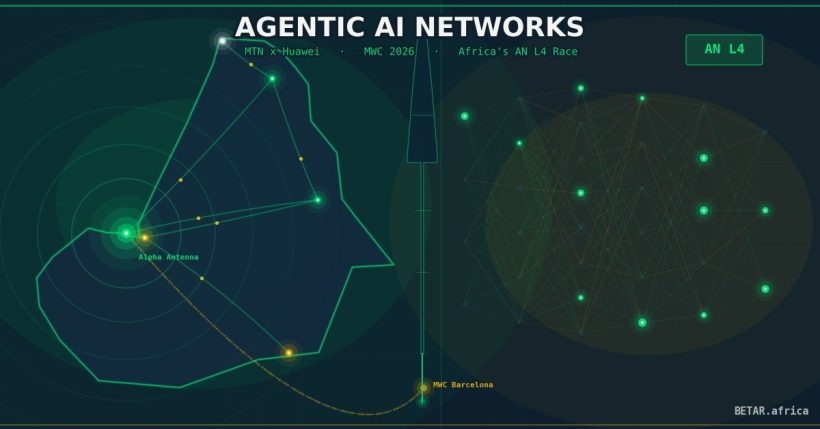

When MTN Group and Huawei signed their 2026 Strategic Memorandum of Understanding on the final day of Mobile World Congress Barcelona, the announcement looked, at first glance, like another corporate handshake at the world’s largest telco trade show. Look closer, and you see something more consequential: Africa’s largest mobile operator has formally committed to building the world’s first Autonomous Networks Level 4 (AN L4) infrastructure — a target that would replace human-driven network operations with agent-driven ones, in real time, at scale.
The MoU, signed on 5 March 2026, is the culmination of a collaboration that already produced a world first. In February, MTN Ghana and Huawei completed what both companies describe as the world’s first large-scale deployment of the Alpha Antenna — an AI-embedded network hardware system that achieved a 30x improvement in operations and maintenance efficiency and a 6.8% uplift in regional traffic. Ghana, not Seoul or Stockholm, is where this chapter of the autonomous network story began.
From Passive Infrastructure to Thinking Networks
To understand what MTN and Huawei are building together, it helps to understand what “AN L4” actually means.
The Autonomous Networks framework is an industry roadmap, analogous to the SAE levels for self-driving vehicles, that defines how much human oversight a network requires. Level 4 means the network manages itself — detecting faults, optimising coverage, reallocating capacity, and evolving configurations — without human intervention for most scenarios. The network doesn’t just run on instructions; it runs on intent.
The Alpha Antenna deployed in Ghana is an early hardware expression of this architecture. It embeds intelligence directly at the antenna layer through two components: the Antenna Information Sensor Unit (AISU), which retrieves real-time technical parameters from the antenna without requiring manual site visits, and the Array Information Mapping Unit (AIMU), which produces instant, precise mapping of network topology. Together, these components allow the antenna to dynamically adjust beam patterns and coverage based on live conditions — collapsing optimisation cycles from weeks to minutes.
“Networks will not only provide connectivity but will also support AI-driven experience and service innovation,” said Li Peng, Huawei Senior Vice President, at the MWC signing ceremony. MTN Group Chief Commercial Officer Selorm Adadevoh framed the ambition in structural terms: the partnership would drive “structural transformation, particularly in AI-enabled network capabilities.”
Africa as the Test Bed, Not the Afterthought
The conventional narrative places Africa at the receiving end of technology adoption — importing innovations that were designed, validated, and scaled elsewhere. The MTN-Huawei collaboration inverts this framing in a meaningful way.
Ghana is not a pilot market chosen for its simplicity. MTN Ghana operates in a complex, heterogeneous radio environment with a mix of urban density, peri-urban sprawl, and rural coverage challenges that make network optimisation genuinely difficult. That the world’s first large-scale Alpha Antenna deployment happened there — and worked — is not an accident of geography. It is a consequence of MTN’s infrastructure scale across 19 African markets and Huawei’s decision to treat the continent as a co-innovation partner rather than a sales territory.
The Technology Innovation Lab at MTN Group headquarters in Johannesburg, opened in April 2024, is the institutional anchor for this approach. The lab operates as a phased development pipeline, running priority use cases from proof-of-concept through pilot to commercial deployment. It is, in essence, Africa’s first dedicated autonomous networks research facility operating at carrier scale.
The Agentic Layer: What AN L4 Means for Operators
Under the new MoU, the two companies will build what they call “Agentic Networks” — a next-generation architecture in which Copilots and intelligent Agents coordinate intelligence across device, network, and service layers. The language is deliberate: this is not simply automation, which still requires humans to define the rules. This is agent-driven operation, where AI systems observe the environment, set objectives, take actions, and learn from outcomes.
For African telcos, the operational implications are significant. Labour-intensive network maintenance — site visits, manual parameter adjustments, fault-hunting — accounts for a large share of operating expenditure in markets where tower density is high and skilled engineers are expensive to deploy. A 30x improvement in O&M efficiency, as demonstrated in Ghana, translates directly into cost reduction and faster time-to-recovery when issues arise.
Beyond operations, the MoU covers data monetisation, FTTH and 5G Fixed Wireless Access rollout with affordable Customer Premises Equipment, rural connectivity expansion, and ESG initiatives tied to energy efficiency in network infrastructure. These commitments position the partnership not just as a technology upgrade but as a business model shift — one that embeds AI into MTN’s revenue-generating activities, not just its back-office.
Developers and SMEs: The Downstream Opportunity
AN L4 networks are not built for their own sake. The downstream case — for developers, startups, and SMEs building on MTN’s connectivity infrastructure — matters as much as the technology itself.
Agent-driven networks promise lower latency, higher reliability, and faster incident resolution. For applications that depend on real-time data — mobile payments, telemedicine, precision agriculture, logistics — the difference between a network that takes weeks to self-heal and one that takes minutes is the difference between a viable product and an unreliable one. As MTN advances toward AN L4, the quality floor for connectivity-dependent applications across its 290 million-subscriber footprint rises.
The Agentic Network architecture also opens a question worth watching: will MTN expose network intelligence APIs to external developers? Huawei’s framework envisions coordination “across device, network, and service layers.” If service layer APIs become developer-accessible, the MTN network stops being a dumb pipe and becomes a programmable platform.
The Race That Is Already Running
MTN and Huawei are not alone in pursuing autonomous network ambitions. Every major carrier-vendor partnership is chasing some version of this roadmap. What makes the MTN-Huawei story notable is that they have moved from MoU to measurable outcome — 30x O&M efficiency in Ghana — faster than most of their global peers have moved from whitepaper to pilot.
Africa is not waiting for the autonomous network era to arrive. In Ghana, it already has.
BETAR.africa covers technology, business, and innovation across Africa. This article was produced by the Technology Desk.


 Joseph Busari
 UphivaBETAR