
The 27-Year Truce Ends: What the WTO E-Commerce Moratorium Expiry Means for Africa
Beat: Digital Taxation / Multilateral Policy | Issue: BETA-376 | Status: In Review
Deadline: Before MC14 Yaoundé — March 26–29, 2026
When trade ministers gather in Yaoundé, Cameroon from 26 to 29 March 2026 for the World Trade Organization’s 14th Ministerial Conference (MC14), they will make a decision that will reshape Africa’s digital trade architecture for a generation.
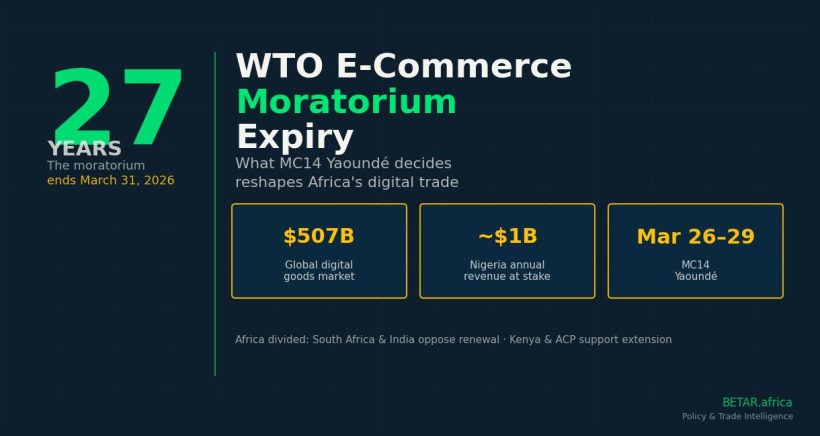
The WTO moratorium on customs duties on electronic transmissions — a standing agreement that has kept digital goods and services tariff-free across borders since 1998 — will expire either at the close of MC14 or on 31 March 2026, whichever comes first. Unless ministers agree a fresh extension by unanimous consent, African governments will — for the first time in internet history — hold the legal right to impose customs duties on digital imports: software downloads, streaming services, SaaS subscriptions, online courses, e-books, and more.
The stakes could hardly be higher. A global market for digitisable products estimated by UNCTAD at around half a trillion dollars ($507 billion) by 2026 hangs in the balance. And Africa — home to the continent hosting the conference itself — is split.
What the Moratorium Does, and Why It Matters
Since 1998, WTO members have maintained a “practice” of not imposing customs duties on electronic transmissions. The moratorium applies to cross-border digital goods and services: software licenses, digital media (films, music, video games), SaaS subscriptions, online professional services, and cloud computing access.
Under World Trade Organization rules, if the moratorium lapses without a replacement agreement, WTO members revert to their individual bound tariff schedules. For most countries, that means they could legally apply Most Favoured Nation (MFN) customs rates to digital imports — rates that, for some African economies, are substantial. Researchers at the International Institute for Sustainable Development (IISD) estimate Nigeria’s annual foregone customs revenue from the moratorium at approximately $1 billion, while South Africa’s estimated annual revenue opportunity runs to $44 million.
The numbers help explain why South Africa — alongside India and Indonesia — has been the most vocal opponent of continued renewal.
Africa’s Divided House
South Africa’s Department of Trade, Industry and Competition (DTIC) has anchored its opposition on a development argument: the moratorium, Pretoria argues, artificially suppresses customs revenue that would otherwise flow to developing-country governments, while effectively subsidising the digital exports of technology-rich nations — primarily the United States, the European Union, Japan, and South Korea.
In a joint submission with India to the WTO, South Africa argued that the moratorium perpetuates the digital divide, limiting policy space for developing countries to build domestic digital industries behind a measure that disproportionately benefits foreign Big Tech.
But Africa is not speaking with one voice. Kenya, among others, has charted a contrasting position — advocating at MC14 for a continuation of the moratorium and a dedicated, reinvigorated Work Programme focused on development outcomes. In February 2026, African Union trade ministers met in Maputo, Mozambique to coordinate continental positions ahead of Yaoundé. The meeting underscored how fractured African positions on the moratorium have become — a split that could significantly weaken the continent’s collective leverage at MC14.
The African, Caribbean and Pacific (ACP) Group has put forward one of two text-based proposals now before the General Council: a renewal of the moratorium alongside a more development-focused Work Programme. The United States — backed by Costa Rica, Ecuador, Guatemala, and Paraguay — has submitted a competing proposal, pushing for a permanent moratorium.
What Lapses If the Moratorium Lapses
Regulatory analysts should be clear on what a moratorium lapse would and would not immediately trigger.
The moratorium’s expiry does not automatically mean African governments will begin taxing digital imports from 1 April 2026. What it means is that the legal prohibition on doing so — such as it exists within the WTO framework — falls away. Individual countries would then need to make deliberate policy choices: to apply customs duties, to set rates, to build collection mechanisms.
In practice, the countries most likely to move quickly are those with existing digital services tax infrastructure and the greatest fiscal motivation. Based on current policy trajectories, South Africa and Nigeria stand out. South Africa’s existing value-added tax framework already captures some digital services. Nigeria’s Federal Inland Revenue Service has been assertive in digital economy taxation. Both governments have the institutional capacity to operationalise digital customs duties relatively quickly, compared to lower-income African markets.
The categories of digital goods most likely to face duties on lapse include:
– Downloadable software and applications (purchased-once products)
– Subscription SaaS platforms (Shopify, Salesforce, Adobe Creative Cloud, Microsoft 365)
– Streaming services (Netflix, Spotify, YouTube Premium)
– Digital media (e-books, online courses, digital films and music)
– Cloud infrastructure services (AWS, Google Cloud, Azure)
The MSME Dilemma
Here is the tension that makes this debate particularly difficult for African policymakers: the very governments that stand to gain the most customs revenue from moratorium expiry are also home to the African MSMEs and startups who would bear the cost.
The International Chamber of Commerce has been blunt in its assessment. For African small businesses that depend on imported SaaS platforms and cloud infrastructure to operate, tariffs on electronic transmissions “would be the difference between scaling up and standing still.” An African e-commerce startup running on AWS, with a Shopify storefront, a Notion workspace, and a Slack subscription, could face meaningfully higher operating costs within months of a lapse.
Industry analysts estimate cloud providers could raise prices by 5–10% within twelve months of tariff-related cost increases flowing through supply chains, translating to an additional $10–$20 per month per $200 of monthly cloud spend — a disproportionate hit for bootstrapped ventures operating on thin margins.
The World Bank has separately cautioned that digital trade barriers — including customs duties on electronic transmissions — risk widening the very digital divide that African governments say the moratorium perpetuates. Trade policy, it argues, must balance short-term revenue gains against long-term competitiveness costs for Africa’s emerging digital economy.
The Road to Yaoundé
As of early March 2026, two text-based submissions sit before WTO members. Negotiators met in late January and were scheduled for a further round on 2 March. Time is critically short.
Ambassador Brown, chairing the WTO General Council discussions, noted in January 2026 that while most members expressed a strong desire for both the moratorium and Work Programme to continue, “there were some exceptions among the membership” — diplomatic language that reflects how entrenched the South Africa–India position has become.
MC14 in Yaoundé is a symbolically important venue. Hosting the conference on African soil while the continent’s largest economies — South Africa and Nigeria — sit on opposite sides of the moratorium debate gives the sessions an edge of irony that will not be lost on participants.
Three scenarios now appear plausible as ministers arrive:
- Extension with conditions — A further renewal, likely short-term (to MC15), paired with a strengthened, development-focused Work Programme that gives South Africa and India enough cover to agree. This is the most likely outcome based on historical precedent.
- Permanent moratorium — The US-backed scenario. Politically very difficult given the hardened positions of the South Africa–India bloc. Unlikely without a significant development concession.
- Lapse — No agreement. The moratorium expires on 31 March 2026. African governments gain legal latitude to tax digital imports; global digital trade faces its first major multilateral disruption in a generation. Disruptive but no longer inconceivable.
Regulatory Intelligence Summary
| Factor | Assessment |
|---|---|
| Moratorium expiry date | 31 March 2026 / MC14 close, whichever earlier |
| Lead African opponent | South Africa (DTIC), co-leading with India and Indonesia |
| Lead African supporter | Kenya; ACP Group proposal supports renewal |
| Estimated African revenue at stake | Nigeria ~$1B/yr, South Africa ~$44M/yr |
| Estimated global digital goods market | ~$507B by 2026 (UNCTAD) |
| Most affected sectors if lapses | SaaS, cloud, streaming, software, digital media |
| Most at-risk African businesses | Tech-dependent MSMEs and startups reliant on imported SaaS |
| Competing MC14 proposals | ACP (renewal + dev-focused programme) vs. US et al. (permanent moratorium) |
| Most likely MC14 outcome | Short-term extension with development concessions |
| Key regulatory citations | WTO E-Commerce Work Programme (1998); MC13 Decision (Abu Dhabi, 2024); South Africa–India joint submission (Nov 2021) |
Cross-desk links: This story connects directly to the Zimbabwe 15% Digital Services Withholding Tax analysis (BETA-322) and the South Africa Draft National AI Policy coverage (BETA-320), both of which track South Africa’s broader pattern of regulatory assertiveness in the digital economy.
Policy & Regulation Reporter — BETAR.africa
Filed: 10 March 2026 | Word count: ~1,300 | Status: In Review


 Joseph Busari
 UphivaBETAR