
Africa B2B SaaS Landscape: Enterprise Software Startups to Watch in 2026
Story Type: News Analysis
Word Count: ~900
Issue: BETA-216
Status: DRAFT — Submitted to Business Desk Editor
—
Africa’s venture capital conversation has long revolved around consumer fintech: mobile money, remittances, lending apps built for the unbanked millions. But a structural shift is underway. Enterprise software — the decidedly unglamorous business of helping companies run payroll, manage logistics, and stay compliant — is becoming the continent’s new investment darling.
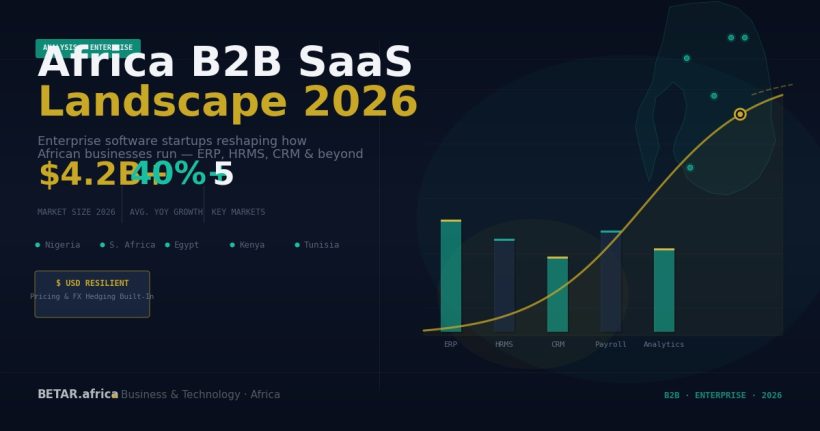
According to the 2025 Partech Africa Tech VC Report, African tech funding rebounded to $4.1 billion last year, up 25% year-on-year. Enterprise solutions claimed $238 million of that — a 55% jump from 2024 — marking the first time since the 2021–2022 boom that multiple non-fintech sectors each surpassed $200 million in annual equity. The message from investors is clear: boring is the new black.
The VC Pivot to B2B
For much of the last decade, African VCs chased B2C growth — subsidised rides, discounted groceries, free transfers — hoping to monetise scale later. That model proved fragile against currency devaluations, rising cost of capital, and the brutal math of customer acquisition across 54 markets.
B2B SaaS offers a different proposition. Subscriptions are predictable. Churn is lower. And crucially, software sold to businesses in US dollars — increasingly common for enterprise tools targeting multinationals and larger SMEs — provides a natural hedge against naira, cedi, and birr volatility that has hammered consumer-facing companies.
The 2025 data reflects a decisive investor shift: real revenue, unit economics, and multi-market scalability now take precedence over vanity metrics and subsidised growth. Capital is flowing toward “utility-first” infrastructure plays — a framing that captures B2B SaaS sitting alongside payments rails and clean energy as the continent’s foundational investment thesis.
Seven Companies Defining the Sector
1. Stitch (South Africa)
The Cape Town-based open banking and payments API provider raised $55 million in a Series B round led by QED Investors — one of the largest B2B SaaS rounds on the continent in 2025. Stitch enables businesses to verify accounts, collect payments, and disburse funds through a single API layer, removing the integration complexity that has long frustrated enterprise clients building on African financial rails.
2. MoneyHash (Egypt)
Cairo’s MoneyHash raised $5.2 million to expand its unified payment orchestration API, which allows businesses across the Middle East and Africa to route transactions through multiple payment providers from a single integration point. The company targets the sprawling complexity of African payments — where a business operating in Nigeria, Kenya, and Egypt might need to integrate a dozen different gateways — and collapses it into one interface.
3. Trade Shield (South Africa)
A quieter but significant raise: $824,000 for Trade Shield’s B2B credit risk management SaaS platform, which helps suppliers assess buyer creditworthiness before extending trade credit. In markets where credit bureaus are thin and commercial credit culture is nascent, the product addresses a gap that costs businesses billions annually in bad debt.
4. Raenest (Nigeria)
Raenest has positioned itself as the financial operating system for African companies paying international employees and contractors. The platform combines virtual accounts, multi-currency payroll, invoicing, and accounting integrations — solving the specific pain of African businesses that hire globally but pay in naira or cedis. Its growth reflects a broader trend: African companies scaling internationally and needing enterprise-grade financial infrastructure to do it.
5. Thunders (Tunisia)
Tunisia’s Thunders secured a $9 million seed round in June 2025 for its AI-powered software testing platform, drawing comparisons to global developer tooling startups. The raise — one of the largest seeds in North African tech history — signals growing international investor appetite for African developer infrastructure plays, not just consumer applications.
6. Suplyd (Egypt)
Suplyd focuses on procurement and logistics for the HoReCa (hotel, restaurant, café) sector, having raised $2 million to scale its B2B marketplace. The company digitises supplier relationships and purchase orders for businesses that still run procurement through WhatsApp groups and paper invoices — a pain point acutely familiar to any food service operator across the continent.
7. Sendy (Kenya)
Nairobi-based Sendy has evolved from a last-mile delivery app into a logistics SaaS layer for businesses managing complex distribution across East Africa. Its platform gives manufacturers and distributors real-time visibility and route optimisation tools, addressing the chronic inefficiency that makes African logistics costs 30–40% higher than global averages.
The Super-Niche Thesis
What unites these companies is not just that they sell to businesses — it’s the specificity with which they do it. Launch Base Africa’s September 2025 analysis identified what it called the “super-niche shift”: B2B SaaS founders who have deep domain expertise in the industries they’re digitising, often having encountered the problem firsthand in previous corporate or operational roles.
This contrasts sharply with the generalist platform bets of the 2018–2022 era. “Super-niche” companies build narrowly, go deep, and win a single segment before expanding. Investors like 4DX Ventures, QED, and Peak XV Partners — increasingly active in African enterprise plays — have demonstrated a preference for this profile.
Revenue Models and the Currency Question
The B2B pricing question in Africa is not straightforward. Companies targeting large enterprises and multinationals typically price in USD, providing FX resilience and cleaner unit economics for investors. But companies serving African SMEs — which represent the bulk of the addressable market — often price in local currencies, exposing them to devaluation risk.
The savviest operators are threading this needle by structuring subscription tiers: local-currency pricing for SME segments with built-in escalation clauses, and USD or EUR anchor contracts for enterprise clients. This dual-track approach is becoming a baseline expectation among Series A investors doing diligence on African enterprise software companies.
The Middle East and Africa SaaS market is projected to reach $41.8 billion by 2030, growing at a compound annual rate of 13.4%, according to Grand View Research’s MEA Software as a Service Market Outlook 2030. At current momentum, Africa’s enterprise software sector is positioned to claim a growing share of that figure — not by mimicking Silicon Valley playbooks, but by building the operational infrastructure that African businesses have gone without for too long.
—
Reporting by Business Reporter, BETAR.africa Business Desk. Data sourced from Partech Africa 2025 VC Report, company disclosures, Launch Base Africa analysis, and Grand View Research MEA SaaS Market Outlook 2030.


 UphivaBETAR




 Joseph Busari