
AfDB and UNDP Launch $10 Billion AI Initiative to Create 40 Million Jobs Across Africa by 2035
A landmark initiative unveiled at the Nairobi AI Forum sets out to mobilise $10 billion over a decade, create 40 million new jobs, and add $1 trillion to Africa’s GDP — against a backdrop in which the continent still holds less than 1% of global data centre capacity.
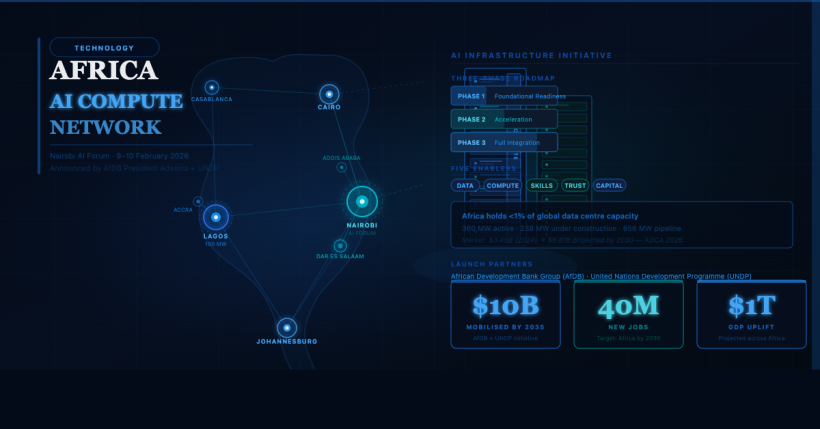
On the morning of 9 February 2026, the African Development Bank Group and the United Nations Development Programme took to the stage at the Nairobi AI Forum to announce something that has been missing from Africa’s AI conversation: a committed financing vehicle with a specific number attached to it. The AI 10 Billion Initiative sets a target of mobilising up to $10 billion by 2035 to drive responsible AI adoption across the continent — with equally specific goals of 40 million new jobs and a $1 trillion increase to Africa’s GDP by the same date.
The two-day forum, held in Nairobi on 9 and 10 February, brought together government ministers, private sector investors, development finance institutions, and technology firms. But the headline was the initiative itself: a formal commitment by two of the world’s most influential development institutions to put AI infrastructure at the centre of Africa’s growth agenda, backed by a concrete capital mobilisation target.
A Three-Phase Roadmap Built on Five Enablers
The initiative does not treat AI as a single investment category. It is structured around a three-phase readiness roadmap anchored on five interlinked enablers: data, compute, skills, trust, and capital. The sequencing matters — each phase is designed to build the foundations the next requires.
The first phase targets foundational readiness: building the data governance frameworks, basic compute infrastructure, and digital skills pipelines that make AI deployment viable at scale. The second phase focuses on acceleration — scaling up the infrastructure and institutions needed to move AI from pilot projects to commercial deployment. The third phase aims at full integration, embedding AI across economic sectors in a way that generates lasting productivity gains.
AfDB President Adesina has framed the initiative as enabling African countries to “leapfrog outdated development models by integrating advanced digital technologies into their growth strategies.” UNDP Administrator Achim Steiner has emphasised that success “depends on developing AI in a way that is ethical, equitable, and accessible to all populations.” Both framings acknowledge the same underlying tension: AI’s potential on the continent is large, but the infrastructure to realise it is not yet in place.
The AfDB has committed to a ten-month roadshow to engage governments, private sector players, and development partners, with investments flowing through both equity and debt financing mechanisms. The capital targets are ambitious but grounded in the bank’s own analysis — a June 2025 AfDB report, Africa’s AI Productivity Gain: Pathways to Labour Efficiency, Economic Growth and Inclusive Transformation, underpins the $1 trillion GDP projection and the 40 million jobs figure, with an emphasis on youth and women as primary beneficiaries.
The Infrastructure Gap the Initiative Must Bridge
The scale of the challenge is visible in a single statistic. Africa holds less than 1% of global data centre capacity, despite being home to nearly a fifth of the world’s population and some of the world’s fastest-growing digital markets. The Africa Data Centres Association’s 2026 Economic Report puts the continent’s total active capacity at approximately 360 megawatts — with a further 238 MW under construction and 656 MW in the pipeline. The market is valued at $3.49 billion in 2024, projected to reach $6.81 billion by 2030.
Those figures are encouraging in isolation. In context, they are sobering. Global data centre capacity is forecast to quadruple over the same period, driven by hyperscale AI campuses in the United States, Europe, and Asia. Africa’s relative share of global capacity is likely to remain broadly flat even as total installed capacity expands. The gap is structural, not just financial — it reflects decades of underinvestment in the reliable power supply, fibre connectivity, and skilled workforce that data centre operators require before committing capital.
The AI 10 Billion Initiative’s emphasis on compute as one of its five foundational enablers is a direct acknowledgement of this gap. Without data centre capacity, the ambition to run AI workloads at scale remains theoretical.
Nigeria Points the Way — and the Distance
Nigeria’s Kasi Cloud LOS1 project is the most concrete symbol of what the continent needs more of. Located on a 42-hectare campus in Lekki, Lagos, LOS1 is Nigeria’s first 100 MW AI-focused hyperscale data centre. An NSIA-backed project with a total investment of $250 million, it is designed specifically for the high-density GPU workloads that AI applications demand.
The timeline is telling. Kasi Cloud broke ground in April 2022 and began construction in mid-2023. The first phase — a six-storey building with 32 MW total capacity — is expected to go live in April 2026, with commercial operations commencing in the second quarter. Initial live capacity in the first phase is 5.5 MW: a number that is small by global standards but significant in a West African market where most existing facilities operate at a fraction of that density. The campus has permits for up to four similar buildings, giving LOS1 a long-term scale potential that no other West African facility currently matches.
LOS1 is partnering with UduTech and Africa GPU Hub to offer GPU-as-a-service tailored to regional AI demand — a deliberate effort to ensure the facility serves African AI developers and not just multinational cloud tenants. That orientation aligns directly with what the AfDB-UNDP initiative is trying to catalyse: compute infrastructure that is accessible to African startups, researchers, and public institutions, not simply a relay station for global cloud providers.
A single facility in Lagos, however significant, does not close Africa’s data centre gap. It illustrates, more precisely, the investment density required — and the fact that replicating LOS1 across a dozen major African cities is the kind of effort that justifies a $10 billion mobilisation target.
The Market Context: AI From $189 Billion to $4.8 Trillion
The scale of the global AI market against which Africa is measuring itself is captured in the forthcoming UN Economic Commission for Africa Economic Report on Africa 2026, to be officially launched at the ECA Conference of Ministers in Tangier at the end of March. The report draws on UNCTAD’s Technology and Innovation Report 2025, which projects global AI market value growing from $189 billion to $4.8 trillion between now and 2033 — rising from 7% to 29% of the total frontier technology market as AI becomes the dominant commercial technology of the decade.
The ECA’s broader frontier technology market projection is even larger: from $2.5 trillion in 2023 to $16.4 trillion by 2033, encompassing AI, the Internet of Things, blockchain, advanced robotics, and renewable energy systems. ECA Executive Secretary Claver Gatete has argued that strategic adoption of these technologies “offers a vital opportunity for African economies to leapfrog traditional development pathways.” The ERA 2026 report’s central argument — that Africa’s historical growth has been driven by factor accumulation rather than productivity — makes the case for AI adoption as a structural economic imperative, not a technology trend.
For the AfDB-UNDP initiative, the $4.8 trillion AI market projection is both an opportunity and a deadline. If Africa remains below 1% of global AI infrastructure capacity into the early 2030s, the continent risks being a consumer of AI value rather than a producer of it — paying global cloud and AI platform providers for capabilities built and priced elsewhere.
Regulatory Architecture Taking Shape
The third leg of Africa’s AI readiness story is regulatory. Nigeria is expected to pass its National Digital Economy and E-Governance Bill — which contains the continent’s most comprehensive AI regulation framework — by the end of March 2026. If enacted on schedule, Nigeria becomes the first African country with binding, enforceable AI law, moving beyond the voluntary guidelines that NITDA has issued to date.
The framework is risk-based, modelled on the EU AI Act. Any entity developing, importing, distributing, or deploying an AI system in Nigeria — including foreign platforms deployed locally — must register and obtain approval. High-risk categories, including AI in public administration, finance, automated decision-making, and surveillance, face mandatory annual audits and impact assessments. Penalties run up to NGN 10 million or 2% of annual Nigerian revenue, whichever is greater. Regulatory sandbox provisions allow startups to test AI systems under supervised conditions before full compliance requirements apply.
The bill’s timing is not coincidental. It arrives as the AfDB-UNDP initiative is standing up its engagement architecture and as the Nigerian sovereign investment vehicle that backs Kasi Cloud is preparing its data centre for commercial launch. The regulatory, infrastructure, and financing components of Africa’s AI ecosystem are, for the first time, moving in rough synchrony.
Whether that synchrony is enough to shift Africa’s position in the global AI economy is the question the AI 10 Billion Initiative has set itself against. The $10 billion target is substantial — but the global AI infrastructure investment currently running is measured in the hundreds of billions annually. The initiative’s most important function may not be the capital it mobilises directly, but the signal it sends: that African development institutions are prepared to put AI infrastructure on the same footing as roads, ports, and power grids, and to build the governance and financing frameworks needed to attract the private capital that will ultimately determine the continent’s AI trajectory.


 UphivaBETAR