
Africa First: MTN and Huawei’s AI Antenna Deal Is Rewriting the Rules of Network Operations
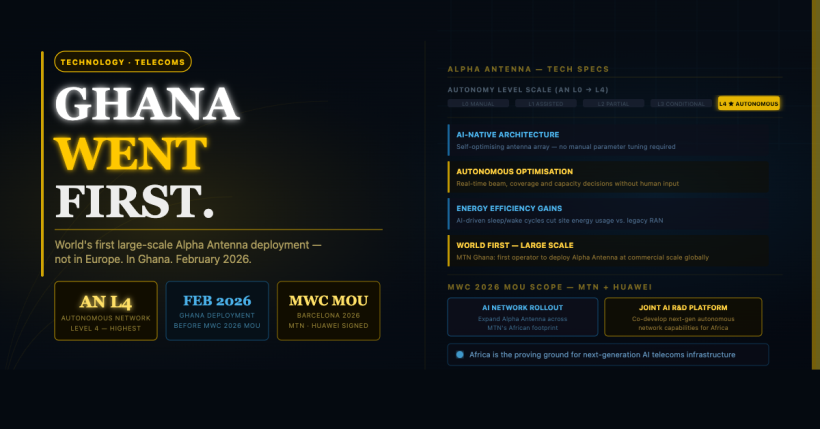
The world’s first large-scale Alpha Antenna deployment landed in Ghana in February. By March, it was the foundation for a landmark MoU at MWC Barcelona. Africa isn’t just receiving AI infrastructure — it’s building it.
On the afternoon of 5 March 2026, in the cavernous halls of Mobile World Congress in Barcelona, MTN Group Chief Technology Officer Mazen Mroué and Huawei’s carrier business chief sat down to sign a document that will shape how 280 million Africans experience mobile networks over the next decade. The 2026 Strategic Memorandum of Understanding between MTN and Huawei isn’t the first partnership document the two companies have signed — but the technology that gives it weight was built not in Barcelona, but in Ghana, three weeks earlier.
On 14 February 2026, MTN and Huawei announced they had completed the world’s first large-scale deployment of the Alpha Antenna — a next-generation AI-powered antenna architecture — across MTN Ghana’s network. The results were striking: a 6.8 per cent rise in regional network traffic and a 30-fold improvement in operations and maintenance efficiency. The performance of that Valentine’s Day milestone is precisely why the MWC MoU matters.
What the Alpha Antenna Actually Does
To understand the significance of the Ghana deployment, it helps to understand what conventional antenna management looks like. Today, most African mobile networks run on a reactive model: an engineer notices a problem — dropped calls in a specific cell, degraded throughput in a dense market — and manually adjusts antenna parameters to fix it. That process can take hours or days. The same cycle repeats across thousands of sites.
The Alpha Antenna breaks that cycle. Equipped with two integrated hardware modules — the AISU (Antenna Information Sensor Unit) and the AIMU (Array Information Mapping Unit) — the system enables fully automated, real-time retrieval of antenna parameters, live network topology mapping, and dynamic beam adjustment. Instead of waiting for a human engineer to diagnose and respond, the antenna continuously reads its own performance data and optimises in real time.
Huawei describes the capability as “closed-loop” — a system that retrieves, processes and acts on data within its own feedback loop, with no human in the middle. The result is what both companies call a shift from a “passive, reactive” network to a “proactive, AI-powered” one. That shift is quantified in the Ghana deployment: 30 times more efficient operations and maintenance.
For context, that efficiency ratio means tasks that previously required 30 engineer-hours may now be completed automatically in one. Scaled across MTN’s 20,000-plus active network sites in Ghana alone — and across its 15 other operating countries on the continent — the cost and speed implications are considerable.
The Signal from Barcelona
The Ghana Alpha Antenna deployment was not simply a pilot — it was a proof of concept for the MoU announced at MWC. The 2026 agreement between MTN and Huawei sets Autonomous Networks Level 4 (AN L4) as a shared evolution target, with a specific architecture in mind: Agentic Networks, built on Copilot and Agentic AI models.
In the International Telecommunication Union’s framework, AN L4 represents a network that is “highly autonomous” — one that can handle full operational lifecycle management with minimal human intervention across most scenarios, escalating to human decision-making only in genuinely novel situations. AN L5 is the theoretical ceiling: full autonomy with no human intervention required. The industry consensus is that L4 represents the realistic horizon for commercial deployment in this decade.
The MoU’s stated goal of transitioning operations from “human-driven” to “agent-driven” is not rhetorical — it defines what AN L4 means in practice for MTN’s network operations centres. Huawei’s Agentic Networks architecture, announced at MWC 2026 under its AgenticCore product family, positions AI agents as the primary operators of network functions: agents that monitor, diagnose, configure and optimise without waiting for human instruction.
Beyond network autonomy, the MoU covers four other strategic areas: advancing coordinated FTTH and 5G Fixed Wireless Access (FWA) home broadband; addressing Africa’s coverage and usage gaps through cost-efficient rural network models; data monetisation; and ESG infrastructure commitments. MTN has been under pressure to expand its Home Internet subscriber base — currently growing but lagging behind fibre-ready demand in its key markets of Nigeria, South Africa and Ghana — and the FTTH/FWA coordination commitment suggests the partnership has a commercial broadband growth agenda alongside its network technology goals.
The Lab Behind the Leap
Neither the Alpha Antenna deployment nor the MoU happened in isolation. They are the latest outputs from a partnership infrastructure that has been quietly building since April 2024, when MTN and Huawei inaugurated the MTN–Huawei Technology Innovation Lab at MTN Group’s headquarters in Johannesburg.
The facility — currently staffed by a small but focused team — is designed to move innovations from proof-of-concept to pilot testing and commercial deployment without depending on vendor-side testing environments. Before rolling out a new technology in one of MTN’s markets, the lab allows engineers to validate performance against African network conditions: traffic profiles, spectrum allocations and infrastructure constraints specific to the continent.
The Alpha Antenna was tested at the lab before the Ghana deployment. The MWC MoU commits both companies to continuing to use the Johannesburg facility as the proving ground for the AN L4 architecture. That means the innovations announced in Barcelona will be validated in South Africa first — and, if successful, deployed across MTN’s African footprint before being considered for other markets.
That sequencing is notable. In most global technology rollouts, Africa is downstream — receiving technologies validated elsewhere. The lab arrangement reverses that, at least for MTN’s network stack. Ghana’s Alpha Antenna deployment, described by both companies as a world first, is the clearest evidence that this reversal is real.
What It Means for African Developers and SMEs
For Africa’s developer and SME communities, the practical question is: what does a 30x more efficient, AI-driven network mean for the services built on top of it?
The most direct impact is network reliability and response time. Autonomous network management means fewer prolonged outages, faster resolution of congestion events and more consistent throughput — critical for SMEs that depend on mobile connectivity for payments, inventory management and customer communications. In markets like Ghana and Nigeria, where network quality variance directly affects mobile commerce conversion rates, a self-optimising network is a business infrastructure upgrade.
For developers building on top of MTN’s developer platforms — including MTN’s Ayoba messaging ecosystem and its developer APIs — a more stable underlying network reduces the engineering overhead required to handle connectivity degradation gracefully. Applications designed around intermittent African connectivity may need fewer fallback mechanisms if AN L4-era reliability is achieved.
There are also competitive implications for other African telcos. Airtel Africa, Safaricom and Orange Africa are all working on their own network modernisation programmes. If MTN and Huawei demonstrate that AN L4 is commercially achievable at scale in African markets — and the Ghana Alpha Antenna results suggest the trajectory is credible — rival operators face increasing pressure to accelerate their own AI network programmes or accept a widening technology gap.
The Geopolitical Dimension
The MTN–Huawei partnership deepening at MWC 2026 does not exist in a vacuum. Huawei remains subject to US technology export restrictions, and its role in African telecoms infrastructure has been a point of geopolitical sensitivity, particularly for operators seeking to maintain relationships with both Chinese and Western technology partners.
MTN has navigated this carefully. The company operates in 18 countries, several of which have active US commercial relationships or are party to data governance frameworks that carry implicit expectations about network vendor choices. The Johannesburg lab is Huawei-partnered but MTN-operated, a structure that preserves MTN’s ownership of the technology validation process.
The 2026 MoU’s emphasis on AN L4 as a “shared evolution target” — rather than a Huawei product deployment — frames the partnership in terms of capability development rather than vendor dependency. Whether that framing withstands scrutiny from regulators or international partners who view Huawei’s network presence as a security concern remains an open question.
What Comes Next
MTN’s expansion of the Alpha Antenna from Ghana to its other 15 operating markets is the immediate technology pipeline item. The company has not announced a rollout schedule, but the language of both companies — describing the Ghana deployment as a “foundation” for the AN L4 journey — implies a phased continental expansion.
The MoU’s home broadband commitments will be watched closely in Nigeria, where MTN Nigeria’s 5G FWA proposition has struggled with affordability constraints, and in South Africa, where fibre competition from Openserve, Vumatel and others is intense. Whether AI-driven network optimisation translates into lower-cost broadband delivery — or simply more efficient premium service — will determine whether the partnership’s impact reaches beyond MTN’s enterprise and high-income customer base.
The Huawei–MTN Technology Innovation Lab in Johannesburg is the institutional mechanism through which those answers will be developed. Barcelona provided the declaration of intent. Ghana provided the evidence. What happens next in the Johannesburg lab will determine whether Africa’s role in global AI network development moves from notable exception to established pattern.

 UphivaBETAR