
Africa’s Series A Desert: How Local VCs Are Filling the Gap Left by Retreating US Investors
by Business Reporter, BETAR.africa | 12 March 2026
On March 11, South African investment firm Hlayisani Capital announced the first close of its second venture fund — ZAR500 million, or roughly $29.9 million, anchored by the Public Investment Corporation and the SA SME Fund. The announcement was modest by global standards. In the context of what is happening to Africa’s venture capital supply chain, it was the most consequential funding story of the week.
Hlayisani’s pitch was explicit: it exists to fill a gap. “Africa’s Series A desert,” as the firm’s materials describe it, is the structural absence of institutional capital between a seed round and the scale-up stage. The fund targets companies that have found product-market fit and need $2–$8 million in Series A capital to expand. In the United States and Southeast Asia, that market is crowded with investors. In sub-Saharan Africa in early 2026, it is a near-vacuum.
The Numbers Behind the Drought
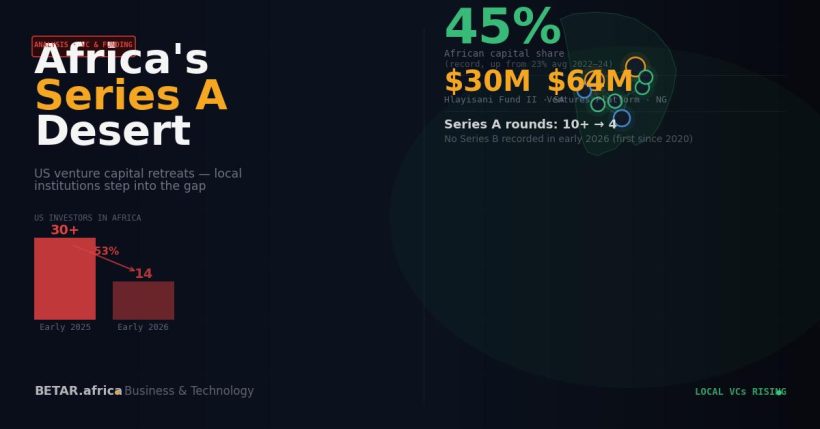
The data is unambiguous. In January and February 2025, African startups recorded more than ten Series A rounds, including transactions backed by QED Investors, Quona Capital, and Flourish Ventures. In the same period of 2026, that number fell to four. No Series B rounds were recorded in early 2026 — the first time that has happened since 2020.
The collapse in growth-stage activity comes despite a headline funding number that looks healthy: African startups collectively raised $487 million in the first two months of 2026, up from $438 million in the same period a year earlier. But as BETAR reported in February, the composition of that capital tells a different story. Equity financing — the venture capital that funds early bets on founder-market fit — fell from $333 million (76% of total) in early 2025 to $209 million (43%) in early 2026. The gap was filled by debt facilities, project finance, and blended instruments. More money; far less venture.
The $20–$50 million financing band — too large for local seed funds and too small for global growth equity — has remained structurally challenged for three years. Only about 5% of African startups that raise seed capital successfully convert to a Series A, according to analysis by Partech. The Series B pipeline has effectively stalled.
Who Left and Where They Went
The withdrawal is not random. The count of US-based investors participating in African deals dropped from more than 30 in early 2025 to approximately 14 in early 2026 — a 53% decline, according to analysis by Launch Base Africa. The names that were active in 2025 and are absent in 2026 include QED Investors, Quona Capital, and Left Lane Capital.
These firms have not stopped investing. In March 2026, QED and Left Lane Capital co-led an $80 million Series A into KAST, a Singapore-based stablecoin fintech. The capital has pivoted — from frontier markets with FX volatility and regulatory opacity toward Southeast Asia, where the risk profile looks more familiar to limited partners in Boston and San Francisco.
The shift reflects LP-level pressure. Higher global interest rates have lengthened the list of asset classes competing for institutional capital. Allocators under return pressure are trimming exposure to long-duration, frontier-market risk. Africa, which demands patience capital and tolerates exit timelines of 8–12 years, is absorbing the reduction.
The US investors still active in Africa in early 2026 are predominantly government-linked or impact-oriented: the International Finance Corporation, the US Development Finance Corporation, and a handful of development-finance-adjacent funds. Return-driven, commercials-only US venture has largely departed for now.
The African Institutional Response
The response is emerging — and its shape matters.
Hlayisani Capital’s Fund II is backed by the Public Investment Corporation, which manages R2.5 trillion in assets primarily for South Africa’s Government Employees Pension Fund, and the SA SME Fund, a blended-finance vehicle backed by South African corporates. Both are patient capital with domestic mandate. Their investment in Hlayisani represents a structural shift: African public and quasi-public capital is being mobilised to replace private global capital that has retreated.
In Nigeria, a similar dynamic played out last November when Ventures Platform closed the first $64 million of its second fund. The headline was the return of 70% of LP investors from Fund I. But the story underneath was a first: Nigeria’s government, through the Innovation-Driven Economic Competitiveness and Expansion (iDICE) programme, marked the first time the Nigerian state has invested directly in a VC fund. Ventures Platform now has a sovereign co-signer — a legitimising signal for other government-adjacent capital sitting on the sidelines.
Kola Aina, Founding Partner of Ventures Platform, framed the fund as part of a broader thesis. “The backing we’ve received from a diverse group of blue-chip partners is a powerful endorsement of Africa’s place as the purest, most asymmetric source for non-consensus alpha,” he said at the time of the Fund II announcement. The language was deliberately pitched at the global LP community — the message being that Africa’s risk-return profile is misunderstood, not fundamentally broken.
African investors as a class now account for 45% of the total capital deployed in African startup deals — a record, up from an average of 23% between 2022 and 2024. The African private capital ecosystem is, in aggregate, becoming less dependent on Northern hemisphere backers.
What This Means for Founders
The structural shift carries real consequences for startup strategy. US VC firms do not just provide capital — they provide networks, co-investor introductions, and the signalling value that has historically unlocked follow-on rounds from other US-adjacent funds. An African founder with QED or Left Lane on their cap table could reach Sequoia’s Global Equities desk faster. That flywheel is stalling.
Founders in South Africa and Nigeria must now orient their fundraising toward a different class of institutional investors: development finance institutions, government-linked capital vehicles, and Africa-native VCs with smaller checkbooks and longer investment horizons. The tradeoff is not simply one of check size — it is one of network access, exit optionality, and the type of growth model that these capital structures reward.
Hlayisani’s portfolio already illustrates the direction: its Fund II has backed Tractor Outdoor Media (digital outdoor advertising), Spatialedge (enterprise machine learning), and Cogitait AI (automation intelligence). These are not the high-velocity consumer fintech bets that defined the 2021–2022 VC boom. They are sector-specific, B2B-oriented, operationally grounded businesses that fit the risk tolerance of pension-fund-adjacent capital.
Structural or Cyclical?
The honest answer is: probably both, with structural forces dominant over the medium term.
The interest rate cycle will eventually turn. When US rate levels normalise and LP allocation pressure eases, some of the departed US VCs will return to Africa — or their successors will. Markets with strong underlying growth dynamics attract capital over the long run.
But the dominance of African institutional capital at 45% of deployed funding is unlikely to reverse entirely. What 2022–2025 demonstrated is that Africa cannot run a venture economy on foreign capital alone. The fragility of that model — subject to rate cycles, LP sentiment, and geopolitical risk appetite — is now structural knowledge. Hlayisani Capital, the PIC, the SA SME Fund, and Nigeria’s iDICE programme are not emergency measures. They are the beginnings of an indigenous capital infrastructure.
The Series A desert is real. So is the institutional response. Whether that response scales fast enough to replace what has left — and on terms that founders can build companies with — is the open question.
Sources: Disrupt Africa (Hlayisani Capital Fund II, March 11, 2026); TechCrunch (Ventures Platform Fund II, November 2025); Launch Base Africa (Africa Early 2026 Funding Analysis, March 2, 2026); Partech Africa 2025 Tech VC Report; Tech in Africa (Hlayisani Fund II details, March 2026); CNBC Africa / The Big Deal (Africa startup funding data); TechNode Global (QED/Left Lane KAST investment, March 2026).


 UphivaBETAR