
The CESA 2016-2025 Audit: 75 Million More Children in School, 100 Million Still Left Out
The African Union’s ten-year Continental Education Strategy has closed. The continent enrolled more children than ever while falling further behind on access and STEM output — and adopted a successor framework without resolving the structural blockers that defeated the last one.
March 2026
In 2016, the African Union Commission launched the Continental Education Strategy for Africa — CESA 16-25 — with twelve strategic objectives, a ten-year implementation window, and a mandate to transform education systems across 54 member states. The strategy set ambitions for access, quality, teacher deployment, higher education expansion, STEM enrolment, and skills development aligned with Agenda 2063. The decade has now closed. The AU has adopted a successor framework. The moment calls for an honest accounting of what CESA actually delivered.
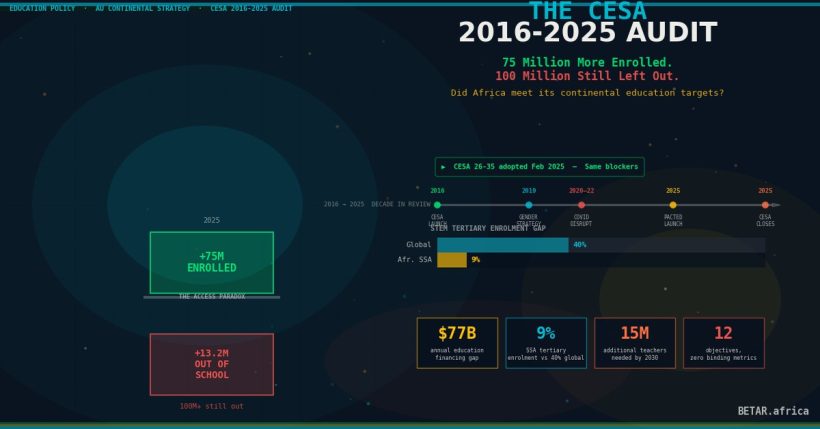
The headline finding is an access paradox that resists easy framing. Seventy-five million more African children are enrolled in school today compared to 2015, according to UNESCO. The same data shows that the number of out-of-school children on the continent has increased by 13.2 million over the same period, to more than 100 million. Africa’s school-age population grew faster than its school systems could absorb. Progress and regression coexisted, continent-wide, for a decade.
The Targets CESA Set
CESA 16-25 was built around twelve strategic objectives spanning the full education pipeline: early childhood care and education; literacy and foundational skills; quality and relevance at all levels; science, technology, engineering and mathematics; teacher development and deployment; higher education and research; and financing. It was deliberately broad — a continental framework intended to guide national policy, not a binding commitment scheme with enforceable numerical benchmarks at country level. That design decision shaped the decade’s accountability failure.
The strategy’s ambition was not in question. CESA 16-25 aligned with both the SDG 4 education framework and the African Union’s Agenda 2063 human capital development priorities. It called for expanded STEM enrolment, achievement of teacher deployment targets, growth in technical and vocational education, and reduced gender disparities in education access at every level. What it lacked was the architecture to enforce those ambitions: no binding numerical targets, no systematic monitoring mechanism capable of holding member states accountable to agreed benchmarks, and no consequence mechanism for underperformance. Twelve objectives, continent-wide. Zero binding metrics.
The Financing Gap That CESA Could Not Bridge
No honest audit of CESA 16-25 is possible without confronting the financing context in which it operated. UNESCO estimates the average annual financing gap for education in Africa at $77 billion — the gap between what national targets require and what governments and development partners are currently providing. That figure is not a forecast for a future crisis. It is an estimate of the structural gap that persisted, year after year, through the entire CESA decade.
African governments’ education spending did not keep pace with population growth. By the end of the CESA period, African countries were generally investing less in education as a share of national budget than they had in 2015 and 2020, according to World Bank data. Development aid to education in sub-Saharan Africa fell by 23 per cent in 2022, the most recent year for which comparable data is available (OECD Development Assistance Committee). Only 9 of 49 African countries met the internationally recommended benchmark of allocating 20 per cent of national budget to education — the level associated with meaningful system-level change. For the majority of the continent, CESA was a strategy operating against a financial gravity that its framework had no mechanism to reverse.
The STEM Pipeline: The Gap That Matters Most for Africa’s Economic Trajectory
CESA’s STEM objectives are where the strategy’s failure carries the most consequential long-term weight. Sub-Saharan Africa’s gross tertiary enrolment ratio stood at approximately 9 per cent in the most recent measurement period, against a global average of 40 per cent. The continent increased its count of higher education institutions by 153 per cent between 2006 and 2018 — an expansion in institutions that did not translate into commensurate expansion in STEM graduate output at the scale CESA targeted.
The gender dimension of STEM underperformance compounded the structural problem. UNESCO Institute for Statistics data published in April 2024 found that women’s share of STEM graduates globally had been stagnant for ten years — and sub-Saharan Africa’s position within that global underperformance is near the bottom. In Nigeria, women account for approximately 22 per cent of STEM graduates. In Ghana’s university ICT programmes, the figure stood at 4 per cent of first-year students in 2022/23. West and Central Africa: fewer than 15 per cent of engineering and technology researchers are women. CESA 16-25’s Gender Equality Strategy — developed in 2018, two years into a ten-year plan — contained no hard numerical STEM gender targets. The accountability architecture was absent before the strategy was halfway through.
Rwanda is the continental exception most cited in this conversation, and the data at secondary level justifies that framing. Female STEM enrolment at secondary reached near-parity under deliberate, multi-layered government policy: the Rwanda Coding Academy, universal ICT curriculum, district-level bootcamps for top female STEM achievers. Rwanda’s secondary-level result shows what a government that treats STEM gender parity as a policy commitment — rather than an aspiration — can achieve within a decade. The critical caveat is that Rwanda’s secondary success has not yet translated to university level. The gap between secondary-level inclusion and tertiary-level persistence is a separate policy problem that the CESA framework did not adequately distinguish.
The Three Blockers CESA Did Not Resolve
CESA 16-25 operated against three structural constraints that were identifiable at its launch in 2016 and remained unresolved at its close in 2025. The first is the financing gap documented above. The second is the teacher deficit. UNESCO estimates that Africa needs to recruit at least 15 million additional teachers to achieve universal primary and secondary education goals by 2030. The teacher gap is simultaneously a quantity problem — insufficient numbers — and a quality problem: the distribution of trained teachers across rural and urban areas, and across science and humanities subjects, creates severe STEM delivery deficits that enrolment statistics do not capture.
The third blocker is COVID-19 disruption, which compresses a decade of trajectory into the years when CESA should have been accelerating. Uganda experienced the longest school closure globally — 83 weeks. Across the continent, UNESCO estimates that school closures affected hundreds of millions of students during the critical 2020-2022 period, with the most severe learning loss concentrated in lower-income countries where remote and digital learning substitutes were least available. CESA had no pandemic-response mechanism. The strategy was written for a normal decade. The decade was not normal.
CESA 26-35: What Has Changed — and What Has Not
In February 2025, African Union Heads of State and governments adopted the successor framework, CESA 2026-2035. The new strategy is structured around six strategic areas and twenty objectives. It explicitly designates “gender, equity, and inclusion” as a named strategic area — an implicit acknowledgement that the gender architecture was missing from CESA 16-25. It was launched formally in October 2025 at the Pan-African Conference on Teachers’ Education and Development (PACTED), which UNESCO co-hosted with the AU Commission.
UNESCO welcomed the adoption, noting that CESA 26-35 is “more ambitious and specific” than its predecessor. The IICBA — UNESCO’s International Institute for Capacity Building in Africa — is developing implementation briefs and an online course on CESA 26-35 policies. The institutional apparatus for a better-monitored implementation cycle exists. Whether CESA 26-35 moves from directional language to numerical commitments with real country-level accountability will determine whether the 2035 audit reads differently from this one.
The honest answer is that the structural constraints are unchanged. The $77 billion annual financing gap has not been closed by a new strategy document. The 15 million teacher deficit is not resolved by a new framework. The STEM gender gap is not narrowed by the designation of “gender, equity, and inclusion” as a strategic area without binding targets. CESA 26-35 is a better-designed strategy than CESA 16-25. The question the continent needs answered is different: whether African governments, development banks, and international partners are prepared to fund, staff, and hold themselves accountable to a continental education commitment at the scale the data shows is required.
Seventy-five million more children enrolled. One hundred million still left out. The arithmetic of Africa’s education challenge did not change between 2016 and 2025. What changed is how clearly the continent understands what it is up against — and how precisely it must now act to build differently in the decade ahead.

 UphivaBETAR