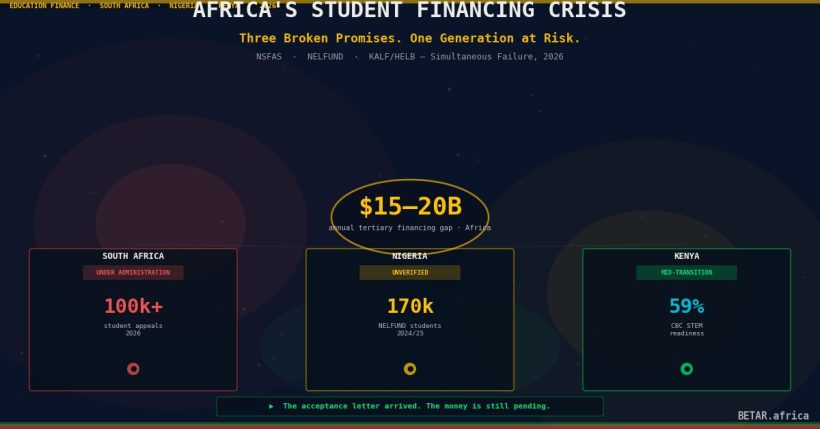

South Africa’s NSFAS is under administration. Nigeria’s NELFUND is untested. Kenya is mid-transition. Across the continent’s three largest higher education markets, the scaffolding that was supposed to carry first-generation students into the professional workforce is creaking — simultaneously.
The acceptance letter arrives, and then the money doesn’t.
This is the defining experience of the first-generation African university student in 2026. Across Sub-Saharan Africa, tertiary enrolment rates have grown steadily over the past two decades — but completion rates have not kept pace. The World Bank estimates a $15–20 billion annual financing gap for tertiary education across the region. That gap does not fall evenly across the student population. It concentrates, predictably and systematically, on students from low-income households, students from rural areas, and first-generation university entrants: those for whom admission represents a generational break, and for whom a missed payment or delayed disbursement is not an inconvenience but an exit.
The continent’s three largest higher education markets — South Africa, Nigeria, and Kenya — have each built national student financing systems intended to close this gap. In 2026, all three are in simultaneous crisis or transition. South Africa’s National Student Financial Aid Scheme (NSFAS) is under administration after years of governance failure and disbursement collapse. Nigeria’s Education Loan Fund (NELFUND) launched in 2024 as a clean-slate replacement for a system that had effectively ceased to function. Kenya is mid-transition from the Higher Education Loans Board (HELB) to the Kenya Advanced Level Fund (KALF), a structural reform timed to coincide with the first cohort of Competency-Based Curriculum (CBC) graduates entering senior secondary school. Together, these three transitions represent the most significant simultaneous reform of higher education financing on the African continent in a generation. The question they collectively pose is the same: are these systems producing a more equitable pipeline, or replacing one broken architecture with another?
South Africa: When the System Eats Its Own Purpose
NSFAS was, by design, one of the world’s most ambitious student aid instruments. Established in 1991 and expanded significantly through the post-Fees Must Fall period, it was intended to convert South Africa’s formally desegregated but economically stratified higher education system into a genuinely accessible one. For more than a million students annually, NSFAS funding is the difference between enrolment and dropout.
In 2026, 1.24 million students have been approved for NSFAS support, with R6.3 billion disbursed under the Missing Middle Loan Programme. The numbers look substantial. The operational reality is more complicated.
The NSFAS crisis of 2025–2026 is not primarily a funding volume crisis. It is a distribution timing crisis. Verification processes — means-testing, bank account confirmation, institutional registration confirmation — have created a bureaucratic bottleneck that delays disbursement to the start of the academic year or beyond. For a student from a low-income household who cannot self-finance the gap between acceptance and disbursement, a disbursement delay of four to eight weeks is functionally equivalent to a rejection. The student cannot register. Cannot pay residence fees. Cannot buy textbooks. The pipeline empties before instruction begins.
More than 100,000 student appeals were lodged in early 2026 following disbursement delays, with Parliament formally flagging concerns about 2026 academic year readiness in official briefings (Parliamentary Monitoring Group, February 2026). The institution that was meant to be the equity mechanism has itself become a source of attrition.
The underlying governance failures compound the operational problems. NSFAS experienced multiple board-level leadership changes between 2022 and 2025, with the scheme placed under administration by the Department of Higher Education as institutional controls broke down. An estimated R13 billion funding shortfall has been documented in official treasury correspondence. The compounding effect of leadership instability, procurement irregularities, and the bureaucratic complexity of disbursing to more than a million students simultaneously has produced a system that is simultaneously large and dysfunctional.
NSFAS’s 70/30 allocation skew toward STEM programmes signals deliberate pipeline policy intent. The irony is that the cohort the skew is designed to support — low-income students in engineering, computer science, and the health sciences — is precisely the cohort most vulnerable to the timing failures. A medical student cannot defer registration. An engineering student cannot sit examinations without paying laboratory fees. The STEM prioritisation delivers nothing if the disbursement infrastructure cannot execute.
Nigeria: A Clean Slate, Unverified
Nigeria’s NELFUND — the Nigeria Education Loan Fund — launched in 2024 with a structural premise that implicitly acknowledged what the previous system could not admit: the old architecture was not reformable. NELFUND is a complete institutional replacement, not a renovation.
The design innovations are significant. NELFUND applies an income-contingent repayment model linked to graduate employment, rather than a fixed-repayment schedule that operates regardless of labour market outcomes. The fund is capitalised through a statutory levy on financial institutions, creating a dedicated recurrent funding source rather than relying on annual appropriations subject to budget variability. An employer-linkage component is built into the design from inception, mapping the loan programme to the graduate employment pipeline rather than treating financing and labour market outcomes as separate systems.
The first disbursement tranches reached borrowers in late 2024. Initial figures — released by the NELFUND board in its inaugural annual update — indicate disbursements to approximately 170,000 students in the 2024/25 academic year, covering federal universities and selected state institutions.
What NELFUND cannot yet answer is the question that matters most: completion and employment outcomes for its first cohort. The income-contingent model works when graduates enter employment; it generates defaults and system pressure when graduates do not. Nigeria’s 2026 youth unemployment rate — estimated at 35–40% among those aged 15–24 by the National Bureau of Statistics (a general youth figure; graduate-specific unemployment data for this cohort will not be available before 2027) — suggests the structural test ahead is formidable. The system is, in the clearest sense, unverified.
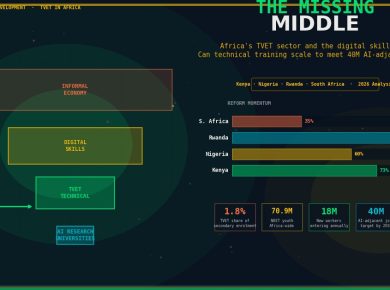
The critical parallel is to the skills side of the pipeline. NELFUND exists within an environment where Nigeria’s National Information Technology Development Agency (NITDA) has enrolled more than 350,000 fellows in digital skills training through the 3MTT initiative. The skills infrastructure is building. Whether the financing infrastructure is also building — or simply deferring the same structural failures under new institutional branding — cannot yet be answered.
Kenya: The Timing Problem, Structural Version
Kenya’s transition from HELB to KALF is not an emergency response to system failure. It is a deliberate structural reform designed to align the financing system with the education architecture that the Competency-Based Curriculum is building.
The CBC’s pioneer cohort sat the Kenya Junior Secondary Education Assessment in 2025. Results showed 59.09% of students demonstrating readiness for the STEM pathway (Kenya National Examinations Council, 2025), with approximately 60% expected to stream into STEM at Senior Secondary from 2026. This is a structural volume increase in the STEM pipeline. If the absorption side — universities, polytechnics, TVET institutions — scales to meet the intake, Kenya’s graduate output in science, technology, engineering, and mathematics will expand substantially within a decade.
KALF is designed for this future. Where HELB was calibrated to the 8-4-4 system’s student volumes and cost structures, KALF incorporates the CBC’s two-year senior secondary stage, the associated junior secondary bridging period, and the expanded TVET sector that the Ministry of Education has been building since 2020. All TVET institutions transitioned to Competency-Based Education and Training frameworks as of January 2026. The African Development Fund approved US$73.31 million for the Kenya Higher Education Science and Technology Project Phase II, part of the infrastructure investment accompanying the reform.
The stress test arrives in 2026/27, when the first CBC cohort applies for KALF-funded tertiary places. HELB annual disbursement data for 2022–2025 shows consistent over-application relative to available funding — loan demand has historically exceeded annual capitalisation, leaving a substantial share of eligible applicants unfunded in each cycle. Whether KALF has been capitalised to a level that closes this gap at CBC scale, rather than simply rebranding the shortfall, is the structural question that Kenya’s 2026/27 intake data will begin to answer.
The Shared Failure Mode
Three systems, three crises, one pattern: the structural failures of African student financing are not primarily about funding volume. They are about timing, verification design, and where means-testing falls in the student lifecycle.
All three systems — NSFAS, the legacy Nigerian loan programme that NELFUND replaced, and HELB — front-loaded eligibility verification to the period immediately before registration. This places the bureaucratic burden at the moment of maximum financial vulnerability. A student whose means-testing documentation is incomplete, whose bank account confirmation fails, or whose institutional registration is delayed enters a verification queue at exactly the point when they need funds in hand. Disbursement delays in this window cause dropout. They do not cause re-application.
All three systems also exclude TVET students from their primary eligibility frameworks in meaningful ways. NSFAS historically prioritised university students; NELFUND’s launch cohort excluded most polytechnic and vocational college students; HELB’s design is university-anchored in a system where TVET constitutes a growing share of post-secondary enrolment. The Africa Union’s Continental Education Strategy 2016–2025 (CESA) set explicit targets for TVET expansion as a pathway to workforce development. The financing systems do not yet reflect that strategic commitment.
What a Functioning System Would Require
The continental financing gap is not, at its core, a money problem. It is a design problem with a money component.
A financing system calibrated to close the access-to-completion gap rather than merely the access gap would verify eligibility before admission, not during registration week. It would disburse on the first day of term rather than the sixth week. It would extend its coverage to TVET as a first-class pathway, not an afterthought. And it would define success as verified graduate employment at twelve and twenty-four months, not disbursement volume in year one.
None of NSFAS, NELFUND, or KALF has yet demonstrated all of these properties. Some are attempting structural innovation. None have demonstrated it at scale. The generation of students currently entering African universities will be the empirical test of whether the continent’s most significant simultaneous education financing reforms deliver a more equitable pipeline — or an improved mechanism for producing the same outcome at greater institutional cost.
The acceptance letter has arrived. The money is still pending.
Sources: Parliamentary Monitoring Group (PMG) official briefings, February 2026; NSFAS official disbursement reports 2025–2026; NELFUND inaugural annual update 2024/25; Kenya National Examinations Council (KNEC) KJSEA results 2025; African Development Fund Kenya HEST Project II approval notice; World Bank EdStats tertiary financing gap estimates; UNESCO UIS Sub-Saharan Africa tertiary completion data; Kenya Ministry of Education TVET framework transition documentation January 2026; National Bureau of Statistics Nigeria youth unemployment data 2026.


 UphivaBETAR