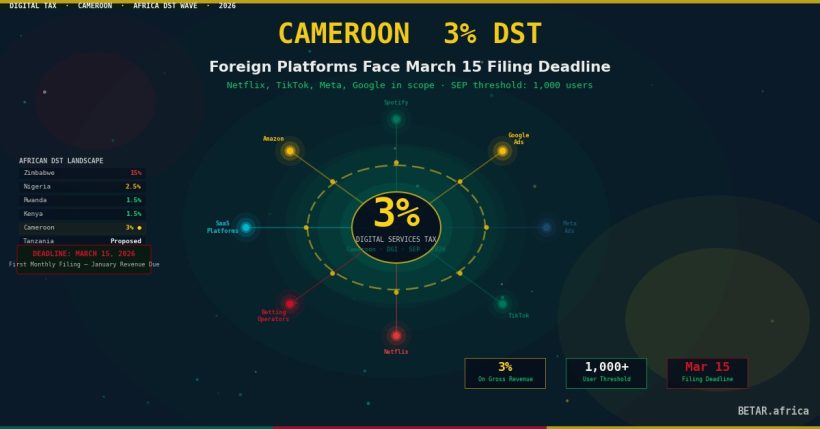

Foreign digital platforms operating in Cameroon are running out of time to comply with one of sub-Saharan Africa’s newest digital services taxes. As of January 1, 2026, Cameroon’s 2026 Finance Law compels any non-resident digital company with a meaningful footprint in the country to register with the tax authority, file monthly revenue declarations, and pay a minimum 3% corporate levy — with the first return deadline falling on March 15, 2026.
The law has attracted attention primarily because of its immediate impact on offshore gambling and sports betting platforms, but the scope is considerably broader. Streaming services, cloud providers, SaaS companies, online advertisers, data monetisation platforms, and e-commerce marketplace operators are all within reach of Section 5 of the Finance Law, which establishes a Significant Economic Presence (SEP) framework modelled on OECD digital economy tax principles.
What the Law Says
A non-resident digital enterprise acquires a Significant Economic Presence in Cameroon — and therefore becomes liable for corporate tax — if it meets either of two thresholds:
- User threshold: at least 1,000 consumers, customers, or account holders based in Cameroon, OR
- Revenue threshold: annual pre-tax revenue of at least CFA 50 million (approximately €76,225) generated from Cameroonian users
Platforms that qualify must register through a dedicated digital platform operated by Cameroon’s Directorate General of Taxes (DGI), file a monthly return reporting their Cameroon-sourced gross receipts, and pay the 3% levy electronically by the 15th day of the month following the taxable period.
The March 15 deadline represents the first monthly settlement — covering revenue earned in January 2026 — after which the cadence repeats every month. For most platforms, the first required action is registration and first filing simultaneously.
Larger operators are not permanently anchored at 3%. The DGI has indicated that platforms with more substantial Cameroonian revenues may transition to the standard corporate tax regime, which taxes profit at 30% rather than applying a flat rate to gross receipts. That escalation pathway is still being operationalised through DGI guidance.
Who Gets Caught
The scope of Section 5 is intentionally wide. The Finance Law defines “digital services” to include streaming and downloads, online gaming, online advertising and data monetisation, e-commerce marketplace commissions, cloud computing, and SaaS platforms.
That means the law touches Netflix, which has been available in Cameroon since 2016. It reaches TikTok, which counts over four million Cameroonian users among its global base. It applies to Meta’s advertising business, Google’s search advertising, and any foreign cloud hosting provider with over 1,000 Cameroonian corporate accounts or individual users.
The sports betting sector is the most immediately exposed. Cameroon has approximately 7 million active sports bettors, and major international operators — Bet9ja, 1xBet, Betway, and dozens of offshore sportsbooks — have long targeted the market. Mobile money integration makes Cameroonian betting participation especially measurable: MTN Mobile Money and Orange Money collectively handle roughly 90% of all bookmaker transactions in the country, providing a natural audit trail for the DGI.
For those operators, clearing the 1,000-user threshold is not a question — it was cleared years ago.
Cameroon’s Digital Economy Context
The tax arrives as Cameroon’s digital economy is growing at a clip that makes revenue capture increasingly meaningful. By end-2025, the country counted 12.6 million internet users — a 41.9% penetration rate — with projections pointing toward 61.1% by end-2026. Mobile internet now accounts for over 95% of all internet access.
MTN Cameroon, the country’s largest operator, reported mobile internet revenue of CFA 90.9 billion in the first half of 2025, up 23.8% year-on-year, with data now comprising 44.9% of total income. The gambling market is projected to reach a volume exceeding €530 million by 2029.
The DGI’s stated rationale is direct: the reform exists “to capture value generated by the digital economy in Cameroon, ensure tax fairness toward local companies, and increase state revenue in a fast-growing sector.” In its absence, foreign platforms have been earning material revenue from Cameroonian users while local operators — who carry full domestic corporate tax obligations — compete at an inherent disadvantage.
The 2026 Finance Law is the fourth digital economy tax measure Cameroon has introduced since 2020, following VAT collection requirements on digital platforms (2021), a tax on electronic money transfers (2022), and customs duties on e-commerce imports (2023).
The Broader African DST Surge
Cameroon joins a rapidly expanding cohort of African governments asserting fiscal sovereignty over foreign digital revenue.
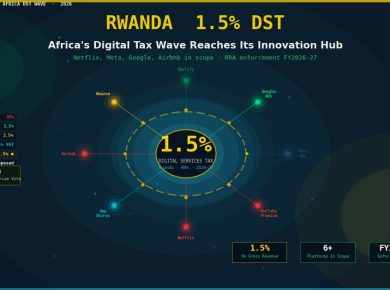
Rwanda implemented a 1.5% digital services tax for fiscal year 2026-27. Zimbabwe activated a 15% withholding tax on offshore digital service payments as of January 1, 2026 — the same day as Cameroon’s SEP law. Uganda modified its 5% DST in 2025, converting it into a 15% withholding tax on non-resident digital service providers with related-party transactions. South Africa’s 2026 Budget introduced a platform operator VAT liability shift, forcing digital marketplace intermediaries to collect and remit VAT rather than leaving compliance to individual sellers.
The convergence is not coincidental. African governments have spent three years watching the WTO’s moratorium on customs duties on electronic transmissions — which effectively bars tariffs on digital goods — quietly expire at successive ministerial conferences. That moratorium is now explicitly scheduled to lapse on March 31, 2026, unless WTO Member States agree to extend it at the MC14 Ministerial Conference in Yaoundé, Cameroon from March 26–29. South Africa, India, and Indonesia are opposing renewal, with South Africa estimating the moratorium costs African governments billions in foregone revenue annually.
Cameroon hosting MC14 while simultaneously activating a digital tax sends an unmistakable signal about where the continent’s fiscal policy is heading.
Compliance Implications for Foreign Platforms
For digital businesses with Cameroonian user bases, the practical compliance steps are straightforward in concept but administratively new:
- Assess exposure: Does the platform have 1,000+ Cameroonian users or CFA 50 million+ in annual Cameroonian-sourced revenue? If yes, the SEP threshold is triggered.
- Register with the DGI: Through the authority’s dedicated digital portal. Registration should have occurred before the first taxable month ended.
- File monthly: A return covering Cameroon-sourced gross receipts for the preceding calendar month must be submitted and paid by the 15th. The March 15 deadline covers January 2026.
- Monitor regime escalation: Platforms with growing Cameroonian revenues should track DGI guidance on the transition from the 3% SEP rate to the 30% standard corporate tax regime.
For platforms that have not yet registered, the March 15 deadline may already represent a compliance miss. The DGI has not publicly announced an amnesty window or phased enforcement period.
What This Means for African Tech Business
Cameroon’s SEP tax reflects a structural shift in how African governments view foreign digital revenue. The “invisible business” model — serving millions of users across the continent without a physical office, license, or tax record — is closing. The tools to enforce SEP frameworks vary in sophistication across the continent, but the policy direction is now clear.
For regional tech operators and investors, the emerging DST landscape requires proactive market-entry planning. A platform launching in multiple African markets in 2026 must now budget not only for standard corporate taxes where it has a physical entity but for revenue-based SEP levies in countries where it crosses user or revenue thresholds — without necessarily having any local staff or offices.
Compliance costs are manageable at 3% of gross Cameroon-sourced revenue for most platforms. The more consequential implication is the precedent: Cameroon has now joined Rwanda, Zimbabwe, Uganda, and South Africa in signalling that the decade of frictionless access to African digital markets is over.
BETAR.africa covers Africa’s technology regulation, policy, and digital economy. The WTO MC14 ministerial conference in Yaoundé runs March 26–29, 2026 — BETAR will provide live coverage on the e-commerce moratorium vote.
Key Facts
- Law: Cameroon 2026 Finance Law, Section 5
- Effective: January 1, 2026
- Tax rate: 3% minimum on gross Cameroon-sourced revenue (escalation to 30% standard regime possible)
- SEP threshold: 1,000+ users OR CFA 50M+ annual pre-tax local revenue
- First filing deadline: March 15, 2026 (covering January revenue)
- Filing frequency: Monthly, by 15th of following month
- Administering authority: DGI (Directorate General of Taxes), Cameroon
- Scope: Betting, streaming, SaaS, cloud, online advertising, e-commerce, data monetisation
- Related BETAR coverage: Rwanda DST (1.5%), Zimbabwe 15% Withholding Tax, South Africa VAT Platform Liability, WTO MC14 E-Commerce Moratorium


 UphivaBETAR