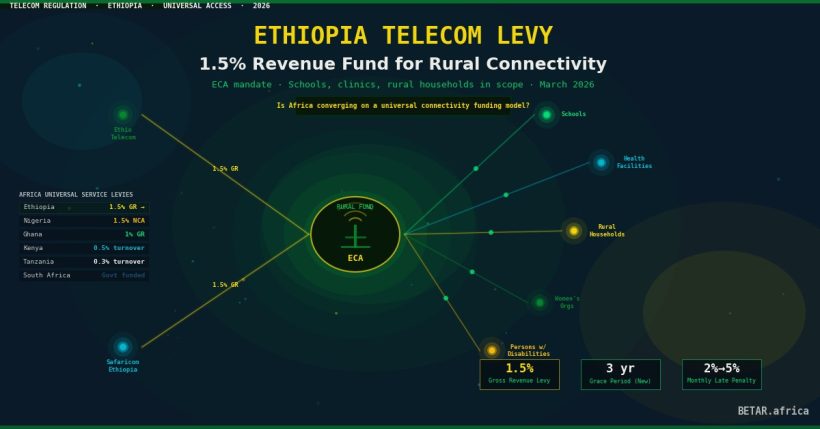

Ethiopia’s Council of Ministers approved a sweeping new telecom financing regulation on March 10, 2026 — a mandatory 1.5% annual gross revenue contribution from all licensed telecommunications operators, directed into a newly constituted Rural Digital Connectivity Fund. The Ethiopian Communications Authority (ECA) will administer the fund.
The regulation, effective immediately, targets schools, healthcare facilities, women’s organisations, persons with disabilities, and low-income rural households as primary beneficiaries of fund-financed infrastructure.
The move makes Ethiopia the latest major African market to formalise a universal service levy model — and raises a pointed question for policymakers and operators across the continent: is Africa converging on a standard mechanism for financing rural digital access?
The Mechanics: How the Levy Works
Under the approved regulation, licensed telecoms operators in Ethiopia — primarily state-owned Ethio Telecom and Safaricom Ethiopia — must contribute 1.5% of their annual gross revenue to the fund.
The regulation includes a notable operator-friendly design choice: operators may deduct the cost of verified rural infrastructure construction from their levy liability. In effect, companies that build in rural areas can offset their financial obligation with in-kind capital expenditure. This creates a direct incentive to deploy networks in underserved areas rather than simply writing a cheque.
Newly licensed operators receive a three-year grace period before the levy applies — a provision clearly designed to avoid burdening entrant operators in the early growth phase.
The penalty structure is graduated: 2% for the first month of non-payment, escalating to 5% for each subsequent month. The Ethiopian Communications Authority serves as regulator and fund administrator.
The Continental Context: Universal Access Levy Models Across Africa
Ethiopia is not alone. Multiple African regulators have adopted some version of a telecom-funded universal access mechanism:
| Country | Mechanism | Rate / Structure | Administrator |
|---|---|---|---|
| Ethiopia | Rural Digital Connectivity Fund | 1.5% gross revenue | ECA |
| Kenya | Universal Service Fund (USF) | 0.5% of gross turnover | CA Kenya |
| Nigeria | National Digital Economy Fund (via NCC) | Embedded in spectrum fees + 1.5% NCA levy | NCC |
| Ghana | National Communications Authority USF | 1% of annual gross revenue | NCA |
| South Africa | Universal Service & Access Agency (USAASA) | Government-funded + operator levies | USAASA |
| Tanzania | USF | 0.3% of annual turnover | TCRA |
| Uganda | Rural Communications Development Fund | 1% gross annual revenue | UCC |
Ethiopia’s 1.5% rate is at the higher end of the East and Horn of Africa range. Combined with the infrastructure deduction mechanism, it represents one of the more structurally sophisticated levy designs on the continent.
Operator Impact: Ethio Telecom and Safaricom Ethiopia
Ethio Telecom, the dominant state-owned operator, reported revenues of approximately ETB 27 billion (~$180M USD) in FY 2024–25. A 1.5% levy would represent roughly $2.7M per year — a manageable cost for a state entity, but one with direct policy alignment since the government is effectively taxing itself to fund rural access.
Safaricom Ethiopia, the Nairobi-headquartered operator that launched in Ethiopia in 2022 with a consortium including Vodacom and the IFC, is the more consequential case. The company has been executing an aggressive rural rollout, and the infrastructure deduction mechanism creates a powerful financial argument for accelerating that build. Every confirmed rural tower site potentially reduces the operator’s levy liability — turning a regulatory burden into a capital deployment incentive.
Safaricom Ethiopia has not yet publicly commented on the regulation.
The Design Innovation: Deduction-for-Deployment
The most technically interesting feature of Ethiopia’s regulation is the infrastructure deduction mechanism. Other African USF models typically collect levies and then redistribute them through competitive grant processes — a model that can be slow and administratively complex.
Ethiopia’s approach inverts this: operators build, document, and deduct. The result is faster deployment without government procurement overhead, though it creates verification challenges for the ECA. How will the Authority certify that infrastructure is genuinely serving rural populations? The implementation guidelines will be critical.
If the deduction mechanism is well-designed, it could become a template for other African regulators seeking to accelerate rural connectivity without creating large, unwieldy public funds.
The Policy Intelligence: What This Means for the Sector
For operators: The levy is a cost of doing business in one of East Africa’s fastest-growing telecom markets. The deduction mechanism mitigates financial impact for operators investing in rural areas. Operators not investing in rural areas carry the full liability.
For device and infrastructure suppliers: Increased rural capex from operators pursuing the infrastructure deduction creates demand for low-cost base stations, solar-powered tower infrastructure, and community devices. Rural Ethiopia is a market in motion.
For investors: Safaricom Ethiopia is a publicly traded entity (via its Kenyan parent). The levy adds cost pressure but also clarifies the regulatory environment — and the infrastructure deduction creates an incentive structure consistent with long-term rural market development. Ethiopia’s 130 million population remains one of the most underconnected large markets in the world.
For policymakers: This is a model worth studying. The combination of levy + infrastructure deduction + graduated penalties is more operator-aligned than most African USF frameworks. The ECA will need strong verification capacity to prevent abuse of the deduction mechanism.
Regulatory Intelligence Summary
| Item | Detail |
|---|---|
| Regulation | Rural Digital Connectivity Fund Levy |
| Approved | March 10, 2026 (Council of Ministers) |
| Effective | Immediate (implementation details pending) |
| Levy rate | 1.5% of annual gross revenue |
| Administrator | Ethiopian Communications Authority (ECA) |
| Beneficiaries | Schools, healthcare, women, disabled persons, rural low-income households |
| Operator offset | Infrastructure build costs deductible from levy |
| Grace period | 3 years for newly licensed operators |
| Penalties | 2% (month 1), 5% (months 2+) |
| Primary affected operators | Ethio Telecom, Safaricom Ethiopia |
BETAR.africa provides regulatory intelligence for Africa’s technology sector. Policy analysis and business intelligence for operators, investors, and regulators across 54 African nations.


 UphivaBETAR