
Africa’s Bootcamp Economy: Are Alt-Training Programmes Closing the Skills Gap or Skimming the Top?
ALX, Andela, Decagon, Semicolon and a growing roster of alternative training programmes claim to be solving Africa’s tech talent crisis. Enrolment numbers are real. But the evidence on who gets in, who gets placed, and whether the skills gap actually narrows raises harder questions about what bootcamps are genuinely accomplishing.
Africa’s tech skills deficit is a well-documented structural problem. The continent needs an estimated 650,000 additional software developers by 2030, according to projections from the International Finance Corporation. University computer science departments are producing graduates at a fraction of that rate — constrained by underfunding, outdated curricula, and throughput bottlenecks that decades of government strategies have not resolved. Into that gap, a generation of alternative training providers has arrived with a proposition: fast, practical, employment-linked credentials that can reach learners the formal system missed.
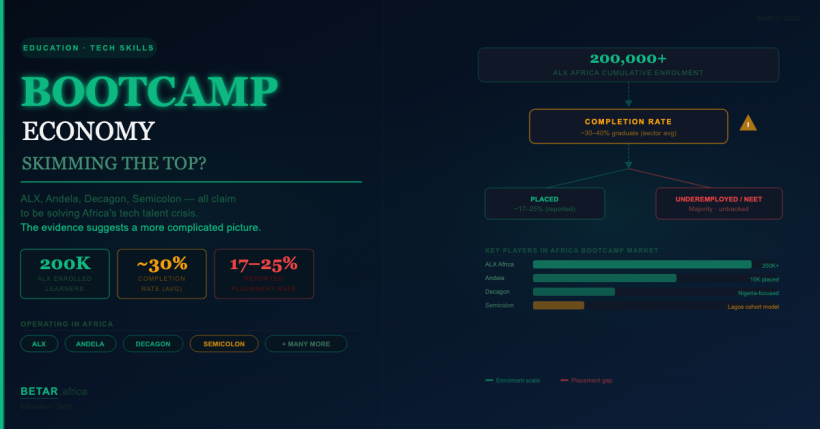
The bootcamp and alt-training sector in Africa now encompasses organisations operating across dozens of countries, collectively enrolling hundreds of thousands of learners annually. The largest player by enrolment — ALX Africa — has trained more than 200,000 learners across 60 countries, according to figures cited by the Mastercard Foundation, which co-anchors its funding alongside other development finance partners. That is a number large enough to appear in continental skills gap projections. It is also a number that, on its own, tells you almost nothing about whether the gap is closing.
Section 1: The Ecosystem — Who Is in the Market and What They Cost
The African alt-training market is not monolithic. It spans institutions with radically different models, funding bases, target learners, and accountability frameworks — a heterogeneity that matters when evaluating aggregate claims about impact.
ALX Africa, launched in 2021 as the education arm of The Room’s broader professional community, runs programmes in software engineering, data science, cloud computing, and product management. Core software engineering programmes run nine months; shorter specialist tracks range from three to six months. ALX operates a scholarship-first model in most markets, with Mastercard Foundation funding enabling free-at-point-of-access enrolment for eligible learners — primarily those 18–35, from low-income households, and meeting digital literacy prerequisites. The 200,000+ learner figure is ALX’s cumulative enrolment count, not a graduate or placement figure.
Andela, which launched in 2014 and has raised more than $480 million in venture capital, operated as a training-plus-employment hybrid for its first seven years before pivoting in 2021 to a talent marketplace model. At its peak as a training programme, Andela selected roughly two per cent of applicants — selectivity comparable to elite universities — and placed graduates in long-term client contracts with global technology companies. The alumna network, often cited in the 110,000 range, reflects cumulative talent network membership, not graduates of the original intensive training pipeline.
Decagon operates at the opposite end of the scale spectrum. The Lagos-based programme takes thirty to sixty learners per cohort, runs a highly selective intake process, and finances tuition through an Income Share Agreement model: no fees up front, with repayment from salary after placement above a minimum income threshold. Decagon’s specificity about cohort quality — and its willingness to publish employer names — makes it one of the more methodologically transparent providers in the market.
Semicolon Africa, also Lagos-based, operates a similarly cohort-intensive model with a focus on engineering and problem-solving culture alongside technical skills. Moringa School, the Nairobi-founded institution that became part of the ALX ecosystem for East Africa, brought a comparable approach to the Kenyan and Ugandan markets before integration into the broader ALX network. AltSchool Africa, launched in 2021, combines software engineering training with product management and data skills in a hybrid online-offline format targeting learners across Nigeria and Ghana.
Table 1: Africa Alt-Training Ecosystem — Key Players, 2026
| Organisation | Primary Markets | Model | Cost to Learner | Cumulative Enrolment (reported) |
|---|---|---|---|---|
| ALX Africa | Pan-Africa (60 countries) | Scholarship-first, cohort | Free (scholarship) / fee-paying tracks | 200,000+ |
| Andela | Pan-Africa, global | Talent marketplace (post-2021 pivot) | N/A (marketplace model) | ~110,000 (network) |
| Decagon | Nigeria | ISA, highly selective cohorts | Zero upfront; ISA on placement | ~1,000–2,000 (est.) |
| Semicolon Africa | Nigeria | Cohort, selective | Subsidised / scholarship | Not publicly reported |
| AltSchool Africa | Nigeria, Ghana | Hybrid online-offline | Fee-paying with instalment options | Not publicly reported |
| Moringa / ALX East Africa | Kenya, Uganda | Cohort (now ALX-integrated) | Scholarship / fee track | ~15,000+ (est. pre-merger) |
Sources: Mastercard Foundation / ALX Africa programme reports; Andela investor communications; Decagon programme documentation; company websites. Note: several organisations do not publish independent enrolment or graduate data.
Section 2: The Placement Gap — What Data Exists and What Doesn’t
The central accountability question for any employment-linked training provider is straightforward: what percentage of graduates get jobs in the field they trained for, at what salary level, and for how long do they hold those jobs? On these questions, the African alt-training sector has a significant transparency deficit.
Most providers publish placement rates as self-reported, unaudited figures. Andela’s original model — in which the company itself employed graduates in long-term client contracts — produced verifiable placement data because the employer relationship was internal. After the 2021 marketplace pivot, that direct accountability link dissolved. ALX publishes outcomes data in partnership with the Mastercard Foundation, but the metrics reported — primarily employment status at a single point in time rather than longitudinal tracking — make it difficult to assess sustained impact versus short-term placement.
Decagon is the sector’s clearest outlier on transparency. The programme publishes employer names, graduate salary ranges, and repayment outcomes from its ISA model — data that is structurally incentivised by the ISA’s financial logic: if graduates are not placed above the income threshold, Decagon does not collect repayments. That alignment of financial incentives with outcomes transparency does not exist for scholarship-funded providers, where revenue is decoupled from placement results.
The broader sector gap matters because it feeds directly into policy decisions. The World Bank’s Skills for Transformation and Regional Integration (STRI) programmes — which have supported alt-training providers in Nigeria, Kenya, and Ethiopia — have increasingly required outcome metrics as a disbursement condition. But the baseline for what counts as an acceptable outcome metric remains negotiated rather than standardised across the sector.
Section 3: The Selection Question — New Talent or Pre-Selected?
The skills gap debate in African tech circles increasingly turns on a distinction that enrolment figures obscure: the difference between additive training — creating capacity that would not otherwise have existed — and substitutive training, which accelerates the development of learners who would likely have reached similar outcomes through self-directed or university routes.
The evidence on this question is not straightforward, but the selectivity data from the sector’s most rigorous providers is suggestive. Andela’s original two-per-cent acceptance rate, Decagon’s highly selective cohort model, and Semicolon’s application screening process all produce graduate cohorts that are, by definition, drawn from the upper end of the available applicant pool. That pool itself skews toward urban, digitally connected, post-secondary-educated applicants — not the bottom-of-the-pyramid learner the sector’s development-finance backing implies it is targeting.
ALX’s scholarship model is the most deliberate attempt to reach beyond that pre-selected cohort, with explicit targeting of first-generation learners, women, and applicants from lower-income households in rural and peri-urban areas. The Mastercard Foundation’s outcomes reporting shows meaningful participation from these demographics — roughly 50 per cent female enrolment in several ALX programme tracks, notably above sector norms. Whether those learners complete at the same rate as their more advantaged peers, and what their post-programme employment outcomes look like, is not yet reported with enough granularity to reach a firm conclusion.
The honest answer to the selection question is that both things are probably true simultaneously: the most selective programmes are disproportionately serving a pre-existing talent pool, while the most accessible programmes are reaching genuine newcomers at a completion and placement cost that is not yet fully accounted for in the sector’s own reporting.
Section 4: The Access Problem — Fees, ISAs, and Who Gets Left Out
The alt-training sector’s fee and financing models create stratification that directly contradicts its equity claims. A learner in rural Côte d’Ivoire with a secondary-school education, intermittent internet access, and no bank account is not the same candidate as a university-educated Lagosian with a smartphone and a family safety net. Both may technically be eligible for the same ALX scholarship. Their actual likelihood of completing a nine-month remote-first programme is not equivalent.
ISA models like Decagon’s are structurally progressive — they eliminate the upfront access barrier — but they require the programme to be highly selective to remain financially viable. A programme that takes thirty learners per cohort and places twenty-eight of them successfully can sustain an ISA. A programme operating at ten-thousand learners per year cannot apply the same model without a radically different risk management framework. This is why the two approaches — scale and selectivity — tend to be inversely correlated across the sector.
Gender breakdown across the sector remains uneven. The IFC estimates that women make up approximately 30 per cent of Africa’s tech workforce — a figure that the alt-training sector has made varying degrees of progress toward improving. ALX’s gender parity claims in specific programme tracks are genuine. Across the sector as a whole, the available data is too incomplete to assess whether alt-training is meaningfully shifting the gender composition of the tech pipeline or primarily enrolling women who were already likely to enter the sector.
Section 5: The Policy Picture — CESA 26-35 and World Bank Positioning
Africa’s continental education policy framework — the Continental Education Strategy for Africa 2026–2035, adopted by the African Union — explicitly recognises alternative education pathways as a component of the skills development response. CESA 26-35 includes targets for TVET (Technical and Vocational Education and Training) expansion and non-formal skills certification, framing alt-training programmes as a supplement to, rather than a replacement for, formal higher education systems.
The critical policy gap is recognition. A graduate of ALX’s software engineering programme, or of Decagon, holds a credential that carries weight in the informal hiring practices of Lagos or Nairobi’s tech ecosystems — but is not formally recognised by most African governments’ professional certification frameworks, most public sector employers, or most academic institutions for purposes of further study. That non-recognition limits the sector’s ability to serve as a genuine alternative pathway rather than a parallel track accessible only to those who can secure private-sector employment.
The World Bank’s Digital Skills for Africa programme, alongside national initiatives such as Nigeria’s 3MTT (Three Million Technical Talent) scheme targeting three million tech-skilled workers by 2025, have positioned alt-training providers as implementation partners for government skills mandates. The 3MTT programme — which engaged ALX and other providers as training partners — reached over one million learners by its own reported count. Independent assessment of employment conversion from those cohorts remains forthcoming. This connects directly to BETAR’s earlier analysis of Africa’s AI skills gap (BETA-494), which found that training volume alone has not correlated with measurable workforce capacity gains in emerging technology roles.
What Genuine Integration Would Require
The African alt-training sector has demonstrated two things clearly: that there is enormous demand for non-university pathways into technology careers, and that the most rigorous programmes can produce employment outcomes competitive with formal graduates. What it has not yet demonstrated is that those outcomes are additive at scale — that the sector is creating capacity that the continent would not otherwise have had.
Genuine integration into the skills pipeline would require three things that the sector currently lacks. First, standardised, independently audited outcome metrics — not self-reported placement rates, but longitudinal employment tracking verified by third parties — linked to disbursement conditions from development-finance funders. Second, formal government recognition of alt-training credentials within professional certification frameworks, enabling graduates to access public-sector employment and formal further education. Third, ISA and scholarship models designed for the learner who cannot guarantee consistent internet access, cannot afford a device, and cannot sustain nine months of reduced income — not just the urban secondary-school graduate who needs a career accelerant.
Africa’s bootcamp economy is real, it is growing, and for the learners it successfully places, it is transformative. Whether it is solving the skills gap — or serving a population that was always going to find its way into tech — is a question the sector’s current data cannot honestly answer. Closing that accountability gap is not optional if alt-training is to be treated as genuine infrastructure rather than a well-funded stopgap.
Sources: International Finance Corporation Skills Gap projections; Mastercard Foundation / ALX Africa programme reports 2023–2025; Andela investor communications and company disclosures; Decagon programme documentation; World Bank Digital Skills for Africa programme; Nigeria 3MTT Scheme progress reports; African Union Continental Education Strategy for Africa 2026–2035 (CESA 26-35); IFC Women in Tech Africa Report 2024.


 UphivaBETAR