
Africa’s Deep Tech Boom Is Built on a Fragile Research Foundation
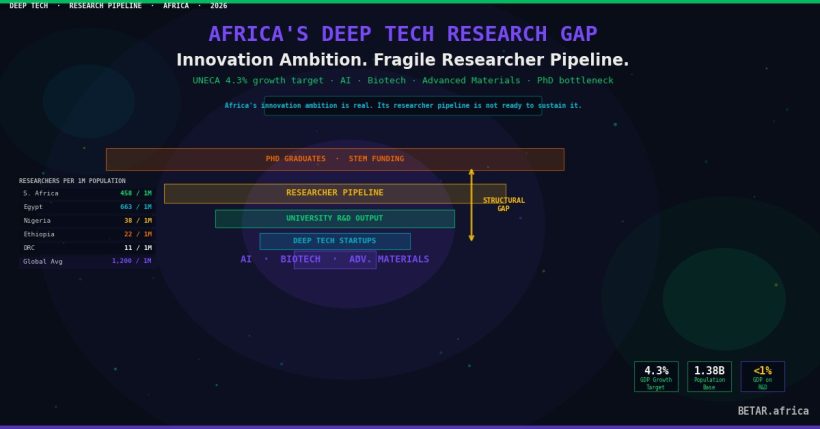
The continent’s innovation ambition is real. Its researcher pipeline is not ready to sustain it.
By BETAR Research Desk | Research | 20 March 2026
On 9 March 2026, the United Nations Economic Commission for Africa released its annual Economic Report on Africa. The title was unambiguous about the argument: Growth through Innovation: Harnessing Data and Frontier Technologies. The projection was 4.3% continental growth for 2026, with frontier technologies — AI, biotechnology, advanced materials — identified as essential drivers of structural transformation.
Two weeks earlier, Nature Africa published a peer-reviewed assessment of the ecosystem that is supposed to produce those technologies. Its findings were equally unambiguous, and significantly less optimistic. Sub-Saharan Africa has fewer than 100 researchers per million people — 15% below the global average. Only 11% of African deep tech founders hold PhDs, compared to approximately 90% among European pre-seed deep tech founders. The deep tech boom, Nature Africa concluded, rests on a fragile research ecosystem.
Read together, these two reports describe a structural contradiction at the centre of Africa’s technology ambition: the continent has a plan for innovation-led growth and an insufficient pipeline of trained researchers to execute it. The question is not whether the gap exists — the data confirms it does — but whether the specific mechanisms needed to close it are part of anyone’s actual policy agenda.
The talent gap in numbers
Researcher density is a blunt metric, but it measures something real: the concentration of people with the training, institutional backing, and time to produce original science. Sub-Saharan Africa’s figure of fewer than 100 researchers per million people sits well below the global benchmark of approximately 1,480 per million.
The continental average obscures significant national variation. North Africa, which benefits from older university systems and higher government R&D investment, outperforms the sub-Saharan average by a factor of ten or more in leading countries. But even Egypt and Tunisia, the continent’s densest research ecosystems, lag behind middle-income comparators in Asia and Latin America.
| Country | Researchers per million people | R&D spending (% GDP) | Notes |
|---|---|---|---|
| Africa — Top 5 by researcher density | |||
| Tunisia | ~1,610 | 0.64% | Highest density on continent; strong state university investment |
| Egypt | ~1,050 | 0.72% | National AI strategy (2022); growing applied research output |
| Morocco | ~730 | 0.71% | Mohammed VI Polytechnic University driving private R&D |
| South Africa | ~490 | 0.72% | SKA flagship; NRF and DSI funding structures most developed on continent |
| Kenya | ~95 | 0.79% | Highest GDP spend ratio in SSA; SEECS/Strathmore AI Centre active |
| Africa — Bottom 5 by researcher density | |||
| Niger | ~18 | 0.19% | Lowest researcher density on continent; conflict-related brain drain |
| Chad | ~20 | 0.15% | University system severely underfunded |
| Mali | ~25 | 0.22% | Political instability has disrupted institutional research continuity |
| Burkina Faso | ~28 | 0.21% | Capacity concentrated in Ouagadougou; limited national distribution |
| Guinea | ~30 | 0.23% | University enrolment growing but postgraduate infrastructure limited |
| Global benchmarks | |||
| Global average | ~1,480 | 2.23% | UNESCO Institute for Statistics, 2024 |
| South Korea | ~8,714 | 4.81% | Highest globally; sustained 40-year R&D investment trajectory |
| Brazil | ~888 | 1.21% | Most useful comparator for Sub-Saharan Africa’s development trajectory |
| Sub-Saharan Africa | <100 | 0.38% | Nature Africa, March 2026; UNESCO 2024 |
The PhD-founder gap compounds the researcher density problem. Deep tech — AI, biotech, advanced materials, quantum — is categorically different from consumer internet: it requires longer research cycles, more specialised training, and more intensive engagement with academic literature and laboratory infrastructure. Europe’s pre-seed deep tech ecosystem is populated overwhelmingly by PhD-holders precisely because these companies are commercialising research, not repackaging existing tools.
Africa’s 11% figure does not mean African deep tech founders are less capable. It means they are building companies without the institutional support structures — lab access, mentored post-doctoral work, research networks — that European counterparts take for granted. The gap is not in ambition; it is in the infrastructure behind it.
The funding problem underneath the talent problem
Researcher density is downstream of research funding. Sub-Saharan Africa spends approximately 0.38% of GDP on research and development — less than one-fifth of the global average of 2.23%. Only a handful of African countries have consistently invested above 0.5% of GDP in R&D; none approaches the 1% threshold that most development economists treat as the floor for self-sustaining research growth.
The funding structure makes the problem worse. African research is disproportionately donor-funded rather than state- or industry-funded. This matters because donor funding is episodic, project-bound, and calibrated to donor priorities rather than continental research needs. A programme that funds 200 African researchers over five years and then sunsets does not build institutional capacity — it builds individual CVs that then become assets for diaspora migration.
Industry funding for African research — the mechanism that most reliably creates the university-industry pipeline that produces commercially viable deep tech — is negligible at the continental level. South Africa has the most developed private sector R&D funding structure; elsewhere, large corporations operating in Africa spend almost no research budget at African universities.
What is actually working
The picture is not uniformly bleak. Three programmes have produced measurable output against this structural deficit.
DELTAS Africa (Developing Excellence in Leadership, Training and Science in Africa), funded by the African Academy of Sciences and the Wellcome Trust, has trained over 1,500 researchers across 54 African institutions since 2015. Its model — building research capacity through postgraduate training embedded within African universities, not imported from elsewhere — is the most credible continent-built answer to the pipeline problem. It covers health and biosciences primarily; a deep tech equivalent does not yet exist at comparable scale.
Masakhane, the African grassroots natural language processing research community, has demonstrated that researcher networks can be built outside institutional frameworks. The organisation has produced hundreds of African language datasets, published peer-reviewed NLP research, and trained a generation of African AI researchers who did not have access to funded PhD programmes.
“The research capacity problem in Africa is real, but it is not fixed,” said Kathleen Siminyu, a Masakhane co-founder and AI language technology researcher, in a 2025 interview with the Alan Turing Institute. “What Masakhane showed is that motivated researchers with internet access can produce world-class work — but that is a workaround for a broken system, not a replacement for it. We still need African universities to fund postdoctoral researchers at scale, and African governments to create the conditions that make returning home from abroad the rational choice.”
Country-level, two investments stand out. Kenya’s Strathmore University AI Centre and the State Department for the Blue Economy and Digital Economy (SEECS) represent the most developed national AI research-policy interface in East Africa. Egypt’s 2022 National AI Strategy established a funded research agenda with measurable targets for researcher output and university-industry partnerships — the continent’s clearest example of an AI strategy that includes a researcher pipeline component rather than only deployment targets.
The AfDB/UNDP $10 Billion AI Initiative, announced in early 2026 with projections of creating 40 million jobs across Africa by 2035, is the largest institutional commitment to AI on the continent. But its primary mechanism is deployment — AI tools applied to agriculture, health, and public services — not research infrastructure. Creating 40 million jobs through AI tools requires those tools to exist and work in African conditions; building the research pipeline to improve, adapt, and eventually originate those tools requires a separate and currently absent investment commitment.
Closing the gap: three policy levers that are specific enough to mean something
Generic calls for “more investment in research” are accurate but not actionable. Three mechanisms are specific, precedented, and scalable.
1. Diaspora return incentives with structured research commitments. Africa’s most research-capable citizens are disproportionately outside Africa. South Africa’s National Research Foundation and Kenya’s diaspora engagement programmes have attempted to address this, with limited success. What has worked elsewhere — notably South Korea in the 1980s and 1990s — is a combination of competitive salaries, research infrastructure investment, and guaranteed research time (protected from teaching and administrative load) for returning researchers. The AU’s Protocol on Free Movement provides a legal foundation for a continental diaspora research return programme that does not yet exist.
2. Regional PhD scholarship networks tied to continental research priorities. DELTAS Africa’s model works. Scaling it to deep tech — AI, advanced materials, biotechnology — requires a funding commitment from African governments, not only foundations and development finance institutions. An AU-administered African Research Scholarship Fund, modelled on the European Research Council’s fellowship structure, with a mandate to fund 5,000 Africa-based PhD researchers per year in frontier technology fields, would cost approximately $500 million annually — less than 1% of the AfDB/UNDP AI Initiative’s headline figure.
3. Industry-university R&D mandates tied to technology operating licences. African governments currently require almost nothing of technology companies operating on the continent in terms of local research investment. A mandatory local R&D spend requirement — 0.5% of African revenue reinvested in African university research partnerships — applied to companies above a revenue threshold would generate hundreds of millions of dollars annually in institutionally-backed research funding. Rwanda’s approach to tech company partnership obligations in its Digital Transformation Policy provides a precedent at the national level; a continental framework does not exist.
The UNECA’s growth projection is not wrong. Africa’s demographic dividend, resource base, and increasingly connected population make innovation-led growth a genuinely plausible trajectory. But the research infrastructure deficit documented by Nature Africa is not a minor headwind — it is a structural constraint on how deep the technology stack can go and how much value African economies can capture from technologies built on African soil.
Without specific action on researcher density, R&D funding, and the diaspora return problem, Africa risks building a digital economy on borrowed research infrastructure: using tools built elsewhere, trained on data from elsewhere, optimised for problems defined elsewhere. That is better than no digital economy. It is not innovation-led growth.
Cross-reference: This analysis examines researcher pipeline and institution-level research capacity. For the gap between African university research outputs and commercial revenue generation, see BETAR’s Research-to-Revenue Gap Report (BETA-606). For the agricultural AI training data deficit — the same structural problem one level down the stack — see BETA-523.
Sources: Nature Africa, “Africa’s deep tech boom rests on a fragile research ecosystem” (March 2026); UN Economic Commission for Africa, Economic Report on Africa 2026: “Growth through Innovation: Harnessing Data and Frontier Technologies” (9 March 2026); UNESCO Institute for Statistics, R&D expenditure and researcher density data (2024); Kathleen Siminyu, interview with Alan Turing Institute (2025); DELTAS Africa programme documentation (African Academy of Sciences / Wellcome Trust); Masakhane research community publications; AfDB/UNDP $10B AI Initiative announcement (2026); Strathmore University AI Centre programme documentation; Egypt National AI Strategy 2022; South Africa National Research Foundation annual report 2025.


 UphivaBETAR