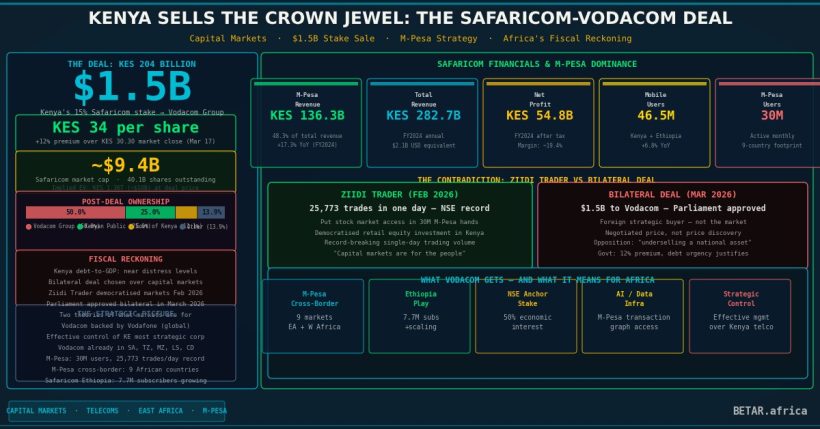

When Kenya’s National Assembly approved the sale of a 15 percent government stake in Safaricom PLC to Vodacom Group last week, the headlines focused on the KES 204 billion ($1.5 billion) price tag. The real story is more consequential: a government operating at near-debt-distress levels has chosen to monetise Africa’s most valuable telecoms and fintech asset through a bilateral deal with a foreign strategic buyer — not through the capital markets that Safaricom itself has spent the last two months democratising.
The contrast is instructive. In February, Safaricom’s Ziidi Trader platform processed 25,773 equity trades in a single day — a Nairobi Securities Exchange record — by putting stock market access in the hands of 30 million M-Pesa users. One month later, Parliament approved the sale of a 15 percent bloc of that same company to Vodacom at a negotiated price, in a transaction that will transfer effective control of Kenya’s most strategically significant corporation to a South African group already backed by Vodafone. The two moves reflect different theories about what capital markets are for.
The Valuation Question: Premium, Discount, or Fintech Mispricing?
The price — KES 34 per share — has drawn both criticism and defence. Opposition MPs, including Ndindi Nyoro, argued the government was underselling a national asset and that Kenyans were receiving a suboptimal deal. The arithmetic, at face value, does not support that claim.
Safaricom shares closed at KES 30.30 on March 17, 2026, giving the company a market capitalisation of approximately $9.4 billion at 40.1 billion shares outstanding. The KES 34 transaction price represents a premium of approximately 12 percent over that market price and sits above the market consensus fair value of KES 30.82 per share. At KES 34, the implied total enterprise value for Safaricom is roughly KES 1.36 trillion, or around $10 billion — consistent with where the stock has been trading.
The more substantive valuation debate is not about whether KES 34 is above or below market. It is about whether Safaricom’s current market price adequately captures M-Pesa’s fintech value in the first place.
M-Pesa generated KES 161.1 billion in revenue in the most recent financial year — more than 40 percent of Safaricom’s total service revenue — and grew at 15.1 percent year-on-year. The platform serves over 30 million active users in Kenya and is the settlement layer for a growing suite of financial products: money market funds, Islamic savings, and now equity trading through Ziidi. Analysts covering the stock assign a maximum price target of KES 44 and a minimum of KES 31.91, reflecting genuine uncertainty about whether M-Pesa should be valued as a telco feature or a standalone fintech at emerging market SaaS multiples.
The government’s advisers chose to price on current market data. Critics who say the deal undervalues Safaricom are implicitly arguing that M-Pesa’s fintech premium is not reflected in the NSE share price — a view that may be correct, but one that would have taken years of patient capital markets development to realise through an alternative route.
The Fiscal Calculus: Why Equity, Not Bonds?
Understanding why the government structured this as a bilateral equity sale requires understanding the fiscal position Kenya was negotiating from.
Kenya’s public debt has nearly doubled as a share of GDP over the past decade, reaching approximately 78 percent by 2024. The previous IMF Extended Fund Facility and Extended Credit Facility programmes collapsed in March 2025, and the government is currently in negotiations for a fresh three-year arrangement with the Fund. For the 2025/2026 fiscal year, Kenya faces KES 901 billion in new borrowing requirements to finance the budget deficit, plus KES 646 billion in debt refinancing — a combined financing need that has left limited room for conventional capital market manoeuvre.
An equity sale to Vodacom solves several problems simultaneously. The KES 204 billion proceeds will be directed to the National Infrastructure Fund, providing a lump sum for capital spending without adding to the sovereign debt stock that IMF reviews scrutinise. Bond issuance of equivalent size — whether domestic or external — would face yield pressure given Kenya’s near-distress debt profile, and external issuance would attract further IMF conditionality. Selling equity in a performing, dividend-paying company generates fiscal space in a way that borrowing does not.
The trade-off is control. With Vodacom acquiring 15 percent from the government and a further 5 percent directly from Vodafone, Vodacom’s stake rises from 40 percent to 55 percent — majority ownership. The government retains 20 percent, dropping from its position as the company’s largest single shareholder. Parliament applied six conditions to the deal, including a 10-year protection for Safaricom’s dealer and agent business model and an indefinite job preservation requirement, but the structural shift in corporate governance is real: Vodacom will consolidate Safaricom onto its balance sheet, and Vodafone will do the same on its.
A Continental Template — Or a Warning?
Kenya’s privatisation context sits within a broader pattern of African governments grappling with the strategic value of state-owned telecoms assets against urgent fiscal needs. The outcomes have not been uniform.
Ethiopia’s attempted 10 percent flotation of Ethio Telecom in 2025 fell significantly short of its targets, with the government selling only about 10.7 percent of the offered shares before scaling back its privatisation ambitions. The macroeconomic environment — foreign currency shortages, post-conflict fiscal pressures — made an open-market float structurally difficult. The government is no longer in a hurry to divest.
Ghana’s approach has been different again: rather than selling government stakes, Accra has overseen a market consolidation — the merger of AT Ghana and Telecel Ghana — aimed at stabilising the competitive landscape and reducing public fiscal exposure without direct privatisation.
Kenya has moved furthest and fastest. Parliament has cleared the deal. COMESA’s Competition and Consumer Commission has already granted regulatory approval, concluding that Vodacom’s 55 percent stake does not create dominance across regional markets. The transaction is expected to close in the first quarter of 2026.
| Metric | Value |
|---|---|
| Transaction price per share | KES 34.00 |
| NSE closing price (March 17, 2026) | KES 30.30 |
| Premium to market | ~12% |
| Average analyst fair value | KES 30.82 |
| Government stake (pre-deal) | ~35% |
| Government stake (post-deal) | ~20% |
| Vodacom stake (pre-deal) | 40% |
| Vodacom stake (post-deal) | 55% |
| Public float | 25% |
| Implied total market cap at KES 34 | ~$10 billion |
| M-Pesa revenue (latest FY) | KES 161.1 billion |
| M-Pesa share of service revenue | >40% |
If the transaction completes cleanly, it will establish a benchmark: a bilateral strategic sale to an existing shareholder, at a premium to market, directed into an infrastructure fund, with parliamentary conditions protecting employment and commercial relationships. That is a replicable template — not just in telecoms, but across African state-owned enterprises where governments need fiscal space without the politics of outright privatisation.
The risk is the precedent it sets for control. Kenya has traded a controlling position in a strategic national asset — one that processes the majority of the country’s digital payments — for liquidity it needs now. Whether that exchange proves to have been at fair value will depend less on the KES 34 share price than on how M-Pesa’s fintech trajectory unfolds in the years ahead. If M-Pesa at scale proves to be worth KES 44 a share or more, the government sold too soon. If Safaricom’s growth moderates as Ethiopia operations weigh on margins, KES 34 will look prescient.
The parliamentary committees made their call. The market will make its own.
BETAR.africa covers business, technology, and innovation from across Africa. Follow the Business Desk for analysis of Africa’s deal economy.

 UphivaBETAR
 Joseph Busari