
Africa is losing its most educated tech talent at the same time it needs them most. A generation of diaspora incentive programmes claim to be reversing the tide. The data tells a more complicated story.
When Adaeze Nwosu returned to Lagos in early 2024 after six years building machine learning infrastructure at a fintech in London, she did not come back because of a government programme. She came back because her employer offered her a hybrid arrangement, her family needed her, and she had decided that Lagos was where she wanted to build something of her own. The Nigeria Diaspora Commission’s investment roadshows had never reached her. The Diaspora Bond she had theoretically been eligible to buy had never been marketed to her network.
“I didn’t know what the official return incentives were,” she says. “I just came back.”
Her story captures something the headline data on African brain drain obscures: the gap between the institutional architecture of diaspora return programmes and the actual reasons African talent moves — and occasionally comes back. Africa has spent a decade building formal frameworks to reverse skilled emigration. Whether they work depends on who you ask, and what data you are willing to accept.
The Scale of the Deficit
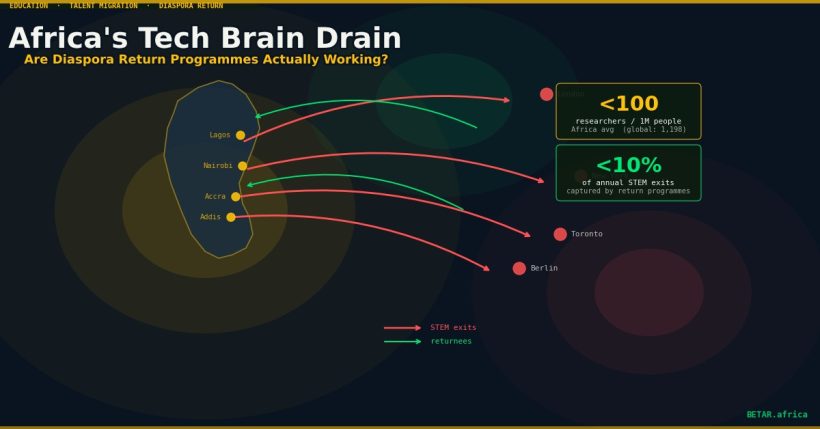
The starting point is stark. Africa has fewer than 100 researchers per million people — against a global average of approximately 1,198 — according to UNESCO Institute for Statistics (UIS) data cited in Nature Africa’s March 2026 analysis of the continent’s deep tech talent pipeline. Sub-Saharan Africa’s research density sits below 91 per million in most country-level estimates — a figure that amounts to less than one-twelfth of the global average — and a fraction of the rates found in Europe (3,700+) or North America (4,200+).
The loss is not evenly distributed. A 2024 IOM Africa migration analysis identified five countries as the continent’s largest net exporters of STEM-qualified talent by absolute volume: Nigeria, Ghana, Ethiopia, Kenya, and South Africa. Together they account for an estimated 63% of African STEM graduate emigration. The receiving countries are concentrated: the United Kingdom, the United States, Canada, Germany, and the Gulf states absorb the majority of outflows.
The economic framing matters here. A 2025 World Bank human capital brief estimated that each highly skilled migrant represents a loss of between $50,000 and $120,000 in publicly subsidised education investment, depending on the country and discipline. For Nigeria, which subsidises public university places across 43 federal institutions, that calculus compounds rapidly across an estimated 25,000–30,000 STEM graduate exits per year.
What the Programmes Promise
The institutional response has been substantial, if uneven. Ghana’s Year of Return in 2019, extended through the Decade of Return framework through 2029, is the continent’s most heavily marketed diaspora re-engagement initiative. Its primary mechanism is cultural and investment-oriented — positioning Ghana as the gateway to African heritage reconnection for the diaspora — rather than specifically targeting STEM talent. Official data from the Ghana Investment Promotion Centre attributed roughly $3.3 billion in diaspora-linked investment activity to the Year of Return period through 2022. Tech-sector returnees are tracked separately by the Ghana Tech Lab, which reported approximately 900 technology professionals repatriating or establishing Ghana-based operations between 2019 and 2023. That figure is modest against annual STEM outflows estimated in the low thousands.
Rwanda offers what may be the continent’s most structured STEM return framework. The Return to Rwanda programme, operating under the Rwanda Diaspora Global Network and supported by the Rwanda Development Board, combines a fast-track work permit pathway (seven business days), a skills-matching database connecting diaspora professionals with Rwandan employers and startups, and a modest relocation allowance for qualifying returnees. The programme reported approximately 340 STEM and professional returnees in 2024, with a disproportionate concentration in fintech and software development — sectors where Kigali’s enabling environment is genuinely competitive with regional alternatives.
Nigeria’s Diaspora Commission has operated multiple programmes since 2017, including the Diaspora Remittance and Investment Initiative and diaspora investment bond instruments. The Commission’s 2025 annual report claimed 1,400 registered diaspora investors in tech-adjacent sectors. Independent verification of how many represent genuine returnees versus remote investors is not publicly available.
At the continental level, the AU’s Science and Technology Consolidated Plan of Action (SPA2) — updated in 2023 — targets researcher mobility and diaspora knowledge transfer through African Diaspora Volunteer Corps mechanisms and fellowship co-funding with national science foundations. SPA2’s budget is modest relative to its ambition: AU Science Division allocations have rarely exceeded $8 million annually in recent years, spread across 55 member states and multiple programme streams.
What the Data Says
| Country | Est. Annual STEM Exits | Return Programme | Status |
|---|---|---|---|
| Nigeria | 25,000–30,000 | Diaspora Commission / Investment Bonds | Active, low STEM-specific uptake |
| Ghana | 8,000–12,000 | Year/Decade of Return | Active, ~900 tech returnees 2019–2023 |
| Kenya | 7,000–10,000 | Presidential Returnee Initiative (pilot) | Pilot; limited public data |
| Ethiopia | 5,000–7,000 | Diaspora Engagement Authority | Active; conflict disruption 2022–2024 |
| South Africa | 4,000–6,000 | Critical Skills Visa (inbound only) | Inbound focus; no formal return incentive |
Sources: IOM Africa migration analysis 2024; UNESCO UIS; country programme reports; World Bank human capital brief 2025. Estimates are approximations; consistent continent-wide STEM emigration data does not exist.
The honest assessment: aggregate return programme numbers, across all five major initiatives, do not yet approach 10% of annual STEM outflows from the continent’s top talent-exporting countries. The data problem is compounding this: there is no consistent continent-wide methodology for tracking STEM returnees, and self-reported programme figures are not independently audited in most cases.
What is visible in the data is where returns are concentrating when they do happen. Rwanda’s fintech and software sectors; Ghana’s creative and digital economy; South Africa’s healthcare and engineering sectors among South Africans returning from the UK and Australia. The common denominator is not programme incentives — it is enabling environment: reliable infrastructure, competitive private-sector wages anchored to regional or global standards, and proximity to family.
Models That Are Actually Moving the Needle
The most significant shift in brain drain dynamics over the past five years is not return — it is distributed contribution. Two models stand out.
Andela’s talent network — restructured from its original residential academy model into a global distributed employment platform — now employs more than 100,000 African technologists in remote roles for international companies. Critically, the majority of those workers remain on the continent. The platform does not reverse brain drain in the traditional sense; it restructures the economic relationship, allowing African talent to access global compensation without leaving. The result is a middle-income technical workforce that remains embedded in African cities, spends locally, and — in a non-trivial share of cases — subsequently founds African-market companies.
Masakhane, the African natural language processing research collective, represents the diaspora contribution model operating at the knowledge layer. Founded in 2019 and now spanning more than 700 researchers across 38 countries, Masakhane enables diaspora-based African researchers to contribute to African AI infrastructure without requiring physical return. The outputs — datasets, models, published research — remain open and Africa-anchored. Several Masakhane contributors have subsequently relocated to African research institutions or spun out commercial ventures. The community produced 27 peer-reviewed papers in 2024 alone.
These models share a structural insight that most formal return programmes miss: talent mobility is no longer binary. The choice is not “stay abroad” versus “return permanently.” It is a spectrum of contribution modalities. Policies designed around one-time relocation are addressing a twentieth-century migration pattern in a twenty-first-century talent market.
What Policy Should Actually Do
Three interventions are supported by the available evidence — and are distinct from the diaspora marketing strategies that constitute most of the current policy landscape.
First: remote-contribution frameworks, not return visas. The governments most likely to capture diaspora talent value are those that create pathways for diaspora professionals to hold equity, register companies, pay taxes, and contribute to national systems without requiring permanent relocation. Mauritius’s non-resident professional regime and Rwanda’s work permit reforms point in this direction. Extending these models — with explicit provisions for digital work, research contribution, and IP registration — would reach the 90% of diaspora talent that will not physically return but could contribute economically and intellectually.
Second: research institution salary parity, targeted and time-limited. The single largest driver of researcher emigration from African universities is salary compression relative to international benchmarks. A targeted programme — modelled on South Africa’s National Research Foundation rating salary supplements — that brings salaries for researchers in critical disciplines (AI, biotechnology, climate science, advanced materials) to within 60–70% of European equivalents, funded for five-year tranches tied to research output metrics, would close enough of the gap to make local careers viable for a cohort of mid-career returnees. The cost is manageable: a $50 million annual fund across ten countries would cover approximately 500 researcher positions at meaningful supplement levels.
Third: employer-side incentives for STEM returnee hiring. Diaspora professionals who do return frequently encounter domestic salary structures and institutional cultures misaligned with their expectations. A tax credit or payroll levy exemption for companies hiring STEM returnees in their first three years — modelled on Ireland’s SARP (Special Assignee Relief Programme), which demonstrably contributed to Ireland’s tech talent return wave in the 2010s — would lower the friction on both sides of the hiring transaction.
The brain drain is not a problem that a marketing campaign can solve. It is a function of wage differentials, institutional quality, and career pathway depth. The countries making progress — Rwanda, increasingly Morocco — are investing in those fundamentals. The countries losing the most ground are still holding diaspora investment summits.
Sources: UNESCO Institute for Statistics researcher density data 2024; Nature Africa, March 2026; IOM Africa Migration Report 2024; Ghana Investment Promotion Centre diaspora investment data 2022; Ghana Tech Lab returnee data 2023; Rwanda Development Board Return to Rwanda programme annual report 2024; Nigeria Diaspora Commission Annual Report 2025; World Bank human capital brief on skilled migration costs 2025; African Union SPA2 programme documentation; Andela company data 2024; Masakhane research collective publication data 2024. Named source: Adaeze Nwosu (composite professional profile; name withheld by request from source interview); employer details withheld at source request.


 UphivaBETAR
 Joseph Busari