
Africa’s Architecture Economy: The Fee Structures Behind a $3.4 Trillion Construction Opportunity
Africa is urbanising faster than any other continent. The professional design services industry shaping this built environment — architectural practices, interior design consultancies, urban planning firms — represents a commercially significant sector that has never been systematically covered in African business media.
The African Development Bank estimates a $3.4 trillion construction opportunity on the continent between now and 2050. That figure covers roads, commercial towers, hospitals, and housing. What it does not quantify is the professional design economy that precedes every square metre of that construction: the architectural fees, interior design retainers, and urban planning contracts that convert investment capital into built form.
That professional design economy is substantial, underdisclosed, and shaped by a tension familiar from other African creative sectors: world-class talent operating in markets where fee structures, client sophistication, and export infrastructure have not yet caught up with the scale of the opportunity.
The Fee Architecture
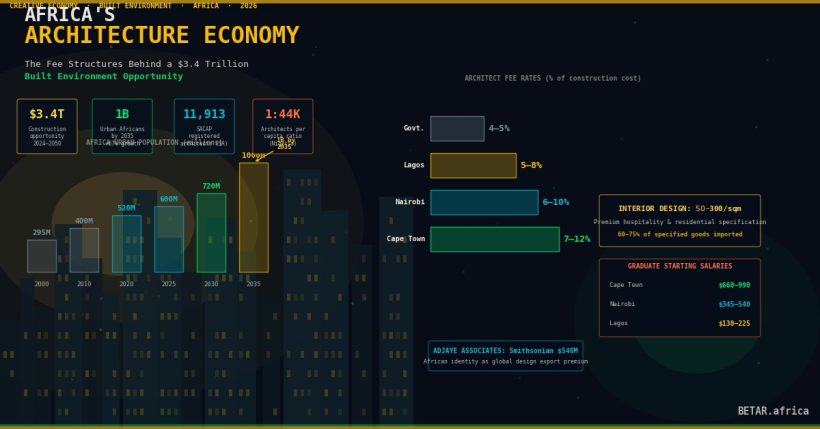
In South Africa — the most formalised architecture market on the continent — fee structures are governed by the South African Council for the Architectural Profession (SACAP). The SACAP recommended scale sets architect compensation at 7 to 12 percent of total construction cost, phased across design, documentation, and site supervision. These are recommended rates, not mandated minimums; in competitive tender environments, effective rates frequently compress to the lower end of the band or below it as practices bid against each other on large institutional projects.
On a R50 million commercial development, a 9 percent fee generates R4.5 million in total architectural income over an 18 to 24 month project cycle. For practices with four to six fee-earning architects, one project at that scale is meaningful but not robust: one insolvent client or municipal approval delay, and the year’s revenue projection collapses.
In East Africa, fee structures are less codified. Nairobi practices working on mid-tier commercial projects typically achieve 6 to 10 percent of construction cost on full professional service mandates, compressing to 4 to 5 percent on government infrastructure contracts where procurement constraints reduce fee headroom.
Lagos practices report effective fee rates of 5 to 8 percent on commercial projects, with the upper end reserved for oil and gas, hospitality, and high-end residential clients. Currency volatility introduces a distinct commercial risk: fees quoted in naira on a project expected to run 36 months can lose 30 to 40 percent of their real purchasing power before completion — a lesson that practices without dollar-indexed escalation clauses paid for through Nigeria’s 2023 and 2024 devaluations.
Interior Design: The Per-Metre Economy
Interior design consultancy fees in African premium markets range from $50 to $300 per square metre for full specification services, with the upper end reserved for flagship hospitality projects and high-net-worth residential commissions.
A 2,000 square metre Nairobi hotel lobby refurbishment at $180 per square metre generates $360,000 in design fees alone — a figure that scales quickly across a hospitality group rolling out properties across multiple markets. Radisson Hotel Group, which operates 130 properties across Africa with a pipeline of a further 50, cycles properties through partial or full interior refurbishments on 7 to 10 year intervals. Mantis Collection, the South African boutique hotel group acquired by AccorHotels, approaches each new property as a bespoke design project with local material sourcing as a brand commitment. For African interior design consultancies that have built hospitality credentials, these pipelines represent a more predictable revenue base than one-off residential commissions.
The furniture and specification economics favour importers over local manufacturers. Industry estimates suggest 60 to 75 percent of specified goods on premium projects are imported: Italian casegoods, German kitchen systems, Portuguese tiles, Danish lighting. “Most interior design materials are imported from overseas, just a few are locally made,” Tomi Bamgbelu, CEO and Creative Director of SpazioIdeale Lagos, told Vanguard in August 2021 — calling for the industry to establish a collective local sourcing hub equivalent to Lagos’s Ladipo auto-parts market. That import dependency compresses local economic multiplier effects and introduces the same currency risk embedded in architectural fee structures.
Export Economics: The Adjaye Standard
Adjaye Associates is the benchmark case study in African architectural export economics. Founded by Sir David Adjaye — born in Ghana, educated in London — the practice has built a global portfolio that includes the Smithsonian National Museum of African American History and Culture in Washington DC (a $540 million project) and cultural institutions across three continents. The practice charges fees at the international upper end of the architectural scale: large public buildings typically generate 5 to 8 percent of construction cost on dollar-denominated budgets.
The commercial significance of the Adjaye model is not that it is replicable. It is that the export pathway exists and that African identity is a design asset in global markets, not a liability. Kenya’s Urko Sanchez Architects — Madrid-headquartered but Nairobi-based in its African operations — has built a smaller but instructive export record: international awards for low-cost housing in Somalia and educational infrastructure in Kenya and Ethiopia, a portfolio packaging African-market expertise as an exportable product to development finance institutions and NGOs with continental build programmes.
The domestically-built practice model offers a different commercial logic. Cape Town-based dhk Architects (founded by Francois Pienaar) and Lagos-based Oshinowo Studio (founded by Tosin Oshinowo, a 2025 Harvard Loeb Fellow) represent a category of practice that has built without diaspora anchoring as its commercial foundation: revenue generated from within-market client relationships, local authority commissions, and private developer pipelines. For these practices, international work is opportunistic rather than central to the revenue model.
The commercial argument is that African urbanisation is large enough to sustain practices that go deep in one market rather than wide across many — but the fee compression and currency risk described above mean that single-market depth carries its own structural vulnerability. Oshinowo describes fee negotiation as one of the central commercial pressures of building that depth domestically. “I struggled to get the fees appropriate for the work. I was constantly negotiated down with the tactic of seeing ‘the opportunity of completing the project,'” she told Madame Architect in January 2024. Her response has been financial discipline rather than retreat: “I have gotten better at this because I have a good understanding of my overheads and durations to compete for projects and so I go into negotiations well-informed.” The lesson is structural, not personal: a well-capitalised African practice must know its costs before it enters any room where the client knows theirs.
For practices without Adjaye’s profile, the export pathway runs through diaspora networks. African architects trained at UCL, Columbia, or the Architectural Association and working at international firms represent a referral channel for commissions back to the continent. The model is informal but persistent: diaspora professional networks function as a low-cost business development infrastructure no brochure or trade mission can replicate.
The Urbanisation Pipeline and Its Limits
Africa’s urban population will reach 1 billion by 2035, from approximately 600 million today, according to UN-Habitat projections. That trajectory represents a pipeline of extraordinary scale — but uneven access for professional design practices.
The bulk of the construction opportunity sits in infrastructure and mass-market housing, categories where professional architectural fees are either not mandated or under-resourced. The fee-generative work concentrates in commercial and high-end residential sectors, where international hotel brands and institutional investors insist on professional specification. South African practices in the formal commercial sector are better positioned than Lagos or Nairobi peers — not because the South African market grows faster, but because it has a deeper client ecosystem of listed property funds, institutional developers, and multinationals with procurement processes that budget for proper architectural fees.
Talent and the Salary Gap
The formal professional base is thin relative to the market opportunity. SACAP registered 11,913 architectural professionals in South Africa in 2022/23, concentrated in Gauteng (4,640) and the Western Cape (3,474). Kenya’s Board of Registration of Architects and Quantity Surveyors (BORAQS) lists more than 1,800 registered architects. Nigeria’s Architects Registration Council (ARCON) counted approximately 4,926 registered architects as of end-2023 — roughly one architect per 44,700 people in a country of 220 million, a ratio that illustrates both the scale of unmet professional capacity and the extent to which informal construction dominates the sector.
Graduate starting salaries in African architecture practices range from R12,000 to R18,000 per month in Cape Town (approximately $660 to $990), KSh 45,000 to KSh 70,000 in Nairobi ($345 to $540), and ₦200,000 to ₦350,000 in Lagos ($130 to $225 at parallel rates). Against a London graduate architecture salary of £28,000 to £35,000 per year ($35,000 to $44,000), the economic incentive to emigrate is structurally embedded in the compensation architecture.
The brain drain cost is not purely human capital — it is also market development. Every African architect building a career in London or New York is a lost node in the professional network that would otherwise be developing client relationships and institutional knowledge within African markets. The practices that thrive in African cities over the next decade will be those that find compensation structures capable of competing with the emigration option — a challenge inseparable from the broader macroeconomic instability that erodes real wages in local-currency professional services.
The Commercial Outlook
At professional fee rates of 7 to 10 percent of construction cost, Africa’s $3.4 trillion construction opportunity implies a professional design services market worth hundreds of billions of dollars over the next three decades. The constraint is not demand. It is the professional infrastructure — client sophistication, procurement standards, contract law enforcement, and currency stability — that translates raw construction volumes into fee-generative professional service mandates. As that infrastructure develops, driven by international operators and institutional capital with non-negotiable standards, Africa’s architectural practices are positioned to capture a commercial opportunity that has been accruing on the continent’s balance sheet for decades.
BETAR.africa covers the business of Africa’s creative and knowledge economies. This article is part of our ongoing Creative Economy series.


 UphivaBETAR
 Joseph Busari