
Winifred Emmanuel left a job in Nigeria’s oil industry in 2017 to start a food YouTube channel. Within six months she had 50,000 subscribers. By 2024 she had over a million, a Knorr brand partnership, a TV cooking show, and a cookbook. She is the founder of Zeelicious Foods — Nigeria’s most-subscribed food YouTube channel — and her commercial trajectory maps the revenue logic of African food media with unusual clarity: YouTube alone cannot sustain a professional food creator in an African market. The income architecture requires brands, and the brands have arrived.
Understanding that architecture — what platforms pay, what FMCG sponsors pay, what publishers pay for African cookbooks, and what it costs to move a Nigerian sauce from a Lagos production facility to a Tesco shelf — requires examining each layer of the food media economy separately.
The YouTube Gap
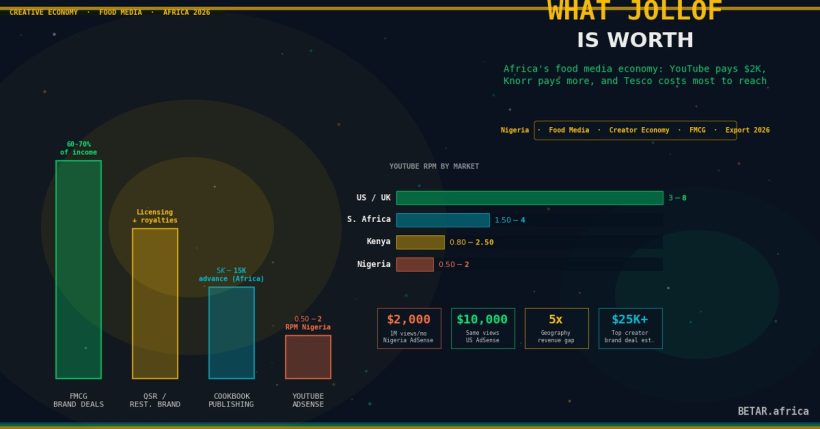
YouTube AdSense revenue for African cooking channels operates on a cost-per-mille (CPM) model in which African geography structurally disadvantages creators. The RPM (revenue per mille, the amount a creator actually receives after YouTube’s 45% cut) for Nigerian-based food channels benchmarks at approximately $0.50 to $2.00 per thousand views, compared with $3 to $8 per thousand views for comparable US food content, per creator analytics data compiled by Lenostube and industry benchmarks published in 2025. Nigeria’s average YouTube CPM is approximately $2.50 — among the lower tiers on the continent — due to advertiser budget concentration in Western markets and limited local programmatic demand for food-category placements.
The practical implication: a Nigerian food channel generating 2 million monthly views at a $1.00 RPM earns approximately $2,000 per month from AdSense — an amount that covers equipment replacement and production costs at a professional level, but leaves little room for creator income. The equivalent output in a US market at $5.00 RPM generates $10,000 monthly. The geography premium is five times.
Emmanuel’s selection for YouTube’s Black Voices Creators Fund — which she described as providing “a good sum of money” alongside training on money management and brand-building — reflects YouTube’s acknowledgement of the structural gap. The fund functions as a one-time capital injection, not a structural fix to the underlying RPM disparity.
The Brand Deal Model: Where the Money Actually Is
For African food creators who reach sustainable scale, FMCG brand partnerships — not platform revenue — constitute the primary income stream. The logic is straightforward: Pan-African food brands need credible, audience-tested distribution channels for recipe integration and product endorsement, and food YouTube creators with demonstrable engagement provide exactly that.
Emmanuel has built brand relationships across multiple categories: cooking oils (Blue Band, Mamador, Power Oil), beverages (Malta Guinness), and seasoning (Knorr/Unilever). Her 2024 appointment as a Knorr Eativist — one of 14 Nigerian food personalities unveiled by Knorr in February 2024 to front the brand’s Eat for Good campaign — is the most commercially visible of these arrangements. The Eativist programme involves recipe development, social content creation, live event appearances, and broadcast integration.
Gbubemi Fregene — better known as Chef Fregz, one of Nigeria’s most prominent culinary personalities — has confirmed the model explicitly. In an April 2025 profile, Fregene identified “endorsement fees from work with Knorr Nigeria” as one of the capital inputs that financed his early business growth, alongside Samsung and Kenwood partnerships. The franchise structure of FMCG brand-creator relationships in Nigerian food media has Knorr and Maggi (Nestlé) as the two dominant sponsors, with telecom and fintech brands providing secondary deal flow for food creators who have built audiences large enough to justify a non-food advertiser’s presence.
Brand deal rates for Nigerian food creators with audiences of 100,000 to 500,000 subscribers are not publicly disclosed by either party. Based on BETAR.africa’s analysis of comparable creator deal structures in the Nigerian market — cross-referenced with regional influencer marketing rate benchmarks published by Autogather and The Creative Brief Africa (2025) — recipe integration sponsorships for mid-tier Nigerian food creators range from approximately ₦500,000 to ₦2,000,000 per campaign deliverable, with annual ambassador packages at established brand level running materially higher.
Cookbook Publishing: The Diaspora Deal Structure
African cookbook economics are determined by two compounding variables: the size of the local publisher advance versus the international rights upside, and the royalty rate applied to a retail price that differs significantly between African and export markets.
Standard royalty rates for African cookbook authors — whether publishing with independent houses (Cassava Republic, Jacana Media) or international imprints — range from 8 to 12 percent of the retail price, consistent with global cookbook publishing norms. The commercial leverage for African authors comes from territorial rights: selling UK and US rights separately from African rights can materially increase total advance income, because international publishers price for their own retail markets, where hardback cookbook retail prices of £25–£35 carry a higher royalty base than equivalent African retail prices.
Lerato Umah-Shaylor’s Africana — published by HarperCollins’ HQ imprint — was acquired on a world all-language rights basis, meaning the publisher controls global distribution across a single deal. For African authors whose cultural authority is the book’s central selling proposition, world rights deals with major international publishers offer scale distribution but concentrate the advance negotiation in a single transaction. The Bookseller’s deal report noted the acquisition was negotiated through Bev James Management — an agent relationship that is itself a structural requirement for accessing the international advance market. African authors without London or New York agent representation typically access smaller advances through regional independent publishers.
Food Delivery: The Take-Rate Compression Problem
Africa’s food delivery sector has undergone a structural contraction that reshapes restaurant economics. Jumia Food and Bolt Food both exited Nigeria in 2023, citing unit economics pressure in a market where average order values were insufficient to cover logistics costs at competitive commission rates. The exits concentrated market share in Chowdeck — the Lagos-founded delivery platform backed by Y Combinator and Novastar, which raised $9 million in Series A funding in August 2025.
Chowdeck operates on a 24 percent take rate — the commission levied on each restaurant order — compared with Jumia Food’s 16 percent in its final period of operation. Across the Nigerian food delivery sector, restaurant commissions range from 15 to 30 percent per order on third-party platforms, per Bolt Food and Glovo rate documentation and Afridigest analysis of the sector. Chowdeck CEO Femi Aluko described the company’s unit economics focus directly: “We took the time to figure out the right economics for our delivery business. This approach kept us focused on selling and targeting the right customers.”
The margin structure this creates for restaurants is compressed: a restaurant selling a ₦3,000 meal through Chowdeck nets approximately ₦2,280 before logistics, packaging, and VAT deductions. The delivery platform economy currently functions as an incremental revenue channel for restaurants with fixed overhead — not a margin-accretive one.
African Food on the Global Shelf: The Export Economics
Africa’s food brands are reaching diaspora consumers in UK and US mainstream retail, but the unit economics of that reach are demanding. Varofoods — the Nigerian food brand founded by Omamo Binitie, maker of jollof rice pouches and moin moin products — has been listed in both Tesco and Asda since 2016, manufactured through a co-packer in Northern India for supply chain compatibility with UK retail requirements. YumChop Foods, another West African ready meal brand, secured Tesco shelf placement in October 2024.
Co-founder Elizabeth Binitie identified the structural constraint on scale: “Nigerian people have only really been in the UK en masse since the 1990s. So it’s taken some time for all that cultural assimilation and for the culture to trickle down.” The diaspora market is real but still maturing. UK mainstream consumer awareness of African cuisine remains limited by unfamiliarity — cited by 32 percent of non-African UK consumers as a barrier to trial in category research, per The Grocer (October 2025).
The landed cost economics for a Nigerian food brand in UK retail require absorbing international co-packing or manufacturing costs, shipping, import duties, and supermarket listing fees — a cost stack that typically requires a retail price premium of 40–60 percent above the equivalent Lagos market price to maintain positive margin, based on BETAR.africa analysis of UK food import economics for comparable ambient grocery categories. That premium limits addressable volume to diaspora and culturally adjacent consumers, constraining the market to a defined but growing segment rather than mainstream grocery.
The Commercial Architecture
Africa’s food media economy has a layered revenue structure that rewards creators who treat platform income as a stepping stone to brand partnerships, brand partnerships as a route to media personality status, and media personality status as a publishing platform. The FMCG majors — Unilever (Knorr) and Nestlé (Maggi) — have institutionalised this pipeline through ambassador and creator programmes that provide African food creators with their most reliable income source. The QSR and delivery sectors are consolidating around domestic players (Chicken Republic, Chowdeck) with the unit economics to survive in a high-inflation market. And the export economy for African food brands is establishing its supply chain logic, even if mainstream penetration remains a ten-year horizon. The economics are not yet mature. But they are no longer informal.
Sources: Winifred Emmanuel / Zeelicious Foods — brand partnerships and YouTube journey (New Telegraph Nigeria; BellaNaija, April 2024); YouTube Black Voices Creator Fund (YouTube official programme documentation); Gbubemi Fregene / Chef Fregz — Knorr endorsement as business financing source (Pulse Nigeria, April 2025; BellaNaija April 2024); Knorr Eativist programme — 14 creators, February 2024 launch (BellaNaija, March 2024); YouTube RPM benchmarks for African food channels $0.50–$2.00 (Lenostube YouTube CPM/RPM rates, 2025); US food YouTube RPM $3–$8 (Lenostube, 2025); Nigerian average YouTube CPM ~$2.50 (Lenostube market data); Cookbook royalty rates 8–12% (standard industry terms); Lerato Umah-Shaylor / Africana world rights deal (The Bookseller, October 2021); Chowdeck 24% take rate and unit economics (Afridigest); Femi Aluko / Chowdeck CEO quote (Afridigest); Chowdeck $9M Series A (TechCrunch, August 2025); Jumia Food and Bolt Food exits (TechCrunch; Trendtype Africa, 2023); Varofoods Tesco/Asda listing (Varofoods official communications; The Grocer); YumChop Foods Tesco entry October 2024 (TITAN Containers case study); Elizabeth Binitie / Varofoods quote (The Grocer); UK consumer unfamiliarity 32% barrier (The Grocer, October 2025); Food Concepts / Chicken Republic — ₦95.3B revenue 2024 (Africa Business Communities; BusinessDay Nigeria).
 UphivaBETAR
 Joseph Busari