
Africa produces a disproportionate share of the world’s elite footballers. Its clubs remain among the most financially fragile sports entities on the planet. Understanding that paradox requires examining how African football clubs actually generate revenue — and where the money goes.
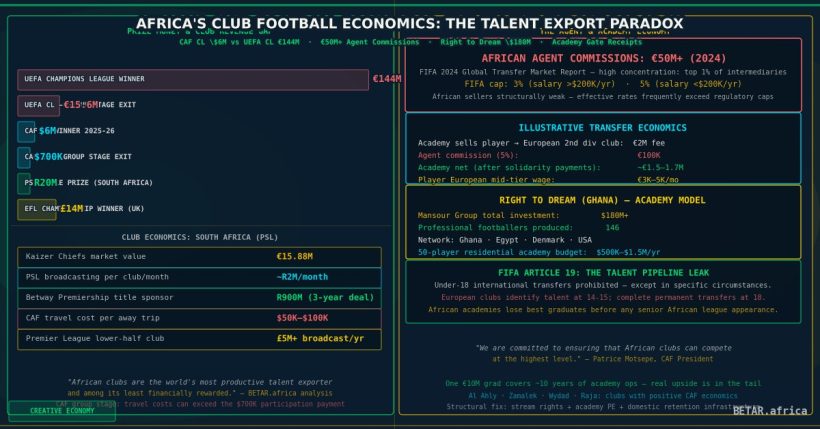
Kaizer Chiefs is the most commercially successful football club in South Africa and one of the strongest brands in African football. Its estimated market value — approximately €15.88 million according to Transfermarkt’s 2025 club valuations — would not cover a month of wages at a mid-table Premier League club. The comparison is not made to diminish what Kaizer Chiefs has built over five decades. It is made to frame the structural economic reality of African club football: extraordinary fan equity, compressed commercial infrastructure, and a revenue architecture that makes retention of homegrown talent structurally irrational.
The Revenue Architecture
South Africa’s Betway Premiership is the most commercially developed football league on the continent. Its title sponsorship — a three-year deal with Betway worth approximately R900 million — sets the benchmark for African football commercial agreements, as reported by SportsPro and confirmed in PSL official communications. Broadcasting is handled by SuperSport, which airs all 240 Premiership matches live on DStv, Showmax, and, through a sub-licensing arrangement, the SABC. PSL financial disclosures and reporting in Soccer Laduma and BusinessDay Sport indicate clubs received central distributions of approximately R2 million per month — a figure that, even allowing for subsequent increases, makes broadcasting money a minor supplement rather than a revenue engine. By comparison, a club finishing in the English Championship’s lower half receives broadcasting distributions of approximately £5 million per season, per EFL published financial distributions data — more than double a top PSL club’s estimated annual central payment.
Match-day economics in the PSL are similarly constrained. FNB Stadium has a capacity of 94,736 — the largest in Africa — but consistently sells out only for marquee fixtures and international matches. Regular Premiership attendance averages are well below capacity for most clubs outside the Soweto derby. Gate receipts cover operating costs at best; they do not generate the match-day surpluses that fund Premier League clubs’ player wage bills.
The Betway Premiership title winner receives R20 million in prize money. The winner of the English Championship receives a base payment of approximately £14 million before promotion bonuses. The gap is instructive.
Where PSL clubs are beginning to find commercial leverage is in merchandise. Kaizer Chiefs’ renewed partnership with Kappa in 2023 generated significant kit sales volume: Kappa South Africa’s public communications at the time of the deal’s announcement cited its status as the largest apparel partnership in South African club football by commercial reach, with retail distribution through over 500 outlets nationally. Independent industry estimates cited in Soccer Laduma in 2024 put first-year combined retail volumes in the multi-hundred-million rand range — though the club has not published audited kit revenue figures. Orlando Pirates’ Betway shirt sponsorship and Mamelodi Sundowns’ corporate backing from the Motsepe family represent South Africa’s highest tier of commercial exposure. For clubs in Nigeria’s Premier Football League or Kenya’s Premier League, these revenue lines are structurally smaller: lower broadcast distributions, smaller attendance revenues, and thinner sponsorship markets.
The Agent Economy
The economics of player transfers — and the intermediaries who broker them — represent one of the least transparent financial flows in African football.
Mike Makaab, the founder of ProSport International and one of South Africa’s most prominent licensed FIFA intermediaries — credited with having placed the first South African player in a top-five European league — describes the mechanics plainly: “In any football transfer, the three major entities are the selling club, the player and the purchasing club. All the agent is, is an intermediary between the three.” That structural simplicity conceals considerable complexity in practice.
FIFA’s Football Agent Regulations, revised in 2023, cap agent service fees at 3 percent of a player’s gross salary where annual remuneration exceeds $200,000, and at 5 percent for players earning below that threshold. In practice, FIFA’s own intermediary transparency data — published in the 2024 Global Transfer Market Report — documents that effective commission rates across all markets frequently exceed the regulatory caps, particularly where multiple agents are layered across jurisdictions. For African-to-European transfers, where sellers operate from a position of commercial weakness, FIFA’s report notes that the distribution of agent earnings is highly concentrated: the top 1 percent of intermediaries globally capture a disproportionate share of total commissions.
African intermediaries collectively earned over €50 million in transfer commissions across all markets in 2024, according to FIFA’s Global Transfer Market Report 2024 — a figure that reflects both the volume of African talent moving to European leagues and the margin structure of deals that clubs and players on the selling side often accept from a position of commercial weakness.
A representative illustrative deal: an African academy produces a player sold to a European second-division club for €2 million. At a 5 percent intermediary rate, the agent earns €100,000. The academy, after paying residual training compensation and any solidarity payments mandated by FIFA’s transfer regulations, retains perhaps €1.5 to €1.7 million — and the player, on a contract worth €3,000 to €5,000 per month at a mid-tier European club, earns multiples of what any African club could offer in wages. The commercial logic of emigration is embedded in the transaction structure itself.
The Academy Model: Africa’s Most Rational Creative Export Asset
If any element of African club football economics merits serious investor attention, it is the football academy as an infrastructure asset.
Right to Dream, founded in Ghana in 1999 by Tom Vernon and acquired by the Mansour Group in 2021, is the clearest case study. At the time of acquisition, Vernon described the model in an interview with SportsPro: “The theory was always that if you can identify talent early enough, educate them properly, and integrate them into a pathway to professional football, the economics work — for the player, for the community, and ultimately for the investors.” The Mansour Group has invested over $180 million into the Right to Dream network — including €15 million in Ghana alone — building a multi-club, multi-academy structure spanning Ghana, Egypt (FC Masar), Denmark (FC Nordsjælland), and the United States (San Diego FC). Right to Dream has produced 146 professional footballers since inception, alongside education scholarships for players who do not advance to professional contracts.
The economics of running a residential academy at scale are significant. Based on BETAR.africa’s analysis of comparable residential academy budgets across published accounts from West and East African programmes — including Diambars (Senegal), Right to Dream (Ghana), and St. George (Ethiopia) — a 50-player residential programme covering accommodation, nutrition, coaching, education, and medical support costs an estimated $500,000 to $1.5 million per year, depending on facility quality, staff mix, and country-level input costs. If that programme produces one €1 million transfer every 18 months — a conservative outcome for a well-run academy — the return on operating expenditure is positive but modest. The real upside is in the tail: one academy graduate who becomes a €10 million player covers the operating costs of a decade of programme investment.
Diambars in Senegal takes a contrasting approach: a foundation-backed model with NGO and development finance support, prioritising education-sport integration over transfer-fee optimisation. Ajax Cape Town’s academy — historically one of South Africa’s most productive — demonstrates the European club ownership model, where player development serves the parent club’s scouting strategy as much as it does local market development.
The commercial problem across all models is FIFA Article 19, which prohibits international player transfers for players under 18, except in specific circumstances. Europe’s academies use this window aggressively: scouts identify African talent at 14 or 15, initiate relationships through development agreements, and complete permanent transfers the moment the player crosses the age threshold. African academies lose their best graduates — and the associated transfer fees — to European clubs before those players ever appear in a senior African league.
CAF Champions League: The Prize Gap
The CAF Champions League provides continental club competition with prize money that has increased significantly in recent years. The 2024-25 winner received $4 million — rising to $6 million for the 2025-26 season under CAF’s revised prize structure, announced officially by CAF at the 2024 CAF Extraordinary Congress. CAF President Patrice Motsepe stated at that Congress: “We are committed to ensuring that African clubs can compete at the highest level, and that starts with making sure the economics of African football are sustainable for our clubs.” Runner-up clubs earn $2 million; semi-finalists $1.2 million; clubs exiting at the quarter-final stage receive $900,000, while group stage exits earn $700,000 regardless of finishing position within the group.
Against those figures, the UEFA Champions League winner PSG received approximately €144 million for its 2024-25 campaign, per UEFA’s official club coefficient and prize distribution announcement — a comparison that situates the CAF prize pool in its commercial context. More immediately relevant is the cost side: a Nigerian club travelling to play a CAF group stage away fixture in Morocco or Egypt incurs charter flight, hotel, and logistics costs that can reach $50,000 to $100,000 per trip — a material fraction of the $700,000 group stage participation payment for clubs that do not advance.
For many African clubs, CAF competition generates net negative economics at the group stage. The participation payment does not fully cover travel and logistics; player insurance and camp preparation add further costs. The clubs that extract positive economics from the competition are those that advance to the knockout rounds — and those are typically the well-capitalised operations in Egypt (Al Ahly, Zamalek) and Morocco (Wydad, Raja) with infrastructure built for continental competition.
The Commercial Horizon
African club football’s financial structure is not broken — it is nascent. The conditions that constrain it today (shallow broadcast markets, limited match-day infrastructure, thin sponsorship ecosystems) are the same conditions that constrained European football in the 1980s before satellite television and commercialisation transformed the revenue model.
The trajectory is clear: streaming penetration is rising, and rights deals are beginning to reflect competitive pressure for African football content. The academy model — particularly the private equity-backed multi-club approach demonstrated by Right to Dream — is proving that African talent development can be institutionalised and capitalised at scale. The structural challenge is that the clubs producing the talent are not yet the entities capturing the full financial value of what they develop. Until African club football builds the commercial infrastructure to retain and monetise its best players domestically, the continent will remain the world’s most productive football talent exporter — and among its least financially rewarded.
BETAR.africa covers the business of Africa’s creative and knowledge economies. This article is part of our ongoing Creative Economy series.
Named sources: Tom Vernon, co-founder of Right to Dream (SportsPro interview, 2022); Mike Makaab, founder, ProSport International (Nounouche, October 2024); Patrice Motsepe, CAF President (CAF Extraordinary Congress 2024, official CAF media release).
Sources: Kaizer Chiefs market valuation (Transfermarkt, January 2025); Betway Premiership title sponsorship value (SportsPro; PSL official communications); PSL central broadcasting distributions c.R2M/month (Soccer Laduma; BusinessDay Sport, 2019/20 PSL financial period reporting); Kappa Kaizer Chiefs partnership reach (Kappa South Africa announcement, 2023; Soccer Laduma industry estimates, 2024); EFL Championship broadcasting distributions (EFL financial distributions data, 2024-25 season); FNB Stadium capacity (FIFA venue records); FIFA Football Agent Regulations 2023 (fifa.com); FIFA Global Transfer Market Report 2024 — African intermediary earnings €50M; Right to Dream investment figures and professional players produced (Mansour Group official announcements; SportsPro; Right to Dream official communications); Academy operating cost estimate ($500K–$1.5M): BETAR.africa analysis based on published accounts of Diambars (Senegal), Right to Dream (Ghana), and St. George Academy (Ethiopia) programme costs; CAF Champions League 2024–25 and 2025–26 prize money structure (CAF official announcements); UEFA Champions League 2024-25 prize distributions (UEFA official club coefficient prize distribution announcement); African club CAF travel cost estimates (BETAR.africa analysis based on charter flight market rates and logistics data).


 UphivaBETAR
 Joseph Busari