
In South Africa, a regulatory obligation underpins the local television production industry: the Independent Communications Authority of South Africa (ICASA) mandates that SABC carries a minimum of 55% local content across its main channels, and that commercial free-to-air broadcaster e.tv maintains 35%. The quota is not a cultural policy footnote. It is a guaranteed purchasing commitment that has created a production industry of several hundred companies, from major integrated studios to one-person director-producer operations filming reality content on single-day shoots.
The economics of that industry — what broadcasters actually pay, what producers earn, and how the system adapts to streaming competition — have never been systematically reported.
The Broadcaster Commissioning Fee
South Africa’s commissioning market has a well-established hierarchy that tracks broadcaster revenue and regulatory obligation.
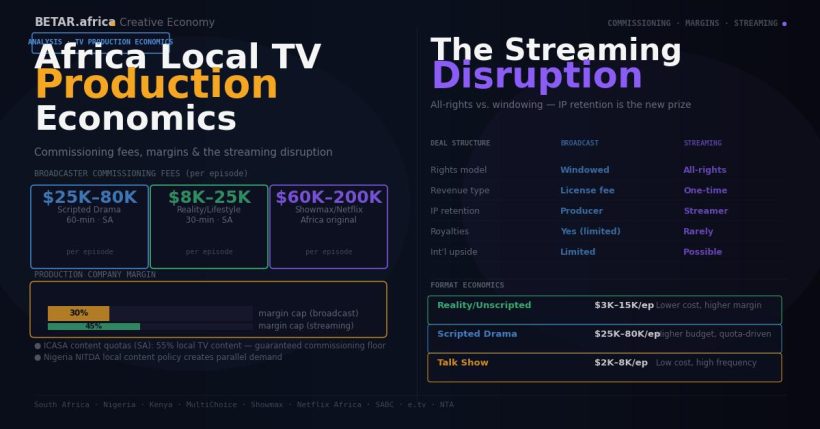
At the SABC tier, per-episode commissioning rates for locally produced content have historically lagged behind actual production cost inflation. As reported in Screen Africa — the trade publication that tracks South African production industry economics — SABC’s commissioning fees for daily drama/telenovela productions have sat in the range of R150,000–R350,000 per episode, depending on format, slot, and production house relationship. A 30-minute reality/lifestyle format attracts lower fees: R80,000–R200,000 per episode for SABC3 lifestyle commissions. The constraints are structural — SABC’s chronic financial difficulty has made it unable to increase commissioning rates at pace with the rand-denominated cost inflation that has driven up crew, equipment, and location costs since 2019.
e.tv, the commercial free-to-air alternative, commissions at broadly comparable rates. Its content budget is smaller than SABC’s by design — the network’s economics are driven by advertising revenue against a commercially focused programming slate — and producers report effective commissioning fees of R120,000–R250,000 per episode for scripted and reality formats respectively.
MultiChoice’s DStv channels represent the step-change in the market. MultiChoice’s FY2024 annual results reported a total content investment of over ZAR 6.5 billion across its African markets, the majority allocated to the South African market. Showmax — MultiChoice’s streaming platform — had been commissioning premium original drama at R2 million–R5 million per episode, budgets that allowed production companies to hire international-grade cast, crew, and post-production infrastructure. In March 2026, Canal+, which acquired MultiChoice in 2025, announced Showmax’s closure effective 30 April 2026, following cumulative losses estimated at R4.9 billion in the financial year ending March 2025. Content is migrating to DStv Stream. The closure removes the highest-spending local commissioning platform from the market.
Nomsa Philiso, CEO of general entertainment at MultiChoice, has signalled the broadcaster’s intent to maintain its commissioning volumes despite the streaming rationalisation. “Not commissioning is really not an option because of the impact it has on the value chain,” Philiso said, adding that MultiChoice was “not slashing the budgets.” She acknowledged the broader constraint: “Everybody is struggling because of the economy. There aren’t unlimited funds.”
The Production Company Margin
The structural problem for African production companies is the gap between commissioning fee and actual production cost.
A 30-minute reality episode commissioned by SABC3 at R150,000 costs roughly R120,000–R140,000 to produce at minimum viable quality: crew day rates, equipment hire, talent fees, post-production, and delivery overheads. The production fee — the slice the production company retains after covering those costs — is typically 10–15% of total budget, by industry convention. At a R150,000 commissioning fee, that is a production margin of R15,000–R22,500 per episode. A 13-episode series generates between R195,000 and R292,500 in production profit before tax and overhead allocation.
Companies that survive in the South African market do so through volume — running multiple commissions simultaneously — or by building proprietary formats they can license internationally. The companies that graduate from survival to growth typically do so by securing a long-running daily drama slot (SABC’s Skeem Saam, e.tv’s Scandal!, DStv’s The River) that provides a 240-episode annual production baseline. Format licensing — selling a South African format to a Nigerian, Kenyan, or international broadcaster — adds a high-margin revenue stream above production income.
Marc Schwinges, a producer and chairperson of the Independent Producers’ Organisation (IPO) — the industry body representing South African independent production companies — describes the capital pressure as structural. “Our finance pools are quite finite and quite small,” Schwinges has said. “It is challenging to work within the framework of South African finance.” The challenge compounds when commissioning fees remain fixed while rand-denominated costs — crew rates, equipment, electricity — rise with inflation.
Netflix Africa and the Deal Structure Divide
Netflix’s entry into African original content commissioning has created a structurally different deal model at the premium tier — and the April 2026 closure of Showmax has left Netflix as the dominant premium streaming commissioner in the South African market.
Where traditional broadcast commissioning transfers all exploitation rights to the broadcaster in perpetuity for a single fee, Netflix Africa commissions tend to be structured as all-rights exclusive global agreements — the production company delivers the content, Netflix acquires global streaming rights, and the production company receives a premium commissioning fee that typically incorporates a margin above cost without any backend royalty participation. Industry reporting on Netflix Africa deals — covered in Screen Africa and the Hollywood Reporter‘s Africa coverage — indicates per-episode budgets for South African originals of R1 million–R4 million, with production company fees structured at roughly 15–20% above total production cost.
The economics therefore diverge: Netflix offers higher gross revenue per episode, but no participation in international licensing upside. A traditional broadcast model might offer lower per-episode fees but permit production companies to retain format rights and secondary market licensing. The choice between the two models depends on whether a production house is optimising for current cash flow or long-term IP value — and most South African production companies, operating under perpetual cash pressure, take the Netflix premium.
With Showmax’s exit, the streaming commissioning market in South Africa narrows sharply. Netflix Africa remains the sole major global streaming commissioner of local original content. Canal+, through DStv Stream, has indicated it will continue some local original commissioning, but the scale and fee structure of that commitment remain unclear at time of publication.
Dorothy Ghettuba, who led Netflix Africa’s original programming strategy from Lagos, articulated the platform’s local content logic in a public address in 2021: “We invest in stories that travel — stories that feel authentically local but resonate globally.” That framing — local authenticity at global scale — sets the production quality floor that Netflix’s higher budgets enable, and that traditional broadcasters cannot currently match.
Reality vs. Scripted: The Economics of Format Choice
The dominance of reality, lifestyle, and unscripted formats in African local television schedules is not an editorial preference — it is an economic inevitability.
A scripted 60-minute drama episode in South Africa requires a minimum crew of 40–60 people, multiple shooting days, location permissions, cast rehearsal time, and post-production colour grading, sound design, and visual effects. Realistic production cost for a high-quality 60-minute SA drama episode: R600,000–R2 million, depending on cast, locations, and post-production ambition. At a SABC commissioning rate of R250,000, that production is economically irrational.
A 30-minute reality/lifestyle episode — cooking, renovation, dating, travel — requires a crew of 8–15, one or two shooting days, and minimal post-production. Production cost: R80,000–R180,000. At a commissioning rate of R150,000, the margin is tight but achievable.
The ratio explains why SABC’s schedule is heavy with lifestyle, reality, and talk formats, and why scripted drama is concentrated at the DStv/Netflix tier — where budgets are large enough to make it rational.
Nigeria, Kenya and the Commissioning Gap
Outside South Africa, local TV commissioning economics are fundamentally different.
Nigeria’s NTA (Nigeria Television Authority) operates with a commissioning budget that is a fraction of SABC’s, constrained by federal government funding and chronic infrastructure underinvestment. In practice, NTA’s local content pipeline is largely driven by co-production and revenue-share arrangements — production companies fund their own content and negotiate time slots in exchange for advertising revenue participation, rather than receiving a commissioning fee. MultiChoice Nigeria’s Africa Magic channel is the most commercially significant commissioner of local Nigerian drama, with per-episode budgets that track Nollywood’s post-streaming cost inflation: $10,000–$50,000 per episode for Africa Magic premium drama, significantly below what Nigerian production companies can access via Netflix.
Kenya’s private broadcaster market — KTN, NTV, Citizen TV — commissions local content on constrained budgets. Local drama production in Kenya typically operates at KSh 500,000–KSh 2 million per episode depending on broadcaster and format, with production companies absorbing thin margins to maintain broadcaster relationships.
The Content Quota as Commercial Floor
ICASA’s content quotas create a guaranteed demand floor that is uniquely South African. No comparable regulatory enforcement exists in Nigeria or Kenya at the same level of specificity. The quota ensures that regardless of streaming competition, South African broadcasters are legally required to commission a minimum volume of local content — providing a structural demand guarantee that production companies in other African markets lack.
The commercial ceiling nonetheless moved upward with streaming competition. As Netflix and Showmax competed for premium South African content through 2022–2025, the top end of the production market was lifted in ways the quota system alone could never achieve. With Showmax’s exit, that competitive dynamic is diminished. The result is a market at an inflection point: the high-volume, low-margin quota-driven broadcast tier remains structurally intact; the high-budget streaming tier now rests on Netflix alone. The gap between the two — wide enough before Showmax closed — has grown wider.
BETAR.africa covers the business of Africa’s creative and knowledge economies. This article is part of our ongoing Creative Economy series.
Sources: ICASA local content quota requirements (ICASA Broadcasting Regulations); SABC commissioning fee benchmarks (Screen Africa industry reporting; South African parliamentary portfolio committee on communications); e.tv commissioning rates (Screen Africa; industry producer surveys); MultiChoice/DStv FY2024 content investment ZAR 6.5B+ (MultiChoice Group Annual Report 2024); Showmax original drama per-episode budgets and closure (Screen Africa; Bloomberg, 5 March 2026; Broadcast Media Africa, 20 March 2026; Showmax trading losses R4.9B, MultiChoice FY2025 interim results); Nomsa Philiso quotes on commissioning (Variety, 2025; South African production industry rebate crisis coverage); Marc Schwinges quotes on production finance (Variety, 2025 — “South African Filmmakers Sound Alarm Over Rebate Crisis”); Netflix Africa deal structure and budget ranges (Hollywood Reporter Africa coverage; Screen Africa industry analysis); Dorothy Ghettuba quote (Netflix Africa public address on local content strategy, 2021); NTA/Nigeria commissioning model (Screen Africa Nigeria coverage; Nollywood industry reporting); Africa Magic per-episode commissioning estimates (Nollywood industry press; BETAR.africa analysis); Kenya local TV production per-episode costs (BETAR.africa analysis based on KTN, NTV, Citizen TV production house market data); production company margin conventions (Screen Africa; industry standard 10–15% production fee model); NAB data on local content budget allocation (National Association of Broadcasters South Africa).
Related Coverage
Creative Economy series: Pan-African Streaming Platform Wars: Revenue Economics | Africa Cinema Exhibition Economy: Box Office Splits and the Streaming Threat | What It Actually Costs to Make an African Music Video

 UphivaBETAR