
Kenya Has the Greenest Grid in Sub-Saharan Africa. Why Is Its Electricity Among the Most Unaffordable?
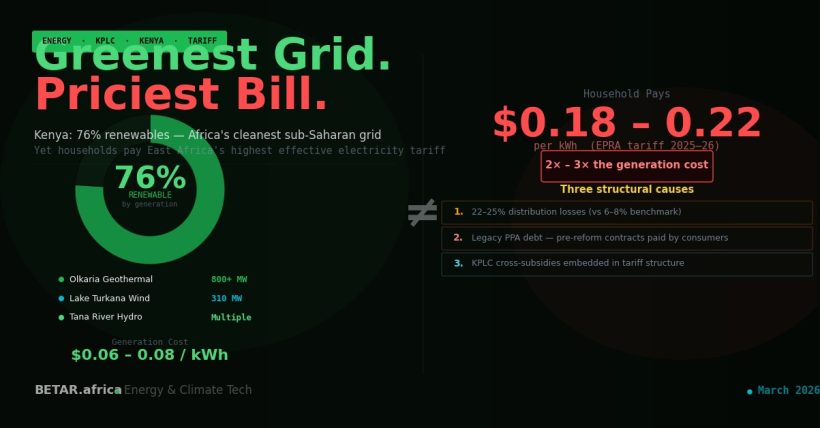
The country generates 76 per cent of its electricity from renewables — much of it from some of the cheapest geothermal energy on the planet. Yet the effective household tariff is two to three times the generation cost. The gap is not a mystery. It is a policy and infrastructure problem that Africa’s climate finance community has mostly failed to address.
The Olkaria geothermal complex, strung along the eastern wall of the Great Rift Valley southwest of Nairobi, produces electricity at a levelised cost of $0.06 to $0.08 per kilowatt-hour. It is among the cheapest baseload power on the African continent, generated by heat drawn from magma chambers that have been building pressure for tens of millions of years. KenGen, the state generation company, has been drilling into this resource since the 1980s. The most recent phase, Olkaria V, added 158 megawatts of capacity in 2019. The system now exceeds 800 megawatts of installed geothermal generation.
Layered on top of this are Lake Turkana Wind Power’s 310 megawatts in Marsabit County — Africa’s largest wind farm — and a hydroelectric system spread across the Tana River basin, the Ewaso Ng’iro watershed, and the country’s western highlands. The grid mix Kenya presented to its energy regulator in the most recent EPRA tariff determination was 76 per cent renewable by generation volume.
And yet a Kenyan household on the cheapest domestic tariff band — consuming between 0 and 100 kilowatt-hours per month — pays an effective retail rate of approximately KSh 25 to 28 per unit, which translates to $0.18 to $0.22 per kilowatt-hour at current exchange rates. That is two to three times the cost of generating the power. It is also among the highest effective electricity retail prices in East Africa, higher than Uganda, Rwanda, and Tanzania on a like-for-like household basis.
This is not a contradiction in Kenya’s energy policy. It is the entirely predictable result of three structural problems that are embedded in the country’s electricity sector — and that Africa’s climate finance community has consistently overlooked in its enthusiasm for generation-side investment.
The First Problem: Distribution Losses That Consumers Pay
Kenya Power and Lighting Company (KPLC), the state distribution monopoly, carries between 22 and 25 per cent of electrical energy as losses through its distribution network. This figure — drawn from KPLC’s annual reports for the 2023–24 financial year — represents electricity that is generated, transmitted to the distribution network, and then lost to degraded infrastructure, illegal connections, or billing failures before it reaches a paying customer.
In a well-functioning distribution system, the international benchmark for technical losses runs between 6 and 8 per cent. Commercial losses — representing unbilled consumption from theft or meter tampering — add perhaps another 2 to 4 per cent in the best-governed utilities. Kenya’s combined loss rate of 22 to 25 per cent is therefore roughly three times what would be expected from a utility operating modern infrastructure.
The economic mechanism that translates those losses into higher tariffs is direct: the cost of lost units does not disappear. KPLC pays generation companies for the electricity it purchases. When that electricity is lost in distribution, the cost falls entirely on paying customers through the tariff. A utility with 25 per cent losses must charge paying customers proportionally more to recover the same total cost base. The EPRA tariff determination formula allows KPLC to recover its costs — including the cost of unrecovered losses — through the regulated tariff. Households are, in effect, paying for electricity they never receive.
KPLC has been under management scrutiny, government intervention, and reform pressure for over a decade without resolving this structural problem. The distribution network requires sustained capital investment in metering infrastructure, underground cabling in theft-prone urban areas, and technical upgrading of rural transformer networks. Those investments are capital-intensive and slow to produce returns — precisely the characteristics that make them difficult to finance under the regulatory regime that governs KPLC.
The Second Problem: Thermal PPAs That Will Not Go Away
During the power deficits of the early 2000s, Kenya contracted emergency power purchase agreements with independent power producers running diesel generators and heavy fuel oil plants. These plants were expensive to run — diesel generation in the $0.25 to $0.35 per kilowatt-hour range — but they could be built quickly and delivered electricity to an under-powered grid within months of contract signature. At the time, the alternative was load-shedding measured in hours per day.
Those thermal PPAs are structured as take-or-pay contracts. KPLC pays a capacity charge — a fixed monthly payment — regardless of how much electricity it actually dispatches from the plant. The capacity charge covers the investor’s capital cost recovery and return. When geothermal and wind came online and Kenya found itself with surplus baseload capacity, the thermal plants were progressively pushed to the margin of dispatch. But the capacity charges remained in the cost stack.
The result is a tariff structure that embeds two generations of power sector investment simultaneously: cheap geothermal at the base, expensive thermal capacity that sits underutilised but must still be paid for. Consumers pay for both. The Kenya Electricity Sector Investment Prospectus 2024 update acknowledged this legacy thermal burden as a material component of the retail tariff, without providing a specific disaggregated figure. Independent power sector analysts estimate that stranded thermal capacity charges account for between 15 and 25 per cent of KPLC’s effective bulk supply cost — a range that would add roughly $0.03 to $0.05 per kilowatt-hour to the retail tariff above what the renewable generation cost alone would imply.
The contractual unwinding of these PPAs is constrained. Renegotiating take-or-pay contracts with private investors requires either payment of termination sums or agreement to restructure the contract terms — both of which require KPLC and the government to absorb near-term financial costs in exchange for long-term tariff relief. Kenya’s fiscal position, shaped by a high public debt-to-GDP ratio and the terms of its 2024 IMF programme, limits the government’s capacity to absorb those costs.
The Third Problem: The Revenue That Never Arrived
KPLC’s 2023–24 annual report disclosed receivables from government ministries and state institutions that had accumulated to a significant multiple of the utility’s monthly billing cycle. Government entities — hospitals, schools, water utilities, security services — consume electricity and pay slowly or incompletely. Ministry budget allocations for electricity are chronically below actual consumption. The arrears compound over fiscal years.
This creates a second revenue gap distinct from distribution losses: electricity that was metered, billed, and attributed to a paying customer, but never actually collected. The gap compresses KPLC’s cash position and creates pressure on its ability to service its own debt obligations to KenGen and independent power producers — which in turn creates a payment chain problem upstream through the sector.
Kenya’s National Treasury has intervened periodically with settlement payments to KPLC for government ministry arrears. But the structural mechanism — whereby government institutions are billed but not allocated adequate electricity budgets — has not been fixed at the root. The result is a semi-permanent subsidy from KPLC to the government of Kenya, funded by cross-subsidy from paying private customers whose tariff must be set high enough to sustain the utility’s overall cost recovery.
What EPRA Can and Cannot Fix
The Energy and Petroleum Regulatory Authority conducts a quarterly adjustment of the electricity tariff, revising components that reflect fuel costs, foreign exchange movements, and the inflation adjustment factor. The quarterly review is genuinely transparent by regional standards — EPRA publishes the calculation methodology — and it does allow Kenya’s tariff to respond to inputs that change in real time.
What the quarterly adjustment cannot do is address the structural components of the tariff gap. Distribution losses cannot be adjusted away — they require capital investment. Stranded thermal capacity charges cannot be adjusted away — they are embedded in contracts. Government receivables cannot be adjusted away — they require fiscal reform. EPRA’s tariff determination methodology allows KPLC to recover its costs; it does not create an incentive structure that rewards loss reduction or penalises poor collection.
Kenya has been discussing distribution network reform — a ring-fencing of KPLC’s retail and distribution functions, and a possible restructuring of the vertically integrated utility — for several years. The Energy Act 2019 created the regulatory architecture for unbundling the sector. Implementation has been incremental. The political economy of reforming a large state utility with tens of thousands of employees and significant political patronage embedded in its procurement and staffing decisions has, as in other countries, moved more slowly than the legislation contemplated.
The Lesson for Africa’s Climate Finance Community
Kenya is the continent’s most instructive test case for what happens after the generation problem is solved. It has done almost everything right on generation: decades of deliberate geothermal investment, a well-structured wind farm in a resource-rich corridor, a hydroelectric base that predates independence. The International Energy Agency’s 2025 Africa Energy Outlook cited Kenya as a regional model for renewable energy deployment.
And yet the electricity it generates is not affordable to a substantial fraction of the households connected to its grid, and remains out of reach for the estimated 30 per cent of Kenyans who remain without access. The affordability constraint is a distribution and governance problem, not a generation problem.
This distinction matters because of how Africa’s climate finance community currently allocates its attention. The International Finance Corporation, the African Development Bank, the Green Climate Fund, and bilateral development finance institutions collectively track and report on megawatts installed and gigawatt-hours of clean energy generated. These are generation-side metrics. They do not capture distribution losses, retail affordability, collection rates, or the cost stack embedded in legacy thermal PPAs. The EIB’s Mission 300 initiative — targeting 300 million new electricity connections by 2030 — has begun to acknowledge last-mile delivery gaps, but the financing architecture still skews heavily toward generation-side investments.
Kenya’s experience is an argument for treating distribution reform as an equal investment priority to generation expansion. The continent’s target of universal electricity access cannot be reached by building more power plants if the systems that move electricity from plant to household are absorbing a quarter of what is generated, charging tariffs calibrated to recover the cost of that waste, and failing to collect reliably from the customers who are billed.
The climate finance community counts gigawatts. It should also be counting kilowatt-hours delivered, billed, and paid. The gap between those two numbers is where the energy access story in Africa will be won or lost — and Kenya, right now, is losing it.


 UphivaBETAR
 Joseph Busari