
BMW’s Rosslyn plant makes the X3, including a plug-in hybrid variant. Ford assembles a hybrid Ranger in Pretoria. Toyota builds the Corolla Cross HEV in Durban. Volkswagen Group Africa’s leadership has stated it will not produce EVs in South Africa until at least 2035. The incentive, signed into law by President Cyril Ramaphosa on December 24, 2024 (Taxation Laws Amendment Bill), applies exclusively to battery electric and hydrogen vehicle production — not hybrids. The National Association of Automobile Manufacturers of South Africa (Naamsa) has formally called for the incentive to be extended to hybrid manufacturing upgrades.
The policy is not aimed at the manufacturers South Africa already has. It is aimed at the manufacturers it is trying to attract.
The Arithmetic of a $500M Bet
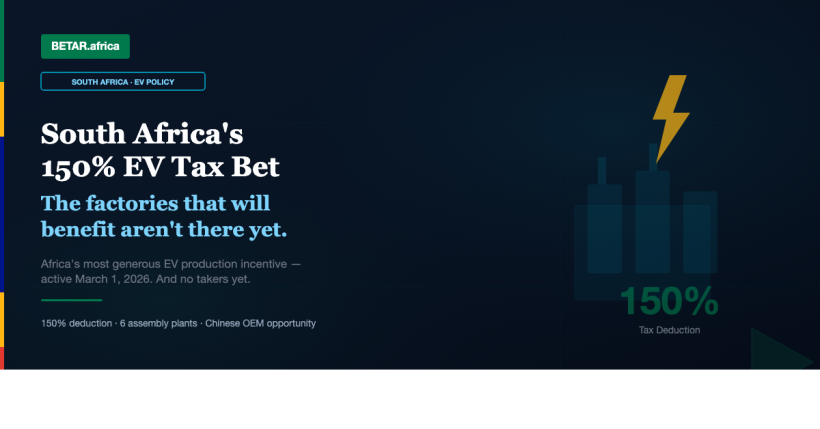
The structure of the deduction is straightforward: invest in qualifying plant, machinery, or buildings used to produce EVs or hydrogen vehicles, and deduct 150% of that cost from taxable income. Assets brought into use between March 1, 2026 and February 28, 2036 qualify.
For a manufacturer making a $500 million factory investment decision — roughly R9 billion at current exchange rates — the incentive produces the following:
| Scenario | Investment (R) | Deduction (R) | Tax saved at 27% | Benefit over standard |
|---|---|---|---|---|
| Standard 100% deduction | R9B | R9B | R2.43B | — |
| 150% EV incentive | R9B | R13.5B | R3.65B | +R1.22B (~$64M) |
In practical terms: a Chinese OEM building a greenfield EV assembly plant in Gauteng or the Eastern Cape would reduce tax liability by an additional $64 million on a $500M investment compared to what normal depreciation would deliver. On a R30 billion ($1.6B) factory — the scale Gotion is investing in Morocco — the additional benefit approaches R4 billion.
An anti-abuse provision applies a 50% recoupment if qualifying assets are disposed of within five years, preventing short-term tax arbitrage without genuine production commitment.
The fiscal cost to the South African Treasury is estimated at R500 million in 2026/27. That number will scale with actual investment.
The Eskom Complication
Before any Chinese OEM runs that calculation, there is a grid question that sits upstream of it.
South Africa’s power system has improved dramatically since 2023. Eskom entered 2026 with 287 consecutive days without an unplanned supply interruption — a genuine turnaround from the era of Stage 6 load shedding. The energy availability factor reached 65.24% for the 2025–26 financial year. For the first time in over a decade, industrial investors are not being handed a rolling blackout schedule as part of their feasibility assessment.
But South Africa’s own 2023 Electric Vehicles White Paper projects that the national grid will need an additional 5 terawatt-hours of electricity capacity by 2034 to accommodate EV growth. A large-scale EV manufacturing facility adds industrial demand before a single vehicle reaches a charger. The Eskom recovery is real; the structural adequacy question for an EV industrial buildout remains open.
The workaround is self-generation. South Africa’s Electricity Regulation Amendment Act allows industrial users to generate their own power without a licence. BMW South Africa and Mercedes-Benz have both invested in on-site solar. A Chinese OEM could design around grid risk entirely — at capital cost that partially offsets the deduction’s benefit.
Four Markets Competing for the Same Money
South Africa is not the only destination pitching for Chinese EV FDI. Between 2014 and 2025, Chinese EV and battery manufacturers invested $143 billion in overseas production capacity. Three other markets have built structured incentive packages to capture it.
| Market | Key incentive | Trade access | EV production status |
|---|---|---|---|
| South Africa | 150% tax deduction on EV factory investment (10 years) | AGOA (US, limited); no EU FTA | None yet; first domestic EV ~2026 |
| Thailand | ≤150,000 baht (~$4,400) subsidy per EV sold; reduced import duties | ASEAN FTAs | BYD, GWM, SAIC plants operational |
| Indonesia | VAT cut 11%→1% on EVs with 40%+ local content; import duty waiver | ASEAN FTAs | Conditioned on production from 2026 |
| Morocco | Gotion $6.3B gigafactory; EU and US FTAs for duty-free export | EU Association Agreement; US FTA | Gotion gigafactory under construction |
The contrast with Morocco is particularly pointed. In 2025, Morocco overtook South Africa as Africa’s largest vehicle producer — 1,000,000 units against South Africa’s 597,000 — partly through a deliberate nearshoring strategy for European markets. Morocco’s local content already exceeds 60%; South Africa’s stands at 39.1%, with a target of 60% by 2035. Morocco’s free trade agreements with the EU and the United States mean that EV components manufactured there can reach Europe duty-free. South Africa’s AGOA access to the US covers automotive, but rules-of-origin requirements for EV battery content are not yet settled.
Thailand and Indonesia’s incentives are also structurally different from South Africa’s. Both combine supply-side incentives (factory support) with demand-side measures (consumer subsidies, VAT cuts). South Africa’s deduction subsidises production capacity but does not reduce the price of the resulting vehicle for South African buyers, who still face a 25% EV import duty — higher than the 18% duty on conventional vehicles.
What the Existing OEM Base Means — and Doesn’t
South Africa’s comparative advantage in this race is its installed manufacturing infrastructure. The country has six OEM assembly operations, a deep tier-1 supplier base, a trained automotive workforce, and port infrastructure at Durban and Port Elizabeth calibrated for vehicle export. No greenfield market — not Morocco, not Indonesia — can replicate that starting point.
“The South African automotive sector remains a key anchor industry for manufacturing and job creation,” Trade and Industry Minister Parks Tau said as the incentive took effect. His framing was defensive as much as promotional, responding directly to concerns about Nissan’s Rosslyn plant.
The issue is conversion. South Africa’s existing OEM infrastructure was built around internal combustion engines. Converting those plants to EV production — or replacing them with purpose-built EV factories — is a decade-long capital decision. The 150% deduction makes greenfield EV investment more attractive. It does not solve the legacy transition problem for the manufacturers already there.
The bet South Africa is making is that its industrial infrastructure will attract Chinese OEMs willing to build alongside the legacy base, not through it. Three Chinese automakers with NDAs in place and $27 billion in headline investment discussions suggest that bet is not unreasonable. Whether those discussions convert to groundbreaking depends on whether the grid holds, whether trade architecture improves, and whether the South African government can close the local content gap that Morocco has already opened.


 UphivaBETAR
 Joseph Busari