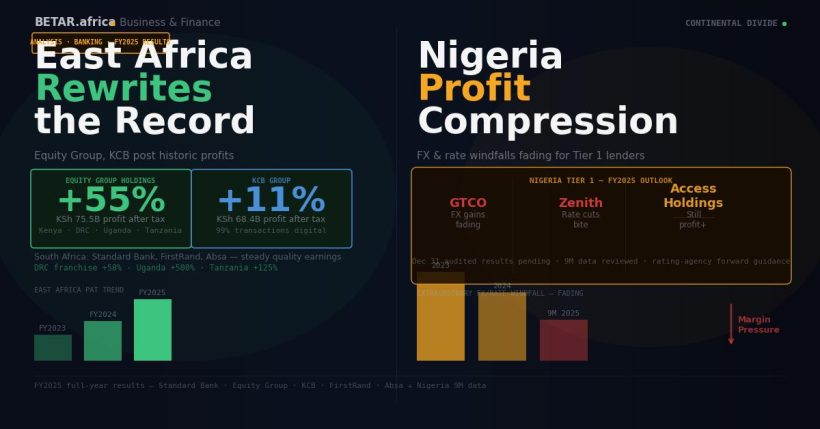

Africa’s 2025 full-year bank results season is exposing a continental divide that no composite headline figure can paper over. East African lenders are reporting record profits, buoyed by currency stabilisation, digital banking momentum, and regional diversification. South African banks are producing steady, high-quality earnings. Nigeria’s major lenders, still tallying their December 31 audited numbers, are heading into a profit compression cycle — not because their businesses are broken, but because the extraordinary FX and interest-rate windfalls of 2023-24 are fading. The continent’s banking sector is, in short, entering a more honest phase.
BETAR examined four confirmed full-year results sets — Standard Bank Group, Equity Group Holdings, KCB Group, and FirstRand — alongside nine-month data for Nigeria’s Tier 1 lenders and rating-agency forward guidance to construct the most comprehensive cross-continental read of the season.
East Africa: Record Books Rewritten
Equity Group Holdings produced the headline result of the season and arguably the most striking profit figure in Kenyan corporate history. Profit after tax surged 55 percent to KSh 75.5 billion in 2025, up from KSh 48.8 billion a year earlier, on total income of KSh 217.7 billion — a 12 percent gain. Net interest income climbed 17 percent to KSh 126.9 billion. The group’s balance sheet topped KSh 1.97 trillion.
The scale of the regional story is what sets Equity apart. Subsidiaries outside Kenya now account for roughly half of group profitability. The DRC franchise — the bank’s most strategically significant bet — grew profit after tax 58 percent to KSh 24.7 billion. Uganda surged 500 percent to KSh 3.6 billion as a prior-year restructuring reversed. Tanzania was up 125 percent.
“We have built a genuine pan-African bank, not a Kenyan bank with regional offices,” Group CEO James Mwangi said at the results presentation. The dividend proposal of KSh 5.75 per share — up 35 percent — underlines management’s confidence.
KCB Group posted a more measured but still impressive performance, with net profit rising 11 percent to KSh 68.4 billion on revenues of KSh 214 billion. The headline contains an important structural footnote: KCB divested National Bank of Kenya during 2025 and still expanded total assets 9.3 percent to KSh 2.15 trillion. Customer loans grew 15 percent to KSh 1.59 trillion. Pre-provision operating profit growth was the real story — KCB’s cost discipline improved meaningfully.
A milestone buried in the results deserves its own mention: digital channels now handle 99 percent of all KCB transactions. This is not the vanity statistic of a bank counting USSD top-ups; it reflects genuine migration of high-value commercial transactions onto mobile and internet platforms. KCB Group CEO Paul Russo framed it plainly: “The branch is no longer the primary point of service. Our investment is now in reliability and feature depth on digital rails.”
Gross NPLs fell from KSh 225.7 billion to KSh 211.8 billion, a positive signal in an environment where provisioning pressure has been building across the continent.
Southern Africa: Quality Earnings at Scale
Standard Bank Group reported headline earnings of R49.2 billion for the year ended December 31, 2025 — an 11 percent increase and a new group record. Return on equity reached 19.3 percent, landing at the top of the Group’s 17–20 percent target corridor. The credit loss ratio improved to 73 basis points, trending toward the bottom of its 70–100 basis-point through-the-cycle range.
The Africa Regions franchise — Standard Bank’s 20-market business outside South Africa — contributed R19.7 billion in headline earnings, representing 40 percent of the group total. South Africa generated R24.9 billion (51 percent). This split matters strategically: Standard Bank is generating nearly as much from a collection of mostly smaller markets as from its home base, the most developed financial system on the continent.
Group Chief Executive Sim Tshabalala described the result as evidence of “the strength of our diversified African platform,” pointing specifically to the Africa Regions contribution. “The consistency of our performance across multiple markets and business lines demonstrates that our strategy is working,” Tshabalala said at the results presentation.
Corporate and Investment Banking grew earnings 18 percent with ROE exceeding 22 percent. Insurance and Asset Management grew 26 percent. The weaker segment was Business and Commercial Banking, which grew just 4 percent as SME credit quality remained uneven.
FirstRand (whose fiscal year runs to June 30) reported earnings up 10 percent for FY2025, with ROE improving to 20.2 percent. The headline was penalised by approximately R3 billion in provisions related to the UK motor finance commission investigation — which the group largely insulated from its African operations. Stripping that out, the underlying business grew 14 percent. FNB’s deposit base crossed R1 trillion during the year. The Africa franchise (outside South Africa) grew profit before tax 5 percent, or 8 percent in constant currency, with weaker performance in Botswana and Mozambique partially offsetting strong gains elsewhere.
Nigeria: The Normalisation Squeeze
Nigeria’s Tier 1 banks — Zenith Bank, Access Holdings, and Guaranty Trust Holding Company — had not yet filed FY2025 full-year audited results with the Nigerian Exchange Group at the time of publication. This article will be updated when those figures land; the sector’s tradition of March filing makes an early April completion of this analysis realistic.
What nine-month data reveals, however, is directionally clear — and confirmed by independent ratings analysis.
Zenith Bank’s gross earnings grew 16 percent through the nine months ended September 2025 to ₦3.37 trillion. But profit after tax fell 8 percent to ₦764 billion. The spread tells the story: revenue is still growing, but cost of funds, provisioning, and operating expenses are growing faster. Access Holdings saw a similar dynamic at the half-year mark, with gross earnings at ₦2.5 trillion (+14 percent year-on-year) but profit before tax declining to ₦320.6 billion from ₦348.9 billion.
S&P Global Ratings has characterised this as a deliberate sector “normalisation,” noting that Nigerian banking return on equity — which reached an exceptional estimated 25 percent in 2024, turbocharged by FX revaluation gains as the naira floated — is on a trajectory toward 20–23 percent in 2026. “The previous two years rewarded banks for balance sheet positioning, not operational excellence,” one ratings analyst noted in published commentary. “The 2025 cycle separates the efficient operators from those who benefited from the macro tailwind.”
NPL dynamics add texture. The Central Bank of Nigeria’s December 2025 Macroeconomic Outlook shows the sector’s NPL ratio approached 7 percent in 2025, above the 5 percent prudential threshold, driven by foreign-currency-linked loans — roughly half of most Nigerian bank loan books — that swelled in naira terms as the currency declined. That same CBN review suggested some stabilisation, but provisioning costs will remain elevated into 2026.
The Fintech Pressure Test: Who Is Winning the Payments War?
Every bank’s management team was asked variants of the same question this results season: are you ceding the payments economy to MTN MoMo, M-Pesa, OPay, and their ilk?
The honest answer is: it depends on market and segment. MTN’s MoMo platform processed $2.1 billion in international remittances across 14 African markets in the first half of 2025 alone, and its merchant network of over 2 million operators processed $9.9 billion in transaction value over the same period. That is volume that would once have flowed through bank branches.
But the banks are not standing still. KCB’s 99 percent digital transaction rate is the clearest evidence that established lenders can migrate to digital rails at scale. Equity’s integration of fintech-style products — real-time payments, agency banking, insurance in app — has made the distinction between “bank” and “fintech” largely academic for East African retail customers. Standard Bank’s move into embedded finance via platform partnerships is an explicit acknowledgement that the payments battleground has moved to the merchant economy.
The real test is lending. Mobile money providers can capture transactions; banks still control credit allocation, at scale, for SMEs and larger corporates. For now, that remains the moat.
Key Metrics Comparison: FY2025
| Bank | Net Profit | YoY Growth | ROE | NPL Trend |
|---|---|---|---|---|
| Equity Group Holdings | KSh 75.5bn | +55% | Record high | Stable |
| KCB Group | KSh 68.4bn | +11% | n/a | Improving |
| Standard Bank Group | R49.2bn headline | +11% | 19.3% | 73bps CLR (improved) |
| FirstRand (FY June 2025) | Earnings +10% | +10% | 20.2% | Stable |
| Zenith Bank* | 9M PAT: ₦764bn | -8% (9M) | ~20–22%* | Rising (FX-linked) |
| Access Holdings* | H1 PBT: ₦320.6bn | -8% (H1) | ~18–20%* | Rising (FX-linked) |
*Nine-month or half-year data; FY2025 audited full-year results pending NGX filing. ROE estimates from S&P Global analysis.
Outlook: Three Things to Watch
Currency stabilisation will determine Nigerian recovery. If the naira holds its current range through Q1 2026, provisioning costs should stabilise and the FY2025 audited figures will likely show PAT declines of 10–15 percent for major lenders — painful but manageable. Further depreciation reopens the provisioning cycle.
East Africa expansion is the structural story of the decade. Equity’s DRC bet is now visibly paying off. KCB’s divestiture of NBK — a dragging asset — shows discipline about where capital is deployed. The EAC banking bloc is coalescing into a group of genuinely continental lenders.
Net interest margins will thin as rates fall. Every central bank on the continent that hiked aggressively in 2023–24 is now in, or approaching, an easing cycle. Banks that built fee income, digital revenue, and insurance streams — Standard Bank’s IAM division, Equity’s non-funded income line — will be better insulated than those that rode the NIM wave.
The 2025 results season will be remembered not as the year African banking hit a wall, but as the year it completed a bifurcation that has been building since 2022: a lean, digitally-confident East African and Southern African cohort pulling away from a Nigerian banking sector that must now earn the hard way.
BETAR will publish an updated table incorporating Zenith Bank, Access Holdings, and GTCO full-year 2025 figures when filed with the NGX, expected by early April 2026.
Sources: Standard Bank Group FY2025 Results (standardbank.com); Equity Group Holdings FY2025 Results (equitygroupholdings.com); KCB Group FY2025 Results (kcbgroup.com); FirstRand FY2025 Results (firstrand.co.za); S&P Global Ratings Nigerian banking sector commentary; Zenith Bank Q3 2025 Interim Report (NGX); Access Holdings H1 2025 Interim Report (NGX); MTN MoMo H1 2025 Operational Data (mtn.com); Central Bank of Nigeria Macroeconomic Outlook December 2025.
— Business Reporter, BETAR.africa

 UphivaBETAR


 Joseph Busari