
Africa Clean Energy Finance Q1 2026: $8B Quarter, Commercial Bank Breakout, and the Structural Shift Rewriting the Investment Map
More than $8 billion in committed capital. A 255MW solar plant financed by a commercial bank without any DFI co-lender. A $200M infrastructure manager’s first dedicated climate-transition fund. As Q1 2026 closes, Africa’s energy investment landscape looks structurally different from twelve months ago — and the deals that explain why are not being read together.
Three months into 2026, Africa’s clean energy finance market has done something it has not done before: it has simultaneously scaled at the multilateral level, broken through at the commercial bank level, and attracted specialist VC capital into climate technology — all within a single quarter. The deals are individually significant. Taken together, they describe a structural shift in how Africa’s energy transition is being financed.
BETAR.africa has covered each of the major Q1 2026 transactions individually. This piece reads them as a single investment cohort: more than $8 billion in committed capital across project finance closings, bilateral pledges, fund first-closes, and manufacturing investments — the most active clean energy finance quarter on the continent on record. The question is not what each deal means on its own. It is what they mean together, and whether the structural signals they carry will survive the test of execution.
The Multilateral Floor Holds — and Moves Upstream
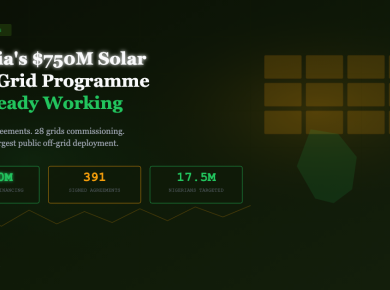
The clearest signal from Q1 2026 is that development finance institutions are not retreating from Africa’s energy transition. They are repositioning. The headline evidence is Nigeria’s Distributed Access through Renewable Energy Scale-Up programme — DARES — a $750 million International Development Association credit from the World Bank, now fully operational. As of early 2026, the programme has 391 active mini-grid grant agreements with eight private developers, with 28 new solar mini-grids commissioning in this quarter alone. Total committed capital across the full programme, including $100 million from the Global Energy Alliance for People and Planet and $200 million from JICA, exceeds $1 billion before private co-investment is counted.
DARES is the clearest articulation of where multilateral capital is going: into early-stage, high-risk, low-return electricity access markets where commercial banks will not go without significant de-risking. Nigeria’s 90 million unelectrified citizens are not a bankable addressable market by commercial lending standards. The World Bank’s performance-based grant model — disbursements only after verified customer connections, not construction milestones — is precisely the kind of instrument that development finance was built for.
At the other end of the capital stack, the European Investment Bank’s EUR 1 billion Mission 300 commitment — announced this quarter — confirms that multilateral capital is scaling to match the ambition of the continent’s electrification gap. Mission 300, the World Bank and African Development Bank initiative targeting electricity access for 300 million Africans by 2030, is now backed by the continent’s largest development finance pledge from a single European institution. The EIB is bringing its balance sheet to a programme that requires sustained long-term capital at concessional rates — the precise instrument class that Africa’s private capital markets cannot replicate at scale.
The pattern is deliberate: DFIs are consolidating in markets where commercial capital is absent or insufficient — rural electrification, grid-constrained frontier markets, early-stage access programmes — while pulling back from transactions where their presence is no longer the deciding factor. South Africa’s mature renewable energy market is the demonstration case.
The Commercial Bank Breakout
The signal event of Q1 2026 is Standard Bank’s sole underwriting of the $240 million Lyra Energy Thakadu solar project. The 255MW plant in South Africa’s North West Province reached financial close in March 2026. There is no IFC, no DBSA, no AFD, no JICA. Standard Bank took the full ~$192 million senior debt position on its own commercial underwriting, against private-sector offtake agreements — not a government utility PPA. Thakadu is not a REIPPPP Round 6 deal. It is a purely commercial transaction, financed by a commercial bank, with private industrial buyers as the counterparties.
The significance is precise: Thakadu demonstrates that large-scale private solar in South Africa has crossed a bankability threshold that no longer requires development finance participation. Standard Bank does not need a first-loss position or guarantee structure to lend $192 million at project-finance terms for a 255MW solar plant with credible private offtake. That is a structural change, not a transaction anomaly.
SolarAfrica’s SunCentral 2 adds a second data point. The 114MW solar plant, financed at R1.5 billion ($94 million) by Rand Merchant Bank and Investec, closed in February 2026. Like Thakadu, the commercial bank debt here is not backstopped by a development lender — RMB and Investec co-lent against SolarAfrica’s wheeling model, in which multiple commercial and industrial customers source power at up to 50 percent below Eskom tariffs through the national grid. SolarAfrica even built and donated a 2GW transmission substation to Eskom to enable the wheeling infrastructure.
SOLA Group’s Naos-1, which reached financial close in February 2026, is the most complex transaction of the quarter. The project delivers 300MW of solar generation combined with 660MWh of battery energy storage — South Africa’s first utility-scale solar+BESS project purpose-built for industrial wheeling. The financing structure includes DBSA as lead lender alongside Absa, Nedbank, Rand Merchant Bank, and Investec as commercial co-lenders. This is a blended model — DBSA’s development mandate sits alongside four commercial banks that brought their own balance sheets to the transaction. The BESS component required lenders to price in battery degradation risk over a long project-finance tenor. The fact that four commercial lenders did so, at scale, for an industrial-wheeling structure with Sasol and Air Liquide as off-takers, is the signal.
Three commercial bank project-finance closings in a single quarter — in two distinct financing structures (pure commercial and DFI-blended) — is not coincidence. South Africa’s private power market has passed a threshold.
Climate VC and the Fund Layer
Below the project-finance tier, Q1 2026 also produced three significant fund closings that indicate institutional capital building a sustained climate investment infrastructure — not just chasing individual transactions.
African Infrastructure Investment Managers reached a first close of $65 million on the $200 million African Transition Acceleration Fund. ATAF is AIIM’s first dedicated energy-transition vehicle — a meaningful signal from Africa’s most experienced infrastructure manager. FSD Africa Investments and Allied Climate Partners committed $50 million in catalytic tranche capital to anchor the close; Proparco, the IFC, and KfW co-invested at the senior equity level. ATAF will invest across clean electrons, sustainable transport, and clean industrial molecules — the mandate that African infrastructure finance has historically left to DFI balance sheets alone.
Persistent reached a first close of $52 million on its Africa Climate Venture Fund, targeting $70 million total. The LP roster — JICA, the Soros Economic Development Fund, the Nordic Development Fund, and FSD Africa Investments — is notable for its institutional depth at the seed and pre-seed stage: precisely the tier where most institutional capital refuses to operate. Persistent pairs early capital with a $5 million venture-building facility. In a market where most climate startups fail not from bad ideas but from insufficient operational support, that distinction matters.
Sistema.bio’s $53 million FarmCarbon first close, backed by BNP Paribas Asset Management, British International Investment, and the Shell Foundation, introduces a third structure: carbon credit monetisation as the financing mechanism for clean energy deployment at the smallholder level. FarmCarbon pre-finances biodigesters for African farmers — deploying clean cooking and energy infrastructure — and captures the carbon credits separately. The inversion of the standard carbon project model, where communities generate the environmental value but developers capture the financial return, is the structural proposition the LP roster is underwriting.
Beyond Generation: Manufacturing and Clean Fuel Export Bets
Two Q1 2026 transactions go beyond energy generation finance entirely and describe what Africa’s longer-term clean energy industrial ambition looks like — or might look like, if execution holds.
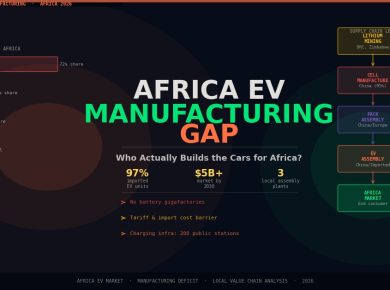
Morocco’s $5.6 billion Gotion battery gigafactory in Kenitra is Africa’s largest single clean-energy manufacturing investment. It is not an energy generation project — it is a bet that Africa can sit inside the global battery supply chain as a manufacturer, not just as a minerals exporter. The strategic logic is sound: Morocco controls phosphate reserves that are critical for lithium iron phosphate battery chemistry, has free trade agreements with the European Union and the United States, and has spent a decade building the renewable energy generation capacity to offer competitive green industrial electricity tariffs. The question is execution at scale, and the timeline — production beginning before 2030 — is ambitious.
Namibia’s Hyphen Energy project is the continent’s highest-profile green hydrogen play. The $4.4 billion project, targeting green ammonia export to European markets, moved a step closer to a final investment decision this quarter after the African Development Bank’s $10 million SEFA grant to fund the Front-End Engineering Design phase. SEFA is not project finance — it is catalytic de-risking capital designed to close the gap between project feasibility and bankable FID. AfDB and its partners are betting that completing FEED removes enough uncertainty to attract the commercial debt and equity the Hyphen project will need at construction stage.
The Gap That $8 Billion Does Not Close
Against the volume of Q1 2026, one number provides the necessary corrective: Africa needs approximately $50 billion per year in clean energy investment to hit its climate and electrification targets by 2030. The quarter’s $8 billion in committed capital — including fund targets, pledges, and project finance closings — represents roughly four months of what is required on an annual basis, delivered across a single quarter. That is progress. It is not enough.
The gap is not evenly distributed. South Africa’s private power market is demonstrating commercial bankability at utility scale. Nigeria’s energy access challenge is being addressed through DFI-backed grant programmes at the distributed end. But the markets between those poles — Kenya, Ghana, Egypt, Ethiopia, Côte d’Ivoire — remain structurally dependent on blended finance structures that require DFI participation to unlock commercial co-lending. Africa’s green bond premium, which forces African issuers to pay yields six times higher than European equivalents for comparable credit quality, makes purely domestic financing systematically more expensive than underlying project risk warrants.
The South Africa JETP, which has grown to a $10 billion pledge from international partners, illustrates the disbursement problem at the other end. Pledges are not capital. The gap between what has been committed to South Africa’s coal transition and what has actually been disbursed — against specific project milestones and policy conditions — remains significant heading into COP30 in Belem. JETP’s architecture of bilateral commitments, multilateral pledges, and mobilised private finance is not a single fund that can be audited against a disbursement ledger. It is a coalition of intentions, some of which have been retracted (the US withdrew in February 2025), some of which have been scaled up (Germany increased its commitment by roughly 50 percent), and most of which remain conditional on South African policy delivery that is still in progress.
Q1 2026 shows that the volume of capital committed to Africa’s energy transition is real and growing. It also shows where that capital concentrates: in mature markets with existing frameworks, in proven asset classes with track records, and in DFI-backed programmes that use development capital to de-risk the access markets that commercial banks will not serve directly. The structural shift is underway. The financing gap is large enough that the shift, at current pace, will not close it.


 UphivaBETAR