
Africa’s education technology sector raised no major equity rounds in Q1 2026 as development finance replaced venture capital. The companies that are surviving have found a different path — and it looks nothing like the EdTech investment narrative of 2021.
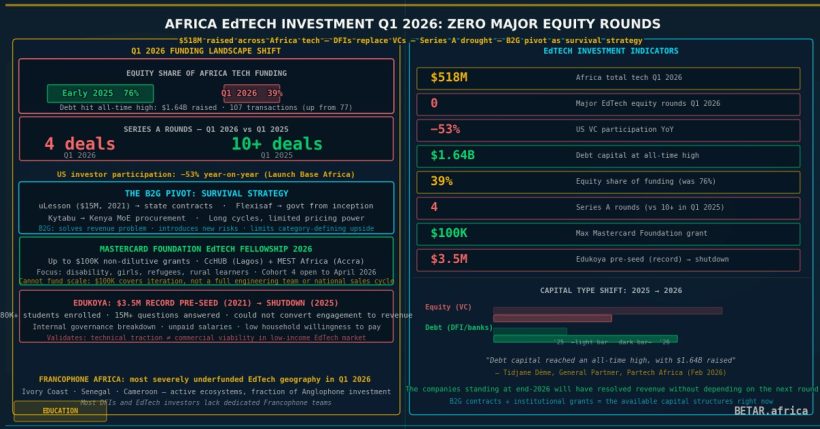
Africa’s technology sector raised approximately $518 million in Q1 2026 — and almost none of it went to education technology in the conventional sense. That is not a verdict on EdTech’s potential. It is a verdict on who is deploying capital in Africa right now, and what they are looking for when they do.
BETAR’s Q1 2026 Africa Tech Funding Tracker, covering 35 verified deals across nine countries through mid-March, records zero major EdTech equity rounds in the quarter. The sector’s absence from the headline deal table is not an anomaly — it reflects structural changes in the funding landscape that will define how African EdTech companies survive, pivot, or fail through the rest of 2026.
The DFI Shift: What It Means for EdTech
The single largest transformation in African startup funding over the past 12 months is the substitution of venture capital with development finance. In early 2025, equity accounted for approximately 76 percent of total Africa tech funding. In Q1 2026, that figure has fallen to roughly 39 percent. The difference is development finance institutions — DFIs — who have expanded their footprint as US venture capital has retreated. US investor participation in African deals fell by approximately 53 percent year-on-year, according to analysis by Launch Base Africa.
For fintech and clean energy, this substitution has been manageable. Infrastructure-scale DFI debt is purpose-built for sectors with asset-heavy balance sheets and predictable revenue models. For EdTech, the picture is more complicated.
“Debt capital reached an all-time high, with US$1.64B raised, and the number of debt transactions went from 77 to 107 deals,” noted Tidjane Dème, General Partner at Partech Africa, in the firm’s February 2026 annual report on African technology venture. The report documented stabilising equity markets at Series A and B — but the EdTech sector, operating at the early growth stage, sits in the Series A band that remains most severely undersupplied on the continent.
Series A rounds in Q1 2026 across all sectors number four — compared to more than ten in the same period last year. Early-stage EdTech companies targeting that band will find it largely empty.
What Capital Is Moving: The Fellowship Economy
The capital that is moving into African EdTech in Q1 2026 is predominantly institutional and equity-free. The Mastercard Foundation EdTech Fellowship 2026, delivered through a network of partners including CcHUB in Lagos and MEST Africa in Accra, offers cohorts of early-stage EdTech startups up to $100,000 in non-dilutive grant funding alongside mentorship, market access, and investor connections. A fourth cohort is accepting applications through April 2026.
The fellowship targets founders building for systematically underserved learners: learners with disabilities, girls and women, refugee populations, and rural communities where mainstream EdTech platforms have not penetrated. This focus reflects a deliberate strategic choice by the Mastercard Foundation, which has emerged as the most active institutional funder of early-stage African EdTech in the absence of traditional venture capital.
What the fellowship economy cannot provide is the growth capital that takes a product from proof of concept to scale. The $100,000 grant funds iteration and market testing; it does not fund a full-time engineering team, content localisation across five languages, or a national school system sales cycle. That is the funding gap that African EdTech founders in 2026 are navigating without a reliable market solution.
The B2G Pivot: Survival Strategy or Structural Transformation?
The most consequential strategic response to the funding contraction is the business-to-government (B2G) pivot. Where EdTech companies once oriented their models around direct-to-consumer subscriptions or business-to-business corporate training, a growing cohort is targeting government procurement as the most reliable revenue source in markets where household purchasing power constrains consumer spending.
uLesson, which raised $15 million in 2021, has expanded its government partnership model into state-level contracts in Nigeria, positioning its digital learning platform as a supplementary resource within public school systems. Flexisaf, the Abuja-based education technology company, built its model on direct government contracts from inception — a decision that placed it against the grain of the venture-backed consumer EdTech consensus but has proved resilient in the current environment. Kytabu, the Nairobi-based platform, has pursued Ministry of Education procurement channels in Kenya as the primary route to scale, given the difficulty of building a sustainable consumer subscription model in a market where household willingness to pay for education software remains constrained.
The B2G model addresses the revenue problem. It introduces a different set of challenges: procurement cycles are long, government budgets are subject to the same austerity pressures as university funding, and the companies that win government contracts become, in effect, quasi-utilities with limited pricing power. The model works as survival. Whether it produces the category-defining companies that early EdTech investors imagined is a different question.
The Startup Graveyard
The broader structural environment is producing EdTech casualties alongside the pivots. Edukoya, the Nigerian edtech startup that raised a record $3.5 million pre-seed in 2021, shut down operations in early 2025 — despite enrolling more than 80,000 students and facilitating over 15 million answered questions on its platform. The company struggled to convert engagement into a sustainable revenue model, faced internal governance breakdowns including unpaid salaries, and ultimately could not survive the combination of a contracting funding environment and the structural limits of consumer EdTech in a low-willingness-to-pay market.
Edukoya’s trajectory — impressive early metrics, significant early-stage capital, followed by shutdown — is a case study in the gap between EdTech’s technical potential and its commercial constraints in the African context. It is not an isolated story. Across the sector, companies that raised in 2020 and 2021 at peak valuations are entering their runway end-dates in 2026 without the Series A rounds those valuations implied.
Geographic Fault Lines
African EdTech investment is geographically uneven in ways that mirror the broader funding landscape — but with important differences. Nigeria leads by deal count in overall African tech but has produced the most prominent EdTech failures. Kenya has a deeper EdTech ecosystem by company age and diversity but faces the same Series A vacuum as the rest of the continent. South Africa’s EdTech sector is largely invisible in the Q1 data — a function of the market’s relatively stronger university system, higher consumer income levels, and a startup scene that concentrates heavily on fintech.
Francophone Africa is the most significantly under-funded geography. Ivory Coast, Senegal, and Cameroon have active EdTech communities but receive a fraction of the investment flowing to Anglophone markets. The absence of Francophone-focused EdTech in the Q1 2026 deal data is structural, not accidental: most active EdTech investors and DFIs do not have dedicated Francophone teams, and the CcHUB-Mastercard Foundation partnership is only now expanding its fellowship programme with explicit cross-Africa ambitions.
What Q2 Signals
The funding environment for African EdTech will not materially improve in Q2 2026. The structural conditions — US VC retreat, DFI capital oriented toward infrastructure rather than software, Series A drought, low household willingness to pay — are not quarterly fluctuations. They are the landscape.
The companies that will be standing at the end of 2026 are the ones that have resolved the revenue question without depending on the next equity round to fund the search. B2G contracts, institutional partnerships, and non-dilutive grant funding through programmes like the Mastercard Foundation Fellowship are not the exciting capital structures that EdTech founders imagined. They are, right now, the available ones.
Sources: BETAR Q1 2026 Africa Tech Funding Tracker (35 verified deals, nine countries, through mid-March 2026); Launch Base Africa, “African Startup Funding in Early 2026,” 2 March 2026; Partech Africa, Africa Tech Venture Report 2025, February 2026 (Tidjane Dème, General Partner); Mastercard Foundation EdTech Fellowship 2026 programme documentation; BETAR “Africa AI Skills Gap 2026” (BETA-494); BETAR “Africa Bootcamp Economy” (BETA-634).

 UphivaBETAR


 Joseph Busari