
Africa’s Battery Gap: How Grid-Scale Storage Becomes the Missing Layer in the Solar Buildout
In 2017, Africa had 31 megawatt-hours of grid-scale battery storage. By 2024, that figure had grown to 1,600 MWh — with a single South African facility accounting for more than 70% of it. Battery energy storage is finally commercially viable on the continent. The question is whether that viability spreads beyond one market.
In 2017, Africa had an estimated 31 megawatt-hours of grid-scale battery storage installed. That number, sourced from IRENA’s energy storage data, sounds like a rounding error. It essentially was. The entire continent’s grid-scale storage capacity could have powered a small industrial facility for a few hours.
By 2024, that figure had reached approximately 1,600 MWh — a fifty-fold increase over seven years. The growth curve is impressive. The concentration is not: South Africa now accounts for roughly 86% of Africa’s operational grid-scale battery energy storage. And within South Africa, one project — Scatec’s Kenhardt facility in the Northern Cape, a 540MW solar plant paired with 1,140MWh of battery storage — holds more capacity than the entire continent had built over the previous seven years combined.
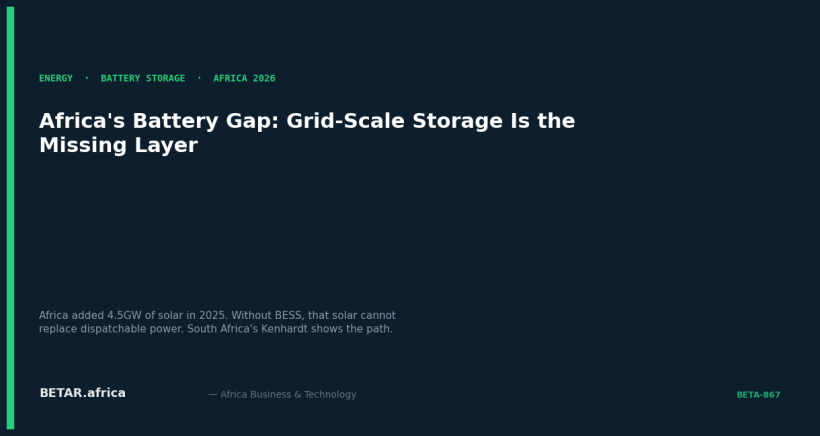
Africa added an estimated 4.5 gigawatts of solar generating capacity in 2025, according to BloombergNEF’s Africa energy data. That solar buildout is real and accelerating. But solar without storage is intermittent power, not dispatchable power. It cannot replace the coal plants or diesel generators that still underpin grid reliability across most of the continent. Battery Energy Storage Systems — BESS — are the infrastructure layer that turns solar installations into firm capacity. That layer is just beginning to materialise in Africa, and understanding why it has taken this long illuminates both the opportunity and the constraint.
Three Structural Shifts Making BESS Commercially Viable
The BESS market has reached an inflection point in Africa driven by three overlapping shifts: cost reduction, project finance precedent, and government procurement frameworks.
On cost: lithium iron phosphate (LFP) battery pack prices fell below $100 per kilowatt-hour in 2024 for the first time, according to BloombergNEF’s annual battery price survey. The $100/kWh threshold is widely treated in the project finance community as the level at which utility-scale BESS becomes competitive with peaker gas turbines on a levelised cost basis in markets with high solar irradiation. Sub-Saharan Africa, with some of the world’s highest solar resources, reaches that crossover point earlier than most regions.
On project finance precedent: the Kenhardt project established that South African commercial and development banks will underwrite large-scale BESS projects. The financing structure — combining Development Bank of Southern Africa (DBSA) and commercial bank debt with BESS as an integral project component, not an add-on — created a replicable template. The SOLA Group’s Naos-1 project (300MW solar / 660MWh BESS, Free State province), which reached financial close in Q1 2026 backed by DBSA, Absa, Nedbank, RMB, and Investec, demonstrated that the Kenhardt structure was not a one-off. See: BETA-759: SOLA Naos-1 Financial Close.
On procurement: South Africa’s Battery Energy Storage Independent Power Producer Procurement Programme (BESIPPPP) created the structured demand signal that the private sector needed to commit capital. BESIPPPP Window 3 awarded 612MW of battery storage for ZAR 9.5 billion (approximately $533 million), with commercial close targeted for January 2026 and commercial operation date January 2028, according to the Department of Mineral Resources and Energy (DMRE) announcement. Window 4 is expected to be substantially larger. The programme’s existence — a government-backed offtake mechanism — has de-risked development decisions in ways that no amount of technology cost reduction alone could achieve.
The combination of sub-$100/kWh LFP costs, a proven financing template, and an active procurement programme has compressed the South African BESS pipeline to approximately 11 gigawatt-hours of proposed capacity, comprising roughly four projects operational, seven under construction, and nineteen in development, based on CSIR and DMRE data. No other African market has a pipeline of remotely comparable depth.
Beyond South Africa: The Pipeline Markets
The near-term BESS expansion beyond South Africa is concentrated in three markets: Egypt, Kenya, and — on a longer timeline — Nigeria’s commercial and industrial (C&I) segment.
In Egypt, AMEA Power’s Aswan project — a large-scale solar facility with integrated BESS backed by the International Finance Corporation — represents the most advanced non-South African grid-scale storage development on the continent. Egypt’s grid integration challenges (managing high penetration of variable renewables while maintaining frequency stability for a large industrial load) are precisely the use case where BESS provides highest value. Egypt’s 2026 renewable procurement rounds include storage components as mandatory specifications for projects above a certain capacity threshold. See: BETA-788: Egypt 1GW Solar Race.
In Kenya, Globeleq and Energy Storage Africa have announced a 120MW/480MWh BESS project for grid stabilisation. Kenya’s grid is already approximately 90% renewable (geothermal and hydro dominant), which means the storage use case is different from South Africa or Egypt — it is primarily frequency regulation and hydro reservoir management during dry seasons, rather than solar firming. That use case is commercially viable but requires a different procurement framework than South Africa’s BESIPPPP model.
In Nigeria, the immediate BESS opportunity is not grid-scale — it is the commercial and industrial segment, where diesel backup generator costs are estimated at approximately $14 billion per year by the IEA. At sub-$100/kWh LFP, solar-plus-storage systems have reached cost parity with diesel for C&I loads above about 50kW in most Nigerian urban markets. The C&I market does not require government procurement frameworks or DFI debt — it requires working capital for system integrators and finance products for end-users. That market is developing faster than the grid-scale segment.
The Binding Constraint: Procurement Architecture
The South African BESS trajectory is directly attributable to BESIPPPP. The absence of equivalent procurement frameworks in most other African markets explains most of the gap between South Africa’s pipeline and everyone else’s.
Without a structured government procurement mechanism, BESS projects face a chicken-and-egg problem: developers need revenue certainty to attract project finance; lenders need project finance track record to price risk; governments need project track record to design procurement specifications. South Africa escaped this trap because it had an existing IPP procurement architecture (the REIPPPP renewables programme) that could be extended to storage. Most African power markets lack equivalent institutional infrastructure.
The World Bank and AfDB are both developing standardised BESS procurement frameworks for frontier markets — Scaling Solar has introduced storage components, and the AfDB’s Mission 300 programme explicitly includes storage in its technical specifications. But translating procurement design into operational programme takes years, not months. The structural gap between South Africa and the rest of the continent is unlikely to close before 2028–2029 in the optimistic scenario.
Also relevant: the Lyra Energy Thakadu project in South Africa (255MW solar, Standard Bank solo underwriting) demonstrated that domestic commercial bank capital — without DFI participation — can now close energy storage-adjacent deals in the most advanced African market. That milestone matters because DFI capital is limited and conditionally priced; a fully commercial deal sets a different benchmark. See: BETA-608: Lyra Energy Thakadu.
What 2026 Will Show
Three milestones in 2026 will indicate whether Africa’s BESS market broadens beyond South Africa or remains a one-country story.
First, BESIPPPP Window 4. If South Africa proceeds with Window 4 procurement at scale (expected 1,500MW+), it will bring approximately $1 billion in BESS project finance to market and extend the technology learning curve to a second generation of projects. That scale effect matters for supply chain, financing templates, and the broader East and West Africa pipeline.
Second, East Africa procurement. If Kenya, Tanzania, or Ethiopia launch structured BESS procurement tenders — even at small scale — it signals that the institutional preconditions for storage development are forming outside South Africa. One BESIPPPP-equivalent in East Africa would be a structural market signal more significant than any individual project announcement.
Third, LFP price trajectory. If battery pack prices continue toward $80/kWh by end-2026 (the BNEF base case), the C&I payback period in Nigeria, Ghana, and Kenya reaches three to four years for many applications — the threshold at which private sector financing without government support becomes standard. At that price point, the BESS market de-risks itself without requiring procurement architecture. South Africa needed BESIPPPP because costs were not yet there. The rest of Africa may not need to replicate that model if LFP costs decline on the current trajectory.
The 31 MWh figure from 2017 is a useful baseline precisely because of how small it is. Africa is not starting from zero on battery storage. It is starting from near zero — which means the growth rate ahead is less constrained by existing infrastructure than almost any other energy technology deployment on the continent.
— Energy & Climate Tech Reporter, BETAR.africa

 UphivaBETAR