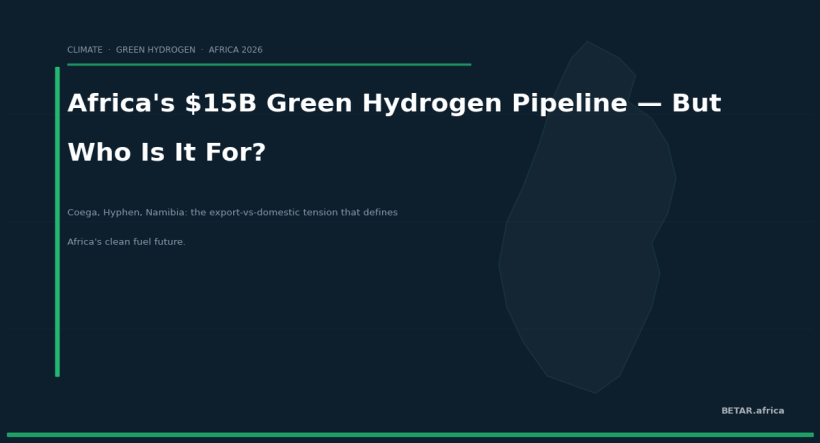

Africa’s Green Hydrogen Moment: $15B in Projects, But Who Are They For?
Three major green hydrogen projects in South Africa, Namibia, and Mauritania are targeting 2026 as their milestone year. The continent that hosts some of the world’s cheapest renewables is well-positioned to become a major clean hydrogen exporter. Whether that positioning serves Africa’s own energy transition is a different — and harder — question.
Africa is about to produce its first commercial-scale green hydrogen. Three major projects — in South Africa, Namibia, and Mauritania — are targeting 2026 as their milestone year. Financial closes are imminent. The first molecules are coming.
The continent hosting some of the world’s cheapest renewable energy is well-positioned to become a major clean hydrogen exporter. Whether that positioning serves Africa’s own energy transition is a different — and harder — question.
What Is Actually Being Built
The Coega Green Ammonia Project, led by Hive Hydrogen South Africa and situated near Nelson Mandela Bay in the Eastern Cape, is the most advanced. It proposes a 1.2 gigawatt electrolyzer — one of the largest in the world — powered by 3.5 gigawatts of dedicated solar and wind energy. Financial close is targeted for late 2026, with commercial operations expected around 2029. Annual output: approximately one million tonnes of green ammonia for export. The SA-H2 Fund has committed $20 million in catalytic capital to support development.
In Namibia, Hyphen Hydrogen Energy is further along on the development timeline. Its first phase — 2 gigawatts of electrolyzer capacity — has a price tag of $4.4 billion and was targeting initial production from 2026. The full project, stretching across a 4,000-square-kilometre site in the Tsau //Khaeb National Park in southern Namibia, could reach 3 gigawatts and $10 billion in total investment. The African Development Bank approved $10 million in catalytic capital to help advance the Namibia project.
In Mauritania, the NWSE (Nouvelle World Solar Energy) project is developing what would be one of the world’s largest renewable-powered green hydrogen facilities, targeting 30 gigawatts of renewables and 8 million tonnes of green hydrogen output at full build-out. The timelines are longer — production is not expected until well into the 2030s — but the ambition is indicative of where the continent’s resource endowment puts it.
The Africa Green Hydrogen Alliance, launched with backing from Morocco, Egypt, Mauritania, Namibia, Kenya, and South Africa, frames the opportunity in aggregate terms: up to 50 million tonnes of low-carbon hydrogen per year by 2035.
The Economics of Why Africa
Green hydrogen requires cheap renewable electricity. Electrolysis — splitting water into hydrogen and oxygen using electricity — is the main production process, and electricity accounts for 60–70 percent of the final cost. Africa’s solar irradiation, particularly across the Sahara, the Kalahari, and the Karoo, consistently ranks among the most cost-effective in the world.
The EU, Japan, and South Korea are running structural deficits in renewable energy relative to their decarbonisation commitments. They cannot cheaply produce green hydrogen domestically. Africa can.
That alignment of supply and demand has produced a specific kind of project: export-oriented, targeting European hydrogen import terminals, operating under long-term offtake agreements with European industrial buyers. Coega’s green ammonia is destined for European buyers. Hyphen’s output has been discussed in the context of European and Asian markets. These are not Africa energy transition projects by design. They are Africa-located global decarbonisation projects.
“There is a version of this story where Africa benefits enormously — through industrialisation, job creation, and energy system development,” said one climate finance professional who works on African project finance. “And there is a version where Africa is just a cheap renewable energy zone for European industry. Which version you get depends almost entirely on how the financing is structured and what conditions come with it.”
The Domestic Development Question
Africa’s energy access deficit is large. More than 600 million Africans lack reliable electricity. The continent’s industrial base — agriculture, manufacturing, mining — runs on expensive imported fossil fuels. Green hydrogen produced at scale could, in theory, address both: providing hydrogen as a feedstock for green fertilisers, displacing diesel in heavy industry, and enabling a domestic clean energy economy.
The reality of most current projects is more complicated.
Hyphen’s Namibia project sits in a protected national park. The project requires relocating indigenous communities. The electricity generated to power the electrolyzers will come from a dedicated renewable energy system — which will not be connected to Namibia’s national grid. The hydrogen produced will be piped to a coastal facility for export. Namibia will receive royalties, taxes, and jobs. But its energy system — Namibia faces chronic electricity shortages and imports power from South Africa — will not meaningfully change.
The Coega project is more promising on the domestic side. It is sited in a special economic zone already hosting industrial users. Green ammonia is a viable feedstock for South Africa’s agricultural sector, which currently imports significant volumes of nitrogen fertiliser. There is a plausible domestic demand story alongside the export one.
But the SA-H2 Fund, which provided catalytic capital, was established specifically to develop export-oriented projects.
What the African Development Bank Is Trying to Do
The AfDB has positioned itself as the primary multilateral trying to ensure that green hydrogen development on the continent builds domestic capacity, not just export pipelines.
Its $10 million commitment to the Namibia project came with conditions: local content requirements, job creation targets, and — critically — requirements that some hydrogen production be made available to Namibia’s domestic market at prices the domestic economy can absorb.
The bank has also been vocal in international forums about the risk of Africa becoming a “hydrogen colony” — exporting cheap clean energy while remaining dependent on expensive fossil fuels domestically. It has called for technology transfer requirements, local manufacturing content for electrolyzers and renewable equipment, and regulatory frameworks that protect domestic offtake rights.
Whether those conditions survive the commercial negotiations that accompany financial close is an open question.
The Financing Stack
Most Africa green hydrogen projects are structured as blended finance — catalytic public capital from development finance institutions, climate funds, and philanthropic sources de-risking equity and debt investment from private capital.
The SA-H2 Fund at Coega, the AfDB plus private equity at Hyphen, and the EU Global Gateway programme backing hydrogen platforms in both South Africa and Namibia represent the standard architecture: public money absorbs early-stage project risk, enabling private capital to commit once technical and regulatory risk has been reduced.
This structure has produced projects. It has also built in an inherent tension: private capital returns depend on offtake prices, which depend on export markets, which depend on European buyers willing to pay a premium for certified green molecules. The domestic market — where buyers may not be willing or able to pay export-market prices — risks being deprioritised at every step.
Allied Climate Partners and FSD Africa Investments, which together committed $50 million to anchor the AIIM African Transition Acceleration Fund, have explicitly committed that the fund will invest in “clean molecules” as one of three thematic areas — alongside clean electrons and sustainable transport. That structure, unlike most pure export hydrogen projects, is designed to target African energy system needs rather than European import demand.
The 2026 Inflection
For Africa’s green hydrogen sector, 2026 is not a symbolic milestone. It is the year financial closes are supposed to happen, construction is supposed to start, and — at Hyphen — initial production is supposed to begin.
If those milestones are hit, they will represent the most significant commercial validation yet that Africa can attract the multi-billion-dollar project finance needed to build energy transition infrastructure at scale.
If they slip — as large infrastructure projects across the continent frequently do — the export financing model will face legitimate questions about whether the risk/return calculus works even with catalytic capital support.
Either way, the projects under development now will set the template for what African green hydrogen looks like and who it serves. The decisions being made in 2026 about offtake structures, grid connectivity, domestic content requirements, and technology transfer terms will shape the continent’s hydrogen economy for decades.
The molecules will be green. Whether the development is — that is the story that has not yet been written.

 UphivaBETAR