
Africa’s Learning Poverty Crisis: The Foundation Beneath the Tech Skills Gap
The continent is investing in AI engineers, coding bootcamps, and digital skills. But most of that investment sits on a base of foundational illiteracy that is going unreported and unresolved.
March 2026
Every headline about Africa’s technology talent gap frames the problem at the wrong level. The shortage of AI engineers, the low throughput of STEM graduates, the completion rate crisis at coding bootcamps — these are real problems. They are also symptoms of a deeper structural failure that rarely appears in the investor decks or the continental strategy documents: Africa’s learning poverty crisis, which ensures that millions of young people arrive at the gate of the digital economy without the foundational literacy and numeracy required to enter it.
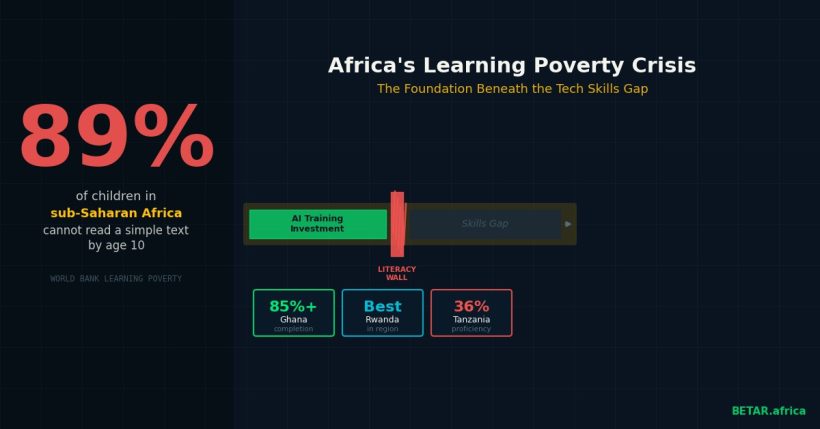
The World Bank defines learning poverty as the inability to read and understand a simple text by age 10. It is a deliberately blunt metric — the minimum bar for educational participation, not a measure of excellence. In sub-Saharan Africa, the learning poverty rate stood at 89 per cent in the most recent pre-COVID measurement period. That means nine out of every ten children reached the age of 10 unable to decode and comprehend a basic passage of text. COVID-19 school closures — the longest of which lasted 83 weeks in Uganda — pushed that figure higher in the years that followed. The World Bank estimates that COVID-era learning losses have set back human capital development across sub-Saharan Africa by the equivalent of three years of schooling, concentrated in the lowest-income countries where remote and digital learning substitutes were least available.
“Learning poverty is the most underdiscussed education crisis on the continent,” said Dr. Silvia Montoya, Director of the UNESCO Institute for Statistics, which tracks education data across Africa and publishes the annual Global Education Monitoring Report. “We have a tendency to measure access — enrolment, out-of-school numbers — because those are easier to count. But what we consistently find is that being in school and learning are not the same thing. The learning crisis is invisible in the enrolment data.”
What the Country Data Shows
The aggregate figure obscures important variation that shapes the realistic policy landscape. Ghana, Rwanda, and Tanzania illustrate three distinct trajectories — and three different starting points for any technology talent strategy.
Ghana has one of the continent’s higher primary school completion rates, consistently above 85 per cent in recent years, supported by a free senior high school policy introduced in 2017. Yet Early Grade Reading Assessment (EGRA) data conducted with Ghana Education Service support shows that a significant proportion of primary school completers leave with literacy levels below functional thresholds. The EGRA findings reveal that the bottleneck is less access than quality: children are completing primary school without consolidating foundational reading and numeracy skills, largely because teacher training has not kept pace with enrolment expansion and because the curriculum transition away from Ghanaian languages as mediums of instruction creates early literacy gaps that compound over time. Ghana’s technology sector — particularly its fintech and mobile money ecosystem, centred on Accra — has absorbed some of the continent’s best-performing graduates at the top of the pipeline. The depth of that pipeline remains thin.
Rwanda presents the continent’s most frequently cited success case, and the data partially supports that framing. The Rwanda Education Board’s investment in curriculum reform, competency-based learning, and ICT integration from lower secondary — supported by the Rwanda Coding Academy and mandatory computer science at secondary level — has produced measurably different outcomes at the top of the system. Uwezo’s East Africa learning assessments have consistently placed Rwanda ahead of regional peers on foundational literacy indicators, particularly at the primary level. The critical caveat, documented in BETAR’s girls in STEM coverage, is that Rwanda’s secondary-level gains have not fully translated into tertiary-level persistence, particularly for girls, and that the country’s model has succeeded partly because Rwanda’s scale — 14 million people — allows a level of centralised policy execution that is difficult to replicate across larger, more heterogeneous education systems.
Tanzania’s trajectory is more troubling. The country introduced free basic education in 2016, generating a sharp enrolment surge that significantly outpaced teacher supply and classroom infrastructure. EGRA data from Tanzania shows some of the continent’s most severe early reading gaps at primary level: children completing Standard 2 (roughly age 8) who cannot identify individual letters, let alone decode words. The 2023 National Learning Assessment found that only 36 per cent of Standard 4 students had achieved minimum proficiency in literacy in Swahili — in a country where Swahili is the mother tongue and medium of primary instruction. The numeracy picture is similarly stark. Tanzania has a significant technology sector ambition, anchored in government ICT strategy and a growing startup ecosystem in Dar es Salaam. That ambition is operating on a foundational learning base that has not yet been stabilised.
The Pipeline That Cannot Be Skipped
BETAR’s coverage of Africa’s AI skills gap documents the investment flowing into the continent’s tech talent infrastructure: Microsoft’s TeKnowledge training programmes, Google’s developer networks, AWS re/Start, the bootcamp economy built around ALX Africa, Moringa School, and Decagon. The AfDB’s $10 billion AI initiative targets 40 million AI-adjacent jobs by 2030. The assumption embedded in all of it is that Africa has a sufficient pool of foundationally literate and numerate young people ready to be trained up. In the countries where that assumption is closest to true — Kenya, South Africa, Egypt, Morocco, Rwanda, increasingly Ghana — the technology talent programmes work reasonably well. Elsewhere, they encounter the learning poverty wall.
“We see the impact of this at hiring,” said Adaeze Okonkwo, Head of Engineering at a Lagos-based fintech that recruits across Nigeria, Ghana, and Kenya. “The coding bootcamp graduates we hire from Decagon and from the top of the university system are excellent. But the pool is genuinely small. When we try to widen the funnel — to hire from second-tier cities, from government TVET programmes, from some of the newer free online platforms — we find learners who have technical certificates but who struggle with analytical reasoning at the level the role requires. That is not a technology training problem. It is a foundational education problem that showed up eight years before they applied to us.”
BETAR’s coverage of the coding bootcamp economy has documented the completion rate crisis in granular terms: ALX Africa’s flagship software engineering track records a completion rate of 6 to 8 per cent. That number — presented as a self-selection story by the programme — is also a learning poverty story. Learners who arrive without solid secondary-level numeracy and analytical reading skills cannot navigate a rigorous self-paced engineering curriculum, however well-designed. The completion rate is not evidence that the programme is too hard. It is evidence that many enrollees were not at the foundational level required when they entered.
What the Next Education Strategy Must Address
CESA 2026–2035, adopted by AU Heads of State in February 2025, is the policy framework within which this problem must be solved. BETAR’s analysis of the new strategy finds a genuine structural improvement over CESA 16–25: tighter objectives, a named gender and inclusion strategic area, and improved alignment with national education sector plans. The question is whether foundational learning — as distinct from access, enrolment, or technology integration — is treated as the primary metric of educational quality.
The AfDB’s human capital development mandate, the AU’s Digital Transformation Strategy, and CESA 26–35 converge on a shared requirement: Africa needs not just more learners in school, but more learners who are learning. That means prioritising teacher quality alongside teacher numbers. It means treating the instructional medium — the language in which children first encounter reading — as a policy variable with measurable learning implications. It means using EGRA and Early Grade Mathematics Assessment (EGMA) data to drive resource allocation to the schools and districts where foundational gaps are deepest, rather than distributing resources uniformly against enrolment counts.
The continental technology ambition is not misplaced. Africa is right to invest in AI infrastructure, digital skills, and engineering talent. But the investment will underperform structurally until the foundational layer — the nine children in ten who cannot read by age 10 — is treated as the primary education crisis it is, rather than a background condition that more senior programmes can somehow route around. The pipeline cannot be skipped. The continent’s tech future will be built on foundations that its primary schools are still failing to lay.

 Joseph Busari
 UphivaBETAR