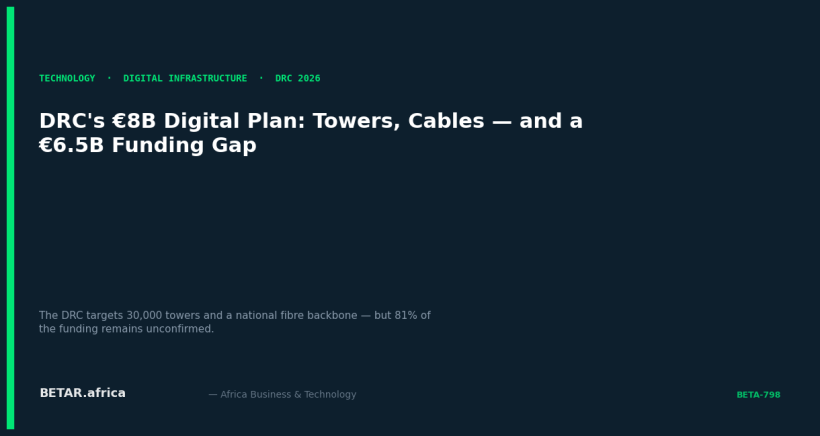

DRC’s €8B Digital Plan: Towers, Cables — and a €6.5 Billion Funding Gap Nobody Has Filled
The Democratic Republic of Congo has announced the continent’s most ambitious telecom buildout: 30,000 towers, a 192-terabit submarine cable, and three new data centres by 2030. With $1.5 billion secured against an €8 billion target, BETAR stress-tests the financing architecture — and scrutinises the Mauritius-based company at the centre of the fibre deal.
The arithmetic is unambiguous. The Democratic Republic of Congo’s National Digital Plan 2026–2030 commits the government to spending €8 billion transforming a telecoms base that currently reaches fewer than one in three citizens. The country has, so far, confirmed $1 billion in domestic funding and $500 million in international partnerships — roughly $1.5 billion in hand. The remaining €6.5 billion does not yet have a confirmed source.
That gap is not a disqualifying problem — Africa’s largest infrastructure programmes have always been assembled from multiple financing tranches over multi-year periods. But it is a structural fact the DRC’s plan requires every investor, operator, and DFI evaluating a role in this programme to hold clearly in mind. The question is not whether the plan is ambitious. It is whether the capital stack to execute it actually exists.
The Financing Architecture: Who Is Actually at the Table
The clearest signal of institutional commitment came in February 2026, when the DRC Ministry of Digital Economy convened a high-level working session with delegations from the World Bank and the French Development Agency (AFD) to accelerate operationalisation of a $500 million digital transformation initiative. That $500 million is part of the $500 million in international commitments already counted in the plan’s secured total — it is not additional capital. The February meeting was about implementation mechanics, not new money. That distinction matters.
The European Investment Bank has a footprint in DRC digital infrastructure: EIB Global has provided financing for Bandwidth and Cloud Services’ (BCS) high-speed fibre network expansion in eastern DRC, connecting communities in the conflict-affected Kivu provinces to backbone capacity. That project has demonstrated that patient DFI capital can reach difficult geographies inside the DRC — but it is fibre in the east, not the nationwide backbone the plan requires.
The most eyebrow-raising addition to the DFI pipeline is the $1 billion memorandum of understanding signed in 2025 with India’s General Technologies. A billion-dollar MoU from a firm not widely known in African digital infrastructure markets is, in the language of development finance, a letter of intent rather than committed capital. Afreximbank, which has financed telecom infrastructure across West and Central Africa, has not been publicly named in any DRC digital infrastructure commitment to date. The World Bank’s broader DRC engagement — a $750 million package approved in June 2022 covering governance, transport, and digital connectivity — provides institutional context, but the digital connectivity slice of that package does not cover the tower rollout at the scale the new plan demands.
The honest summary of the DFI pipeline as of March 2026: $500 million confirmed (World Bank/AFD, operationalisation under way), EIB presence in eastern fibre, one large-denomination MoU of uncertain execution. The remaining €6.5 billion is, at this point, a fundraising target — not a pipeline.
Tower Economics: The 5,000-a-Year Problem
The National Digital Plan’s tower target — from 5,150 today to 30,000 by 2030 — requires the DRC to add approximately 4,970 towers per year for five consecutive years. For context, Nigeria — with a far larger economy, better logistics infrastructure, and a twenty-year head start on independent tower companies — adds roughly 2,000 to 3,000 towers annually in a good year.
The leading independent tower operator in the DRC is Helios Towers, which entered the market in 2011 and describes DRC as its highest revenue-generating market. The company reported 763 new tenancies in the DRC in its 2025 full-year results — a strong performance, but an order of magnitude below the annual new-build pace the national plan requires. Vodacom DRC and Orange DRC launched a joint programme in January 2025 to deploy 2,000 shared solar towers over six years — a credible, modest-pace rollout that targets rural and semi-urban coverage gaps.
Notably absent from the DRC tower market: IHS Towers, despite operating nearly 40,000 towers across six African markets, has no presence in the DRC. Its February 2026 acquisition agreement with MTN Group — a $6.2 billion deal — may eventually bring IHS capacity to DRC through MTN’s existing footprint there, but that is a structural question for 2027 and beyond. American Tower’s DRC footprint is similarly limited.
The tower arithmetic has a partial solution: solar-powered, low-cost shared infrastructure. The DRC’s grid reaches only 19 per cent of the country, making off-grid solar the only viable power model for the majority of new tower sites. The Vodacom–Orange model demonstrates feasibility; scaling it to 5,000 towers per year requires capital, logistics, and local supply chain capacity the country has not yet assembled.
UIL: The $150 Million Deal That Needs Scrutiny
On 20 October 2025, the DRC government signed an agreement with United Investment LMT (UIL) — a Mauritius-based firm — for a $150 million digital infrastructure partnership first agreed in 2023. The scope, as publicly reported, is extraordinary: 60,000 to 80,000 kilometres of fibre-optic cable nationwide, a new 192-terabit-per-second submarine cable, three data centres (including a Tier 3 facility in Kinshasa), and the establishment of a national fixed-and-wireless telecom operator.
Due diligence on UIL reveals a significant discrepancy between the deal’s stated scope and the company’s documented profile. United Investments Ltd is a publicly listed holding company on the Development and Enterprise Market of the Stock Exchange of Mauritius. Its primary disclosed business activities include the manufacture and sale of liquid fertilisers, industrial and agricultural machinery, brokerage, leasing, IT services, and trust and corporate advisory. There is no publicly documented prior track record in submarine cable construction, fibre deployment, or data centre development.
The scope-capital mismatch is also significant. Deploying 60,000 kilometres of fibre-optic infrastructure — the scale of a national backbone — would cost billions of dollars in any comparable African market. $150 million for that scope, plus a submarine cable, plus three data centres, plus a new national operator, is not a delivery budget. It is, at most, feasibility and development capital for a framework that assumes additional financing will follow.
None of this means the UIL deal is fictitious. The agreement has been reported by credible African financial media, and UIL is a regulated, listed entity in Mauritius. But the contractual structure, delivery timeline, and UIL’s actual capital commitments for the fibre and cable components have not been publicly disclosed. Before this deal can be cited as evidence of delivery progress, those details need independent verification. The DRC Ministry of Digital Economy has not responded to requests for the full contract terms.
The Submarine Cable: Capacity Exists, New Route Unconfirmed
The 192-terabit-per-second submarine cable in the UIL deal is, on paper, transformational — nearly double the stated capacity of the 2Africa cable’s core system. In practice, the DRC already gained its first direct submarine cable landing when Meta’s 2Africa system completed in November 2025, landing at Muanda on the DRC’s narrow Atlantic coastline (approximately 40 kilometres long). The Muanda landing is operated by Mawezi RDC SA, a joint venture of Orange DRC and Airtel Congo RDC. Any new submarine cable for the DRC would also need to land at Muanda — there is no other viable Atlantic coastline landing point. No route, no landing station infrastructure, and no construction timeline for the UIL-associated cable has been confirmed by TeleGeography or any submarine cable mapping resource.
What It Means If It Works
The case for the DRC as digital anchor of Central Africa is real and should not be dismissed by the financing uncertainty. A country of 100 million people, with the world’s largest cobalt reserves and a strategic position connecting Central Africa to the Atlantic, achieves transformational outcomes if it reaches even half its 2030 connectivity targets. Universal mobile broadband in a connected DRC reshapes the economics of the critical minerals supply chain, enables a regional payments infrastructure for the wider Great Lakes corridor, and creates the platform for a Congolese digital economy that has, until now, been entirely theoretical. The prize justifies the ambition. But the €6.5 billion gap, the tower pace arithmetic, and the unanswered questions about UIL are the distance between the plan and the prize.
Key Figures
- Total plan value: €8 billion (2026–2030)
- Secured: ~$1.5B ($1B government + $500M international partnerships)
- Financing gap: ~€6.5 billion still to be raised
- DFI commitments confirmed: World Bank/AFD ($500M, operationalisation Feb 2026); EIB (BCS eastern fibre)
- Towers required: 5,150 → 30,000 = ~5,000 new towers/year for 5 years
- Leading DRC towerco: Helios Towers (entered DRC 2011; DRC = highest revenue market; +763 DRC tenancies in 2025)
- UIL deal: $150M, signed Oct 20 2025; Mauritius-listed holding company; primary business: fertilisers and machinery; full contract terms not disclosed
- Submarine cable — existing: 2Africa landed at Muanda, Nov 2025; 180 Tbps core capacity
- Submarine cable — proposed: 192 Tbps (UIL); route and landing station unconfirmed
- Internet penetration: 30.5% (34.7M users, end-2025)
- Grid electricity access: 19% of population

 UphivaBETAR