
Egypt’s 1GW Solar Race: The DFI Financing Architecture Behind Africa’s Largest Renewable Projects
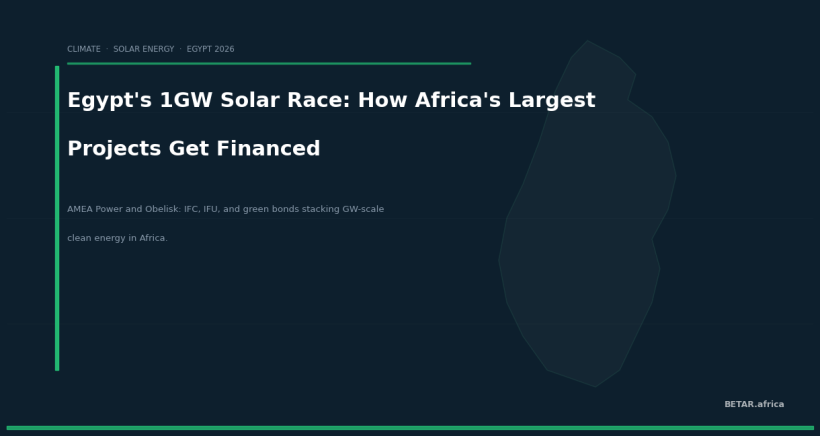
Two projects, both claiming Africa’s largest solar title, both closing financing within months of each other. AMEA Power’s $570M IFC-led debt package and the AfDB’s $184M Obelisk commitment represent the most concentrated deployment of DFI capital in African solar history — and a blueprint that most African nations cannot yet access.
Sometime in mid-2026, two solar power plants in Egypt will begin feeding electricity into the national grid. Both will claim to be the largest single-site renewable energy facility in Africa. Both will be right, depending on how you count — one leads on PV capacity, the other on total generation output. The definitional contest is less important than what it signals: Egypt has become the proving ground for the most ambitious solar infrastructure financing Africa has ever attempted, and it happened because multilateral development finance institutions decided to deploy at scale in a market where commercial capital alone could not close the deal.
The two projects are AMEA Power’s 1GW solar photovoltaic plant paired with 600MWh of battery energy storage in Aswan Governorate, and Scatec’s Obelisk project — a 1.1GW solar facility with 200MWh of BESS in the Nagaa Hammadi region of Upper Egypt. Together they represent over 2.1GW of new solar capacity and more than $750 million in committed DFI debt. Commercial operations for both are targeted for mid to late 2026. Together, they make Egypt the site of the most significant DFI-financed renewable energy buildout in African history.
AMEA Power: The $570M Senior Debt Package
AMEA Power’s Aswan project is the more complex financing story. The company — a UAE-based renewable energy developer with a substantial African footprint — assembled a $570 million senior debt package led by the International Finance Corporation, with co-investment from the OPEC Fund for International Development and Europe Arab Bank. Japan’s Kyuden International Corporation is AMEA’s equity partner in the project. Baker McKenzie advised on the transaction.
The IFC’s role is the structural anchor of the deal. IFC senior debt in an African renewable project does not merely provide financing — it provides the credit enhancement that enables commercial and multilateral co-lenders to participate on terms their own governance would not permit if IFC were absent. The OPEC Fund and Europe Arab Bank are co-lenders precisely because IFC’s due diligence, covenants, and preferred creditor status reduce the risk profile of the transaction. That crowding-in dynamic is how multilateral DFI finance is supposed to work — and in the AMEA Power deal, it has worked at a scale rarely seen in African infrastructure.
The 600MWh BESS component is equally significant. Co-locating utility-scale storage with a 1GW solar plant addresses the curtailment and dispatchability problems that have historically made African solar a less attractive bankable asset than its raw generation economics would suggest. For grid operators, predictable dispatchable renewable power is far more valuable than intermittent solar output — and the BESS pairing is what makes the Aswan project capable of functioning as a reliable baseload substitute rather than a weather-dependent generation asset.
Commercial operations are targeted for June 2026. The project is designed to generate approximately 2,250 GWh annually, avoiding an estimated 1.4 million tonnes of CO2 per year.
Obelisk: The AfDB’s $184M Commitment
The African Development Bank’s $184.1 million financing for Scatec’s Obelisk project was approved in early 2026, making it the AfDB’s largest-ever single investment in a solar energy project. Obelisk is a 1.1GW solar PV plant with 200MWh of co-located BESS, located in the Nagaa Hammadi region of Upper Egypt’s Qena Governorate. Scatec, the Norwegian renewable energy company, is the developer and operator. The project is expected to reach commercial operations in Q3 2026 and is projected to generate 2,772 GWh annually.
The AfDB’s $184.1 million represents a development loan — patient capital with concessional terms structured to de-risk the project for additional co-lenders. The bank’s involvement signals institutional confidence in Scatec’s operational track record in Egypt and in the Egyptian government’s power purchase agreement framework, which provides the revenue certainty that project finance requires.
Obelisk’s BESS component is smaller than AMEA’s in absolute terms — 200MWh versus 600MWh — but its deployment in a 1.1GW plant demonstrates that storage is increasingly a structural requirement, not an optional upgrade, for bankable utility-scale solar in Africa. Lenders and DFIs are now treating storage integration as part of the base case, not an enhancement.
Why Egypt, and Why Now
Egypt’s ability to attract this level of concurrent DFI financing is not accidental. The country has invested systematically in the regulatory and commercial infrastructure that bankable renewable projects require. The Benban Solar Park — 1.65GW of installed PV capacity across 32 independent projects, completed between 2019 and 2021 — was the template: a government-designed solar zone with standardised land allocation, grid connection commitments, and power purchase agreement frameworks that allowed independent power producers to model revenue with sufficient confidence for project finance.
That regulatory foundation, combined with Egypt’s relatively sophisticated banking sector, its IFC and AfDB relationship history, and its sheer scale of energy demand — the country requires enormous new generation capacity to serve a population of over 100 million — creates the conditions under which $750M+ in DFI debt can close within the same financial year on two separate projects. No other African nation currently possesses all four conditions simultaneously: regulatory framework maturity, sovereign creditworthiness sufficient for DFI engagement at scale, a demonstrated IPP track record, and a domestic energy demand large enough to absorb gigawatt-scale solar generation.
That last point matters for the rest of Africa. The question raised by Egypt’s solar moment is not whether DFI-financed utility-scale solar is technically viable in Africa — these two projects answer that definitively. The question is what structural preconditions are necessary for other African nations to access the same financing architecture, and how quickly those preconditions can be created.
The DFI Architecture and Its Limits
The AMEA Power and Obelisk deals share a common structural logic: DFI debt, deployed at scale, creates the credit conditions that allow institutional co-lenders to participate. IFC’s $570M package and AfDB’s $184M are not grants. They are structured debt instruments with covenants, reporting requirements, and enforcement mechanisms. They function as anchors that lower the cost of capital for commercial co-lenders by signalling due diligence quality, regulatory engagement, and institutional accountability.
That architecture is replicable — in theory. In practice, it requires a sovereign context in which DFIs are willing to deploy at that scale, which means a country with a track record of honouring power purchase agreements, a central bank capable of managing currency risk for hard-currency debt service, and a grid operator with the technical capacity to integrate gigawatt-scale variable generation with storage dispatch. Most sub-Saharan African grid operators currently fail at least one of these requirements.
Kenya’s clean grid paradox illustrates the contradiction: a country with among the cleanest generation mixes in Africa — geothermal, hydro, wind — still produces some of the continent’s most expensive electricity, because grid infrastructure, transmission losses, and utility financial distress add costs that generation economics alone cannot explain. Building 1GW of bankable solar in Kenya requires solving problems that Egypt solved with Benban. The finance architecture exists. The preconditions do not.
What 2.1GW Means for Africa’s Solar Pipeline
The combined 2.1GW+ of new solar capacity coming online in Egypt in 2026 will represent a step change in Africa’s installed renewable base. For context, sub-Saharan Africa (excluding South Africa) had approximately 4GW of utility-scale solar installed by end-2024. Egypt’s two projects alone will add more than 50% of that figure in a single year — and they are not the only projects closing in the region. Morocco’s solar pipeline continues to expand. South Africa’s Renewable Energy Independent Power Producer Programme has a new tranche under way. The northern and southern poles of African solar development are accelerating faster than the middle of the continent.
The gap between where DFI capital flows and where the energy access deficit actually exists remains the central tension in African clean energy finance. Egypt’s bankable solar market attracts IFC, AfDB, the OPEC Fund, and Kyuden International. Nigeria, home to 86 million people without electricity access, does not attract the same scale of DFI commitment to utility-scale solar — because the bankability conditions are not yet present. Nigeria’s DARES programme, targeting the world’s largest solar mini-grid deployment with 750MW across rural communities, is an attempt to work around that problem by deploying distributed generation rather than utility-scale infrastructure. It is a necessary alternative. It is not a substitute.
For the DFI community, Egypt’s moment is a proof of concept: Africa can absorb gigawatt-scale solar finance when the structural conditions exist. The harder question — how to create those conditions in the markets that need solar most urgently — is the one that neither AMEA Power’s Aswan project nor Scatec’s Obelisk answers. They show what is possible at the top of Africa’s bankability spectrum. The rest of the continent is still waiting for the architecture that brings it within reach.


 UphivaBETAR