
How $10 Million Unlocks $4.4 Billion: AfDB’s Catalytic Bet on Namibia’s Green Hydrogen Future
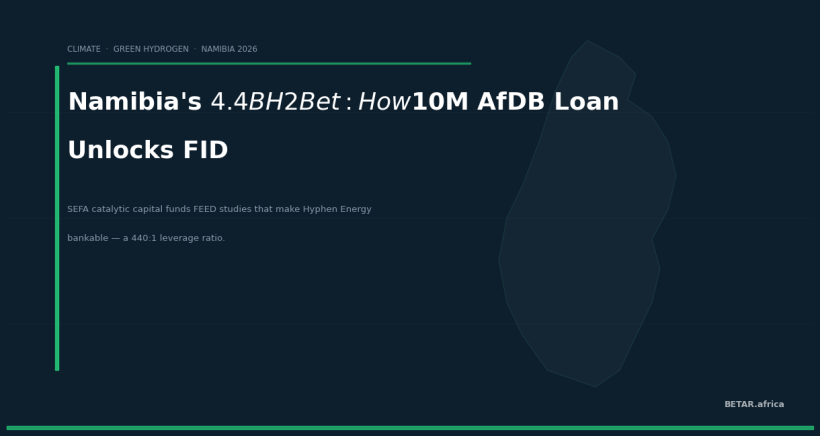
The African Development Bank approved a $10M SEFA loan to Hyphen Hydrogen Energy for front-end engineering studies ahead of a final investment decision on a $4.4 billion project. The ratio — 440:1 — is the story of how multilateral catalytic capital works, and Namibia is its most consequential live test.
In December 2025, the African Development Bank’s Sustainable Energy Fund for Africa approved a $10 million loan to Hyphen Hydrogen Energy — a company building a green hydrogen production facility in Namibia’s Tsau Khaeb National Park that, if it reaches final investment decision, will represent a $4.4 billion project. The stated purpose of the loan is to fund FEED studies: Front-End Engineering and Design work that defines a project’s technical specifications, cost estimates, and constructability at the level of detail that commercial lenders require before committing capital at scale.
The ratio of AfDB capital to project capital is approximately 440:1. That is the business of catalytic development finance — not to fund projects, but to fund the conditions under which projects become fundable.
Why FEED Is the Bottleneck
Large infrastructure projects do not fail at construction. They fail at the point where development costs become too high for private sponsors to absorb before any revenue exists, or too uncertain for commercial lenders to underwrite. FEED studies resolve that uncertainty. A completed FEED package for a project the size of Hyphen typically costs $50–150 million and produces engineering deliverables — process flow diagrams, equipment specifications, site layouts, and construction cost estimates with 15–20% accuracy — that project finance banks require before they will commit to term sheet discussions.
Without FEED, there is no bankable project. With FEED, a project’s capital structure, risk allocation, and off-take arrangements can be structured with enough precision that institutional lenders can model the investment case. The AfDB’s $10M SEFA loan does not build a kilogram of green hydrogen. It funds the engineering documentation that makes $4.4 billion of subsequent investment possible to assemble.
This mechanism — a multilateral development finance institution taking project development risk at the pre-FID stage, where private capital is most reluctant to deploy — is how the global infrastructure project pipeline functions at the frontier. The European Investment Bank, the IFC, and AIIB have all used similar instruments for energy transition projects in emerging markets. AfDB’s SEFA has deployed the mechanism in Africa with a specific focus on sustainable energy projects where development risk is highest.
The Hyphen Project
Hyphen Hydrogen Energy was established in 2021 as a joint venture between Nicholas Holdings and Enertrag, a German renewable energy developer with operational wind and solar assets across Central Europe. The project site is within the Tsau Khaeb National Park in southern Namibia — an area with wind and solar resources at the intensity required for large-scale electrolysis. The full project concept involves a 2 GW electrolyzer installation in Phase 1, producing green hydrogen for export as green ammonia to European industrial buyers under long-term off-take agreements.
FID on Phase 1 has been a moving target. The original timeline anticipated FID in 2023, which slipped to 2024, then to H1 2025, and now to H1 2026. Each delay has reflected the compounding difficulty of assembling a project financing structure for a first-of-kind, commercial-scale green hydrogen export project in a jurisdiction without existing hydrogen infrastructure, against a backdrop of uncertainty in European green hydrogen off-take demand and falling cost projections for electrolysis equipment.
The European hydrogen demand picture has shifted materially since Hyphen was conceived. Germany’s industrial hydrogen demand trajectory has moderated as economic conditions tightened. The EU’s renewable energy directive has faced implementation challenges. And green ammonia prices have remained under pressure as Chinese electrolyzer manufacturing has driven down equipment costs globally, making some European buyers reluctant to lock into long-term contracts at prices that reflect 2023-era project economics.
The Financing Challenge
Hyphen’s capital structure challenge is characteristic of first-mover green hydrogen projects globally. The project is not a technology risk — electrolysis is a proven industrial process, and the equipment from suppliers like Nel, ITM, and Thyssenkrupp is commercially deployed. The risk is commercial: off-take commitment at the scale and price required to make a $4.4 billion project financeable.
Commercial project finance lenders — the export credit agencies and commercial banks that would provide the majority of debt financing for a project of this size — require contracted revenue covering a defined percentage of the debt service, typically 80–90% minimum. For green hydrogen, that means either a long-term off-take agreement at a fixed price, or a take-or-pay arrangement with a creditworthy counterparty, or some combination of the two. Finding a European industrial buyer willing to commit to a 20-year green hydrogen supply contract at prices that make the Namibia project viable has been Hyphen’s core challenge.
The AfDB SEFA loan is designed to reduce the time and capital cost of reaching that off-take arrangement by ensuring that when Hyphen approaches potential buyers, it has a completed FEED package to demonstrate the project’s technical credibility and cost basis. A buyer negotiating an off-take agreement with a project that has completed FEED can assess actual construction costs and schedule risks. Without FEED, the conversation is prospective and speculative.
Namibia in the Africa H2 Race
Hyphen is one of three credible large-scale green hydrogen export projects in Africa at varying stages of development. South Africa’s Coega Special Economic Zone is hosting project development work by multiple developers including Hive Hydrogen, which received IFC backing in 2023 for a green ammonia plant, and the Coega Development Corporation’s own hydrogen hub concept. Morocco’s Noor Midelt Water, Solar and Electrolysis project is at an earlier conceptual stage, but benefits from Morocco’s established relationship with European energy partners and proximity to EU markets.
Each of these projects faces the same fundamental challenge: European industrial demand for green hydrogen imports is developing more slowly than the supply-side pipeline implies. The International Energy Agency has revised its hydrogen demand projections downward in successive annual reports. Germany, which was projected to need 45–90 TWh of imported hydrogen by 2030, has revised its near-term import demand estimates downward as industrial restructuring has reduced near-term consumption needs.
The AfDB’s decision to fund Hyphen’s FEED studies signals an institutional view that Namibia’s project has sufficient technical and commercial merit to justify development capital even in that uncertain demand environment. It is a statement of development finance priority — Africa should be positioned to supply clean fuel exports if and when European demand materialises — and a practical bet that completing FEED will keep Hyphen competitive if the off-take market firms up in the 2026–2028 window.
The Catalytic Capital Model
The SEFA instrument represents a specific theory of how development finance should function in the energy transition: not as a substitute for commercial capital, but as a complement that reduces development risk to the point where commercial capital can operate. A $10 million loan to enable FEED studies costs the AfDB approximately 0.23% of the total project value. If FEED leads to FID, and FID leads to construction financing, the AfDB’s leverage ratio on its catalytic capital exceeds any conventional development finance instrument.
That logic has limitations. Catalytic capital does not create commercial demand. FEED studies completed with AfDB funding do not guarantee that a European industrial buyer will sign an off-take agreement on terms that make the project financeable. The instrument reduces one barrier — the cost and uncertainty of project development documentation — while leaving the core commercial challenge unresolved.
What it does accomplish is keeping the option open. A project with completed FEED can respond to market conditions as they evolve. A project that has not completed FEED cannot. In a global green hydrogen market that is moving faster in some directions and slower in others than most analysts projected three years ago, optionality has a concrete value — and $10 million from the AfDB is the price of maintaining it for one of Africa’s most strategically significant clean energy projects.
 UphivaBETAR