
By Business Reporter, BETAR.africa | 22 March 2026
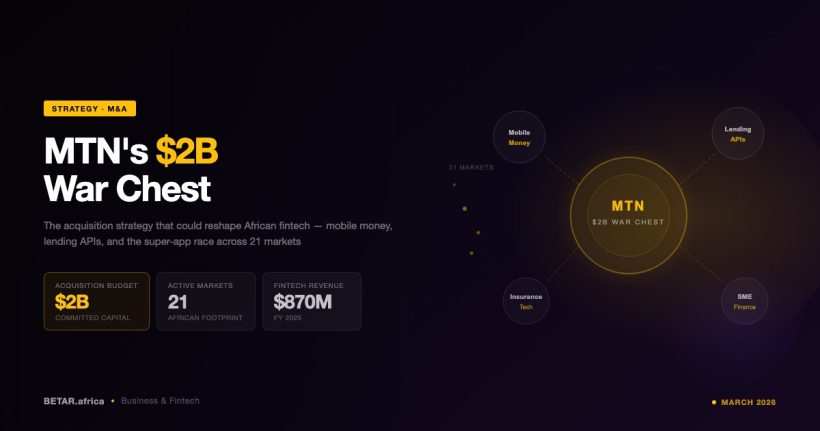
When BETAR profiled MTN Group’s $2 billion acquisition war chest in February 2026, the question was whether the thesis — MTN using its capital position to acquire product depth for MoMo — would survive contact with its full-year results. The FY2025 numbers, released on 16 March, answer that question clearly: the capital is intact, the cash generation has accelerated, and MTN has earned the right to deploy aggressively.
The harder question is whether the company is moving quickly enough.
The Thesis, Validated
BETAR’s original analysis argued that MTN’s $2 billion war chest represented the first genuine opportunity for a continent-scale telecoms operator to buy its way into financial services product depth. MoMo had the distribution: 70 million monthly active users across 16 markets. What it lacked was the product stack — lending, savings, insurance — that would convert that distribution into durable ARPU expansion.
The FY2025 results confirm that the foundation is sound and strengthening.
MTN Group posted service revenue of R218 billion for the year, up 22.7 percent in constant-currency terms. Profit before tax reached R47.4 billion ($2.81 billion), against a pre-tax loss of R4.1 billion in 2024 — a swing of more than $3 billion in a single year. Operating free cash flow before spectrum payments grew 82 percent to R57 billion. The board declared a dividend of ZAR 5.00 per share, 45 percent above the prior year.
These are not cyclical numbers. They are structural: MTN crossed 307 million subscribers, active data customers grew 9.4 percent, and MoMo monthly active users expanded 10 percent to 69.5 million. The company is growing its base and extracting more value from it simultaneously — the combination that makes the M&A thesis defensible rather than speculative.
MoMo: The Revenue Picture
Fintech revenue across the group is growing fast, but the absolute share of total service revenue remains low — and that gap is precisely the rationale for acquisitions.
MTN Nigeria’s fintech revenue grew 79.7 percent in FY2025 to ₦191.27 billion — a strong expansion that nonetheless represents less than 4 percent of MTN Nigeria’s total service revenue of ₦5.20 trillion. At the group level, the picture is similar: MoMo is a growing segment, but it has not yet converted its scale into the revenue contribution that a financial services platform of 70 million users would imply.
The benchmark is instructive. M-Pesa contributes approximately 40 percent of Safaricom’s revenue. Airtel Money contributed roughly 25 percent of Airtel Africa’s revenue in its most recent full-year results. MTN’s fintech revenue is growing faster than both, but from a lower base — which is both a challenge for current monetisation and the strongest possible argument for the acquisition strategy.
The gap between what MoMo’s distribution base should generate and what it currently generates is the opportunity MTN is trying to close through product acquisitions. The FY2025 data confirms that the gap is real, meaningful, and not closing through organic growth alone.
Capital Allocation: What Has Been Deployed?
MTN has not announced a major acquisition since the FY2025 results. But the capital is moving — quietly, and in the right direction.
MTN Nigeria’s acquisition of full ownership in MoMo PSB (completed 2024) gave it direct control over its payment service bank licence, removing the joint-venture structure that had limited agility in product development. MTN Uganda’s MoMo spin-off process, announced in 2025, positions the East African fintech unit as an independent capital-raising entity capable of pursuing acquisitions in its own right.
Group-level, MTN’s capex ran at R38.5 billion — 17 percent of service revenue, toward the top of guidance but sustainable given the operating free cash flow expansion. The company has telegraphed that capex intensity will moderate in 2026 and 2027 as the current infrastructure investment cycle matures, releasing additional free cash flow for M&A deployment.
The $2 billion war chest, confirmed by CEO Ralph Mupita in February 2026, is still materially intact. The question investors and analysts are now asking is whether MTN will deploy it in 2026, or whether the search for the right targets is taking longer than the capital thesis assumed.
Mupita’s stated target categories — payments, lending, remittances — have not changed. Geographic priorities: East Africa, specifically Kenya, Tanzania, and Ethiopia, where MTN is absent from markets that represent more than 200 million people. Structural constraint: acquisition targets in those markets need to carry regulatory licences that give MTN immediate operational permission, not just asset value.
A Kenya-licensed fintech acquisition remains the most consequential single deal MTN could announce. The pipeline exists: Kenya’s fintech ecosystem has produced numerous licensed operators in lending, insurance, and cross-border payments. Several are acquisition-scale. The deal that has not happened is notable for its absence.
Dividend Policy and the Naira Risk
MTN’s dividend increase to ZAR 5.00 per share — 45 percent above 2024 — is a statement of confidence in the sustainability of its earnings recovery. It is also a commitment that creates future obligation.
The risk embedded in that commitment is the naira. Nigeria generated EBITDA of $1.926 billion in FY2025 — more than Ghana ($1.276 billion) and South Africa ($1.048 billion) combined. Nigeria is now the group’s largest profit contributor, which means the group dividend is, in large part, a function of naira stability.
MTN Nigeria’s FX gain of ₦90.27 billion in 2025 — after a loss of ₦925.36 billion in 2024 — contributed materially to the earnings recovery. If the naira deteriorates again, that contribution reverses. The 2025 FX environment was dramatically more favourable than 2024, but Nigeria’s macro conditions do not guarantee a repeat.
MTN’s dividend commitment is courageous given this exposure. The board has either concluded that the naira is structurally stabilising at current levels, or it is accepting the risk of a dividend cut in a bad year for the sake of signalling earnings confidence in a good one. Either reading is consistent with the data available — but investors should model the naira devaluation scenario explicitly before treating the dividend as a floor.
MTN vs. Airtel Africa: The Divergent Playbook
MTN and Airtel Africa are both pursuing fintech as the next phase of telecoms monetisation in Africa. Their strategies are structurally different, and FY2025 clarifies the trajectory of each.
Airtel Africa (LSE: AAF) operates in 14 African markets — predominantly East and Central Africa — with Nigeria as its single largest market. Airtel Money is the fintech vehicle, serving approximately 39 million users as of its most recent reported period. That is roughly half MTN MoMo’s active user base despite a similar number of markets.
The strategic divergence is in capital allocation. Airtel Africa has been a seller of assets: it completed the sale of its tower portfolios across multiple markets to fund debt reduction and maintain its dividend in a period of naira and dollar-denominated pressure. Tower monetisation allowed Airtel to extract near-term capital from a non-core asset class, but it also reduces its infrastructure control.
MTN, by contrast, has retained its tower infrastructure and pursued capex investment at the top of its guidance range. The R38.5 billion capex commitment in FY2025 is a bet that connectivity infrastructure — particularly fixed wireless and data — will be a competitive moat, not a liability to be divested.
The two strategies imply different competitive positions in five years. Airtel’s tower divestiture lightens the balance sheet but limits its ability to differentiate on network quality in markets where MTN is simultaneously expanding fixed broadband access. MTN’s capex investment maintains infrastructure advantage at the cost of lower short-term free cash flow relative to what Airtel’s asset sales generate today.
On fintech monetisation, Airtel Money’s contribution (~25% of group service revenue) exceeds MoMo’s current share, but Airtel is growing from a smaller, more concentrated market base. MTN’s larger user base and the $2 billion acquisition war chest give it a structural capability that Airtel cannot match — if MTN deploys the capital effectively.
The verdict from FY2025: MTN has the better earnings base, the stronger cash generation, and the more aggressive growth thesis. Airtel has a more focused geographic footprint and a head start on fintech revenue share. The race over the next three years is whether MTN’s acquisitions can close the fintech monetisation gap faster than Airtel can scale its user base.
The Clock Is Running
MTN’s FY2025 results give the company the financial credibility to execute the acquisition strategy Mupita has described. The cash is there. The free cash flow is expanding. The subscriber base is growing.
What has not happened yet is the transformative M&A move that would convert the war chest thesis from a stated ambition into a structural reality. MTN Nigeria absorbed MoMo PSB. That is important but not transformative. The East Africa entry — the Kenya acquisition, the Tanzania play, the Ethiopia fintech wedge — has not materialised.
MTN enters 2026 with a stronger balance sheet than any point in the last five years, in a window where African fintech valuations remain compressed from their 2021 peaks and sellers are more motivated than they were. If the company does not deploy in 2026, the thesis does not fail — but it begins to require more explanation.
The FY2025 results say MTN can afford to buy. The next twelve months will determine whether it is willing to.
Sources: MTN Group FY2025 Results (16 March 2026); MTN Nigeria FY2025 Earnings Release; Airtel Africa interim results. Related BETAR coverage: BETA-366 — MTN’s $2B War Chest Analysis | BETA-743 — MTN 30M Connected Homes Strategy | BETA-945 — MTN FY2025 Results: Nigeria Is Now the Engine.


 UphivaBETAR


 Joseph Busari