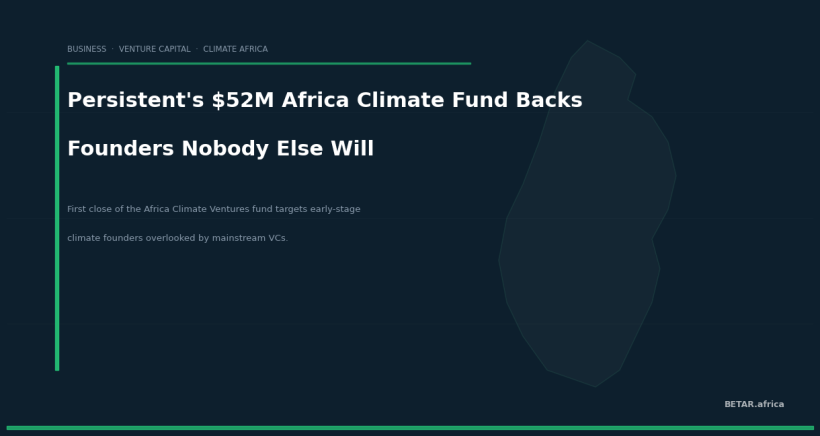

Persistent’s $52M Africa Climate Fund Is Backing the Founders Nobody Else Will
A $52 million first close, a rare LP roster, and a $5 million venture-building facility attached to the fund. Persistent has spent fourteen years learning how African climate startups fail — and is now deploying capital specifically to prevent it.
The Africa climate finance conversation is dominated by large numbers — Sun King at $196 million, M-KOPA at $160 million, Spiro at $100 million in battery-swap infrastructure. These are real achievements. They also describe one end of a market, where revenue is proven and institutional investors can model a return with confidence. They say almost nothing about what happens to a climate startup before it reaches that tier.
Persistent — a climate venture builder that has operated quietly across Africa for fourteen years — is trying to answer that question with capital. On March 11, 2026, the firm announced a $52 million first close of its Africa Climate Venture Fund, targeting a final close of $70 million, with an additional $5 million Venture Building Facility attached. The LP roster is unusual for Africa early-stage: the Japan International Cooperation Agency, the Soros Economic Development Fund ($7 million), the Nordic Development Fund, the Schmidt Family Foundation, Impact Fund Denmark, the Cottier Donzé Foundation, FMO, and an undisclosed family office, alongside anchor investor FSD Africa Investments.
The fund targets pre-seed, seed, and Series A African climate startups. Cheque sizes run from $250,000 to $1 million. The sectors are the ones that matter — energy access, sustainable agriculture, water and sanitation, waste management, e-mobility — and the sectors that most institutional capital, including most impact capital, declines to touch at the earliest stages.
The Gap the Fund Is Designed For
African climate tech funding rebounded to approximately $1.1 billion in 2025 — but less than 3% of that historically reaches pre-seed or seed stage companies. Growth-stage deals receive the institutional attention. Early-stage founders face a market that offers very little between friends-and-family capital and the $5 million minimum cheques growth-stage funds require.
“Frequent fundraising meant follow-on funding availability wasn’t plannable,” said Tobias Ruckstuhl, Managing Partner of Persistent. The consequence is systematic: early-stage climate startups that cannot survive long enough to demonstrate traction produce fewer Series A candidates, fewer scaled solutions. Persistent’s $250,000 to $1 million cheque range fills the space Novastar, Greentec Capital, and Equator will not enter — because the risk-adjusted returns at formation stage require a different investor tolerance than most institutional capital possesses.
Fourteen Years Before the Fund
What makes Persistent’s position distinctive is institutional memory. Founded in 2012 as a spinout from the restructuring of E+Co — among the first organisations to systematically finance clean energy entrepreneurs in the developing world — the firm deployed $23 million across 23 companies in 22 African countries before raising a formal fund. Portfolio companies include Candi Solar, Ecobodaa, Solar Taxi (Tanzania), Hohm Energy, and Beacon Power Solutions. Collectively: 6.5 million people connected to energy services, 21,700 jobs, 1.4 million tons of CO2 eliminated. Average portfolio growth since investment: over 200%.
Those numbers are the track record that persuaded JICA, Soros, and the Nordic Development Fund to commit at first close. They are also the source of Persistent’s operating thesis: that African climate startups fail not primarily because of capital absence, but because of the absence of the support infrastructure that capital assumes exists when it is deployed.
Beacon Power Solutions illustrates the thesis. Persistent backed the South Africa-based energy storage company before its commercial model for C&I battery storage was proven — providing capital alongside the CFO support and corporate structuring that allowed Beacon to navigate regulatory requirements for grid-tied storage. By 2025, Beacon had grown to serve a substantial commercial customer base and completed additional fundraising rounds. That trajectory — from pre-commercial risk to institutional bankability — is what Persistent is trying to replicate at fund scale.
The Venture-Building Facility: Why Capital Is Not Enough
The $5 million Venture Building Facility is the feature of the fund’s structure that most distinguishes it from a conventional venture vehicle. The VBF is a ring-fenced sub-allocation within the fund’s overall structure — not a separate legal entity — that provides operational and strategic services to portfolio companies regardless of whether Persistent has yet made an equity investment in them. Persistent has not publicly disclosed the precise legal mechanics, but the facility functions as a dedicated services budget accessible to companies in the venture-building pipeline before they formally become fund investees.
Those services are concrete: corporate structuring, CFO functions, legal support, ESG compliance, international expansion strategy, and fundraising assistance. For a pre-seed climate startup in West Africa trying to navigate a cross-border grid interconnection project, or a seed-stage agritech founder attempting to structure a carbon credits monetisation agreement, these are not peripheral concerns — they are the difference between a company that survives its first two years and one that does not.
“We are excited to achieve the milestone of the First Close of the Persistent ACV Fund,” said Ruckstuhl. “The Fund is uniquely capable of growing early-stage climate businesses across Africa through our combination of investment capital and Venture Building.”
“Africa is seen as risky. We focused on how we mitigate and demystify the risks,” said Wairimu Karanja, a Persistent partner who manages the corporate, legal, and compliance dimension of the venture-building work. The fund’s blended finance architecture — DFI capital absorbing first losses, priority return protections for private investors — translates that philosophy into capital structure directly.
The LP Roster as Signal
The LP composition signals institutional conviction in the early-stage Africa climate thesis. JICA, the Nordic Development Fund, and FSD Africa Investments (backed by the UK’s FCDO, which conceived of the vehicle in collaboration with Persistent) all carry explicit development mandates for this market. The Soros Economic Development Fund and Schmidt Family Foundation represent philanthropically motivated capital that accepts early-stage African climate risk for impact reasons.
“SEDF is proud to invest in Persistent’s Africa Climate Venture Builder Fund, which will help to scale early-stage climate solutions, unlock private capital, and build a resilient, climate-positive future for communities across the continent,” said Georgia Levenson Keohane, CEO of the Soros Economic Development Fund.
“Closing Africa’s climate financing gap requires more than capital,” said Anne-Marie Chidzero, CIO of FSD Africa Investments. “It requires the right fund managers, supported at the right moment.”
What a Final Close at $70M Would Mean
Persistent is targeting a final close of $70 million. The remaining $18 million gap is less alarming than the headline suggests. For impact-oriented blended finance vehicles targeting DFI-anchored LPs, a first close at 74% of target is within normal range — final close typically follows six to twelve months later as institutional LP approvals complete. The more meaningful benchmark is whether the fund reaches full deployment capacity, which determines whether it can deliver on its stated lifetime impact targets: 17 million tons of CO2 mitigated, 7 million beneficiaries, and $450 million in additional capital catalysed.
The context matters here. BETAR’s analysis of Africa’s Series A drought and the rise of local VC documented the structural fragmentation of Africa’s startup funding market — a growth-stage concentration that leaves early-stage companies chronically underfunded. Persistent’s ACV Fund is one of very few institutional vehicles explicitly designed to operate at the stage the market currently abandons.
For African climate founders at pre-seed or seed — solar, waste-to-energy, e-mobility, agritech — the first close is the news that matters. The fund is active and deploying. It is structured to offer what most institutional capital in Africa will not: a cheque small enough to be useful at formation, paired with operational support that turns formation into survival.


 UphivaBETAR