
Power Africa Is Gone. Who Fills the $2–3B Annual Gap It Left Behind?
The Trump administration’s dismantling of USAID has hollowed out Power Africa — the US bilateral programme that contracted over 10,000 megawatts and extended electricity access to 165 million people since 2013. AfDB, World Bank, and European DFIs are expanding their commitments. None of them do what Power Africa did for the projects and populations that needed it most.
The headline numbers for Power Africa were always large enough to obscure what the programme actually did. Yes, it supported more than 10,000 megawatts of contracted generating capacity since its 2013 launch under President Obama. Yes, it helped extend electricity access to an estimated 165 million people across sub-Saharan Africa. Those numbers, cited in every retrospective, are real.
What those numbers do not capture is the operational layer that made them possible: the transaction advisors who structured deals that private capital would not have touched without hand-holding; the first-loss capital positions that absorbed the risk premium African project sponsors could not afford; the offtaker credit support that made state utilities creditworthy enough to sign PPAs; the off-grid market development grants that seeded solar home system companies into markets that generated no return for years.
That operational layer is now gone. The IEA and Sustainable Energy for All estimate the USAID collapse widens Africa’s annual energy access financing gap by $2–3 billion. That figure almost certainly understates the disruption, because it measures dollars — not the advisory capacity, the deal-structuring expertise, and the risk-absorbing instruments that dollars alone cannot replace.
What Power Africa Actually Funded
The confusion about what Power Africa provided stems partly from how it was communicated. The programme was marketed in megawatts and connections — metrics that suggested a capital deployment operation. In practice, Power Africa was a catalytic finance operation. Its core value proposition was not writing large cheques but enabling deals that could not close without its intervention.
The primary instruments: transaction advisory grants that funded the legal, financial, and environmental work needed to get projects to financial close; first-loss guarantees through the US Development Finance Corporation (DFC, formerly OPIC) that absorbed downside risk and unlocked commercial bank participation; offtaker credit support that insured project developers against non-payment by state utilities; and market development grants that funded the operational losses of early-stage off-grid companies building distribution networks in markets with no reliable revenue path for three to five years.
Countries where Power Africa had the most active programme activity at the time of the USAID freeze include Nigeria, Kenya, Tanzania, Ethiopia, Ghana, and Mozambique — all markets with live projects in structuring or construction that had Power Africa components. In Nigeria, multiple mini-grid developers had active DFC guarantee applications. In Tanzania, the off-grid component of the programme was running technical assistance for at least fourteen community energy schemes. In Mozambique, the Scaling Solar programme had Power Africa co-investment structured in.
None of those structures automatically survive the withdrawal of the US technical and financial backstop. Some will find alternative arrangements. Others will not.
Who Is Expanding Into the Void
The institutions stepping up since the USAID freeze are real — and their commitments are material. They are not, in most cases, filling the same gap.
The African Development Bank’s Mission 300 — the $90 billion electrification programme targeting 300 million people by 2030 — represents the single largest institutional response to Africa’s energy access deficit. Mission 300 secured a EUR 1 billion commitment from the European Investment Bank in late 2025 and has attracted additional co-financing from bilateral partners. AfDB President Akinwumi Adesina has positioned Mission 300 explicitly as the framework that can absorb the deals and ambitions that bilateral programmes like Power Africa once anchored.
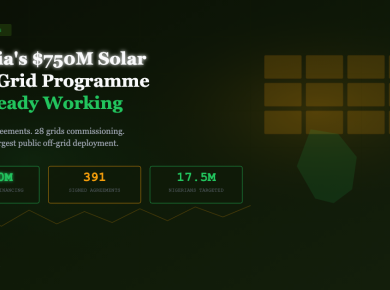
The World Bank’s Electrifying Africa programme and the Nigeria DARES deployment — $750 million committed for 750,000 solar connections, the largest single off-grid solar deployment programme in history — demonstrate that the World Bank is scaling into the energy access space at precisely the moment the US is scaling out. The World Bank is also the primary institutional backer of the Scaling Solar programme that Power Africa previously co-sponsored.
European DFIs are expanding exposure. Germany’s KfW has increased energy access lending to East and West Africa, with particular attention to markets where Power Africa had concentrations of activity. The UK’s British International Investment has signalled an expanded energy access mandate following the US withdrawal — consistent with BII’s broader push into frontier markets that commercial capital will not reach unassisted. France’s Proparco has added clean cooking and off-grid components to existing country programmes.
Taken together, this expansion is significant. It does not add up to a replacement.
The Gap That Remains
The structural problem is that multilateral and European DFI capital tends to flow toward bankable, at-scale projects — the same projects that commercial banks will eventually reach once risk premiums compress. Power Africa’s distinctive function was to work below that threshold: the pre-commercial, the too-small-to-underwrite, the technically complex, the politically difficult.
The off-grid solar sector provides the clearest illustration. Companies including ENGIE Energy Access, SunCulture, and d.light built their African distribution networks partly on concessional debt facilities and market development grants backed by USAID. The cost of capital on those facilities was low precisely because Power Africa was absorbing a portion of the credit risk. Refinancing into commercial instruments — at current African credit spreads of 15–18% — would restructure unit economics in a way that eliminates service to the bottom two income quintiles entirely.
Transaction advisory is a second gap that institutional finance cannot easily bridge. Power Africa employed or contracted hundreds of transaction advisors who worked embedded in African energy ministries and with project developers who lacked the expertise or budget to structure bankable deals independently. Firms including Dalberg, Tetra Tech, and Palladium held large Power Africa advisory contracts. Those contracts have been terminated. No equivalent programme exists.
The US Development Finance Corporation’s guarantee capacity — which backed DFC guarantees for Power Africa projects — technically remains in place. The DFC was not abolished. But the pipeline of projects that Power Africa fed into the DFC’s guarantee queue has been disrupted, and without the transaction advisory layer generating bankable deal structures, the DFC’s guarantee facility in Africa will sit underutilised.
The Template Question
For African energy ministers and power sector planners, the Power Africa collapse raises a question that has no comfortable answer: how do you build an energy access strategy around a bilateral partner who can reverse programme commitments in a change of administration?
The answer that several African governments are arriving at — quietly, and with urgency — is that you cannot. The practical response is a recalibration toward multilateral financing and regional capital: AfDB, the World Bank, the African Export-Import Bank, and domestic institutional investors. Several African sovereign wealth funds — including Botswana’s Pula Fund, Nigeria’s NSIA, and Rwanda’s Agaciro Development Fund — have begun active conversations about deploying domestic capital into energy access instruments, a development that would have been politically premature five years ago.
The longer-term question is whether the Power Africa collapse accelerates African multilateral self-sufficiency in energy finance — or simply means fewer projects get built, fewer connections get made, and the 600 million people without reliable electricity wait longer. The evidence from Q1 2026 suggests both things are true simultaneously: institutional commitments are expanding and the operational gap left by USAID is widening. Those two facts are not in contradiction. They describe a continent reconfiguring its energy finance architecture in real time, without a guarantee that the reconfiguration happens fast enough for the people it needs to reach.
The IEA estimates Africa needs $90 billion per year in clean energy investment to meet its climate commitments by 2030. Q1 2026 delivered roughly $8 billion in committed capital across major deals. The gap between those numbers is structural. Power Africa’s collapse did not create it — but it has made clear how much of the work of closing it depended on instruments that no institution has yet agreed to replicate.


 UphivaBETAR