
Powering Africa Summit 2026: America Is Still Coming to Power Africa — Just Not to Help
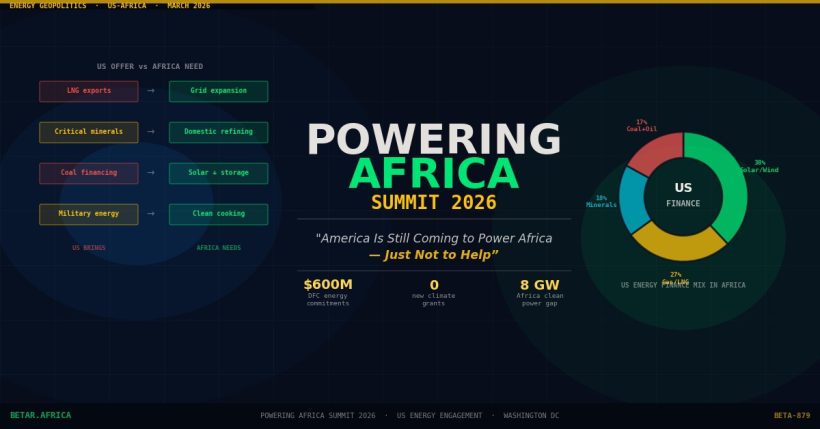
The 11th Powering Africa Summit produced a 500MW solar MOU for Liberia and a fireside chat with the US Energy Secretary. What it did not produce was a single new dollar of concessional climate finance. The model has changed. African energy planners need to change their models too.
The biggest announcement at the 11th Powering Africa Summit was a memorandum of understanding. Sun Africa — a Washington-based developer that has been working the African energy space for a decade — signed an agreement to develop 500MW of solar generation and 200MWh of battery storage in Liberia. Secretary of Energy Chris Wright was in the room. EXIM Bank Chairman John Jovanovic and Bureau of African Affairs Senior Official Nicholas Checker were on stage. The ceremony had all the production value of a major bilateral deal.
But MOUs are not financial commitments. And the gap between what Powering Africa Summits used to deliver and what this one actually delivered tells the story of where US-Africa energy engagement stands in 2026.
What the Summit Theme Signalled
The 2026 summit theme was “Powering the US-Africa Partnership: Energy Infrastructure, Critical Minerals & Investment Strategies.” The words “climate finance” did not appear. The word “transition” appeared once, in a panel title. Clean cooking — a sector that USAID’s Power Africa programme once funded through direct grants — was reframed as an investment opportunity.
This is not subtle. Under Biden, Powering Africa Summits were anchored in climate commitment language: the Just Energy Transition Partnership, the Africa Clean Energy Finance Initiative, Power Africa grant programmes. The vocabulary of 2026 is different: bankable projects, bilateral investment strategies, critical minerals supply chains, EXIM Bank commercial credit facilities.
Energy Secretary Chris Wright — formerly the CEO of Liberty Oilfield Services and a public sceptic of aggressive decarbonisation timelines — represented the administration’s positioning accurately. His message was not that America is abandoning Africa’s energy sector. It was that America is entering it as a commercial partner rather than a development donor.
The Sun Africa Deal: What It Actually Means
Sun Africa’s Liberia MOU is the deal most likely to generate headlines. A 500MW solar project with 200MWh of battery storage would be transformative for Liberia — a country where grid electricity reaches fewer than 30% of the population and the national utility still depends substantially on expensive heavy fuel oil generation.
But 500MW is also larger than Liberia’s entire current installed generation capacity. Projects at this scale take three to five years from MOU to financial close in the best circumstances, and substantially longer when grid integration, land acquisition, transmission investment and power purchase agreement negotiations are involved. Without a credible offtake structure, a DFC loan guarantee or concessional finance from a multilateral to absorb Liberia’s sovereign risk premium, the MOU is a planning document — not a project.
Sun Africa has closed projects before. Its 100MW gas-to-power deal in Guinea closed in 2021 with DFC backing. The question is whether DFC — whose Africa energy mandate has been reoriented toward commercial returns and strategic minerals extraction under the current administration — will provide the same concessional risk-sharing for a Liberian solar project that it might have provided under the previous climate finance framework.
What the Old Model Actually Provided
Power Africa, launched by the Obama administration in 2013 and expanded under Biden, operated through a combination of transaction advisory services, grant funding, DFC loan guarantees and USAID technical assistance. The programme catalysed more than 13,000MW of new power generation capacity across sub-Saharan Africa — not by writing cheques for projects, but by reducing the transaction costs that make African power deals unprofitable for commercial developers.
The JETP — the Just Energy Transition Partnership — was the Biden-era follow-on. For South Africa, the JETP promised $8.5 billion in concessional finance and grant funding to accelerate coal retirement and renewable buildout. For Kenya and Senegal, JETP frameworks were announced in late 2023. These commitments were partially contingent on US bilateral contributions through DFC and USAID.
When the Trump administration withdrew from the JETP in early 2025, it eliminated approximately $1 billion in DFC financing and $150 million in grant commitments to South Africa alone. USAID’s broader energy portfolio — covering off-grid electrification, clean cooking access, and regulatory capacity building in 23 countries — was cut as part of the wider USAID restructuring.
EXIM Bank and the DFC remain. But their mandates are different instruments. EXIM Bank extends commercial credit to US exporters selling into African markets. DFC provides debt and equity to commercially viable projects that serve US strategic interests. Neither institution was designed to absorb the concessional risk that grant finance and technical assistance once handled.
The China Comparison
The strategic framing of US commercial energy engagement in Africa is explicitly competitive with China. EXIM Bank’s latest Africa energy commitments — including grid infrastructure financing in Nigeria and transmission investment in East Africa — are presented under the logic that Chinese state-owned enterprises should not be the only commercial actors offering large-scale energy project financing on the continent.
That competitive logic has merit in narrow terms. US developers and US-manufactured equipment (turbines, solar modules assembled in US supply chains, battery systems) do benefit from EXIM Bank support. African governments with limited options for large-scale project finance gain an additional lender at the table.
But the comparison breaks down on terms. China’s energy financing in Africa — despite well-documented governance and debt sustainability concerns — has consistently offered longer tenors, lower headline rates, and reduced local content requirements relative to EXIM Bank structures. African governments capable of negotiating both sets of terms will use that leverage. The US commercial offer needs to be competitive on price, not just on geopolitical signalling.
COP30 and What Comes After the Summit
COP30 in Belém in November 2026 will be the first major multilateral climate moment where the new US posture is formally on display. The Biden administration committed the US to climate finance contributions that helped define the developed-world envelope. Those commitments have been withdrawn or restructured.
For African negotiators, the practical consequence is that the 2026 summit’s commercial-first framing is not simply a rhetorical shift — it is a preview of what the US will bring to Belém. Commercial lending offers for bankable projects are not substitutes for concessional finance to build transmission infrastructure, fund rural electrification, or retire coal assets. The JETP model was designed to address exactly those gaps. Its withdrawal leaves them unfilled.
The Powering Africa Summit MOU with Liberia is real. Sun Africa is a real developer. EXIM Bank has real capital to deploy. None of that changes the structural gap between what commercial energy finance delivers and what Africa’s 600 million energy-poor residents need.
America is still coming to power Africa. The terms are just different now — and the difference costs.
— Energy & Climate Tech Reporter, BETAR.africa

 UphivaBETAR