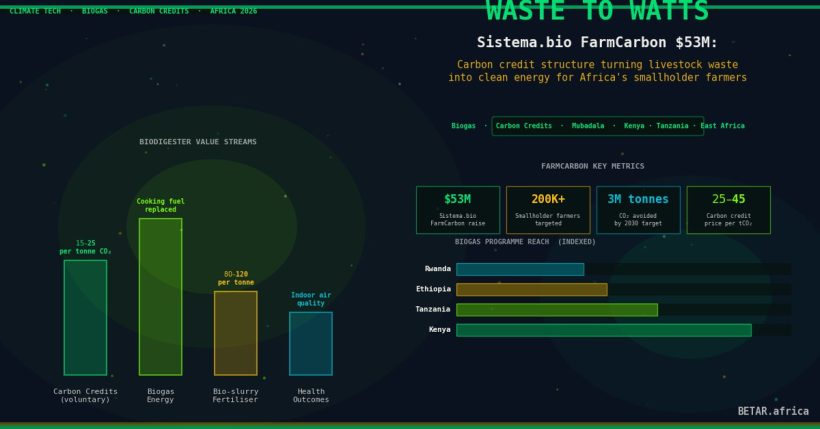

Sistema.bio FarmCarbon $53M: The Carbon Credit Structure Turning Livestock Waste Into Clean Energy for Africa’s Smallholder Farmers
Every carbon credit project in Africa has the same basic problem: the communities generating the credits rarely see much of the money. Sistema.bio’s FarmCarbon vehicle is structured to break that logic — and $53 million from BNP Paribas Asset Management, British International Investment, and the Shell Foundation suggests serious institutional money believes the model works.
FarmCarbon, the new carbon finance vehicle from Sistema.bio, closed its first tranche at $53 million in March 2026. The anchor investors — BNP Paribas Asset Management Alternatives, British International Investment (BII), and the Shell Foundation — are not a typical clean-energy consortium. That combination of European institutional asset management, UK development finance, and energy transition philanthropy is a signal in itself.
The structure they are backing is deliberately unconventional. Rather than treating carbon credits as the headline product, FarmCarbon uses them as a financing subsidy — a mechanism to make biodigester hardware affordable for smallholder farmers who cannot pay the upfront cost. The credit revenue funds the discount. Farmers get cheaper clean energy. The fund gets verified, high-integrity carbon assets from an underserved asset class.
What FarmCarbon Actually Does
FarmCarbon is a dedicated carbon finance vehicle. Its job is to make Sistema.bio’s biodigesters financially accessible to smallholder farmers who cannot pay the upfront cost. The mechanism inverts the typical carbon project flow.
Instead of developers monetising credits at a premium while farmers receive nominal payments, FarmCarbon pre-finances the biodigester hardware. Farmers access the equipment at a discounted price — either upfront or through instalment plans. In exchange, the methane-capture carbon credits generated by each system are assigned to the fund, then sold through long-term offtake agreements to institutional buyers.
The carbon revenue pays for the subsidy. Farmers get cheap clean energy. The fund gets verified, high-integrity credits from an asset class — livestock waste methane — that remains systematically underfinanced.
The carbon credit is not the product; it is the subsidy architecture that makes the product affordable. The farmer accesses cheaper hardware. The fund manages the carbon market side entirely. That inversion — credit as mechanism rather than headline — is what separates FarmCarbon from standard offset projects.
The Technology Underneath
Sistema.bio has been installing prefabricated biodigesters in Kenya since 2017. The technology is straightforward: animal manure from cows, pigs or goats feeds into an anaerobic digestion unit. Biogas is piped directly to household cookstoves, replacing charcoal, firewood or LPG. The solid byproduct — bio-slurry — replaces purchased chemical fertiliser.
The economics are real even before FarmCarbon: Sistema.bio estimates that a single biodigester eliminates both the cooking fuel bill and a significant portion of the farm’s fertiliser spend. The 20-year product lifespan means the economics compound over time. The company has already installed more than 13,000 domestic biodigesters, reaching over 80,000 households, and reports 230,000-plus tonnes of CO₂ mitigated across its existing base.
FarmCarbon scales this by resolving the one constraint that has capped growth: upfront cost. For a smallholder farming household earning $2–4 per day, even a subsidised biodigester can represent months of income. FarmCarbon’s carbon credit mechanism closes that gap structurally, not through charity.
Why Methane, Why Now
The climate rationale for agricultural methane projects is compelling on paper but has historically been difficult to finance. Methane is a potent greenhouse gas — roughly 80 times more warming than CO₂ over a 20-year horizon — and livestock waste is one of the largest agricultural methane sources globally. Africa’s cattle herd of over 300 million animals makes the continent a significant contributor.
Yet the voluntary carbon market has largely neglected agricultural methane at smallholder scale. Projects are administratively complex, geographically dispersed, and difficult to monitor and verify at unit economics that pencil out. Large-scale industrial methane capture — landfills, oil fields — has attracted the capital. Distributed smallholder biodigester programmes have not.
FarmCarbon’s thesis is that aggregation solves the MRV problem. By financing 90,000-plus biodigesters through a single vehicle, the fund can achieve monitoring, reporting and verification at scale — standardising what has previously been bespoke project-by-project work. The projected impact: over 9 million tonnes of CO₂-equivalent reductions over the fund’s deployment horizon. At current voluntary carbon market prices, that is a meaningful asset even accounting for the methodological risk associated with agricultural methane credits.
The clean cooking dimension connects to a broader carbon finance trend across the continent. The African Development Bank’s BEEP programme, which channels carbon finance into clean cooking access across sub-Saharan Africa, operates on a similar premise: that carbon market revenues can be structured as access subsidies rather than developer returns. FarmCarbon extends that logic specifically to agricultural households where cooking fuel and fertiliser costs compound simultaneously.
The Institutional Signal
The investor composition is notable. BNP Paribas Asset Management Alternatives joining a first-close African agricultural carbon vehicle is a signal: mainstream European asset management is building appetite for African carbon assets at scale, not just as philanthropic exposure.
British International Investment — the UK’s development finance institution, backed by FCDO — brings a clear development mandate and a track record of anchoring deals that subsequently attract private capital in East Africa. Shell Foundation, long associated with distributed energy and clean cooking in Africa, adds sectoral credibility.
The $1 billion total mobilisation target over ten years would make FarmCarbon one of the largest dedicated agricultural carbon vehicles ever structured for Africa. Whether it reaches that target will depend substantially on the evolution of voluntary carbon market prices and the resilience of high-integrity agricultural methane credits through the post-Verra methodology revisions that have roiled the market since 2023.
What This Isn’t
FarmCarbon is not a carbon offset scheme where wealthy corporations buy their way to net-zero while African communities see little tangible benefit. The explicit design intent is that carbon revenue subsidises real technology access for real farmers. The hardware is the product; the credits are the financing mechanism.
It is also not a solar story. Africa’s clean energy narrative has been dominated by photovoltaics — understandably, given plummeting panel costs and the continent’s solar resource. But solar does not replace cooking fuel. It does not produce fertiliser. For smallholder farmers whose largest household energy cost is cooking and whose largest input cost is fertiliser, a biodigester addresses both simultaneously. FarmCarbon is financing a technology that is structurally better suited to smallholder agricultural households than solar alone.
That positioning may be its most durable competitive advantage — and the reason BNP Paribas, BII and Shell Foundation are betting on it together.
— Energy & Climate Tech Reporter, BETAR.africa


 UphivaBETAR

 Joseph Busari