
SOLA Naos-1: South Africa’s Largest Private Solar+BESS Project Closes — Built to Decarbonise Sasol and Air Liquide
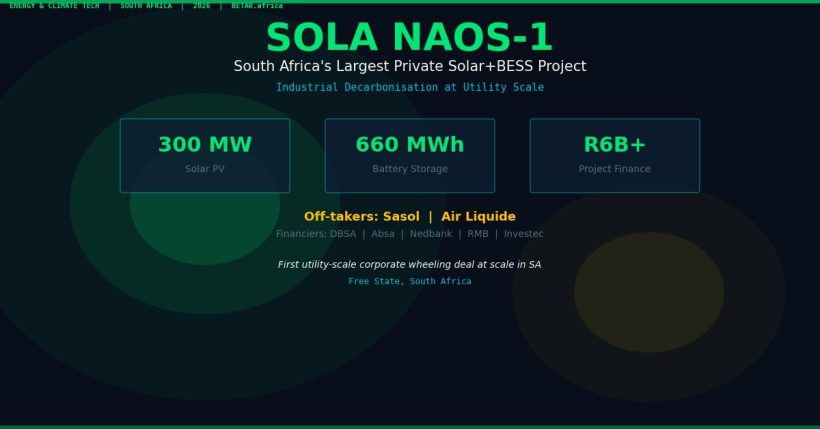
A 300-megawatt solar plant paired with 660 megawatt-hours of battery storage has reached financial close in the Free State. Its off-takers are not households or municipalities but two of South Africa’s largest industrial emitters. The project signals that corporate decarbonisation through private renewable energy is no longer conceptual — it is being financed and built at scale.
South Africa’s corporate renewable energy market has been building momentum since the Electricity Regulation Amendment Act of 2022 opened the door to private generation and direct wheeling across the Eskom grid. The regulatory shift enabled companies to contract directly with private renewable energy developers and receive clean power through the national transmission network — without going through government procurement channels or waiting for Eskom tariff structures to align with decarbonisation ambitions.
SOLA Group’s Naos-1 project, which has now reached financial close, is the first transaction to test what that framework looks like at utility scale. At 300 megawatts of solar PV and 660 megawatt-hours of battery energy storage, Naos-1 is the largest private renewable energy and storage project in South Africa’s history. It is not designed for the grid at large. It is designed to deliver clean, dispatchable power to two specific industrial buyers: Sasol and Air Liquide.
For both companies, the motivation is structural. Sasol — South Africa’s largest single industrial emitter, a chemicals and synthetic fuels company that accounts for a significant portion of the country’s greenhouse gas output — faces mounting pressure from international investors and its own net-zero commitments to reduce Scope 2 emissions from electricity consumption. Air Liquide, the French industrial gases company with major South African operations, has made similar decarbonisation pledges to its European shareholders. Both companies need large volumes of verifiable renewable energy. Naos-1 is their answer.
The Industrial Wheeling Structure
The architecture of Naos-1 reflects the specific requirements of industrial off-takers rather than retail or commercial electricity buyers. Industrial operations — refineries, chemicals plants, gas separation facilities — run continuously. They cannot absorb the variability of solar generation without either curtailing production during low-generation periods or drawing from the Eskom grid as backup. The 660MWh BESS component of Naos-1 is the solution to this problem.
Battery storage at this scale — large enough to cover several hours of significant industrial load — means that when solar generation drops during cloud cover, ramp transitions, or after sunset, the battery bank can dispatch stored energy to maintain continuous supply to the off-takers’ facilities. The result is a renewable energy supply profile that matches industrial demand curves rather than solar irradiance curves. For Sasol and Air Liquide, it is operationally closer to firm power than to variable renewable.
The wheeling mechanism itself adds a layer of complexity that earlier generation South African corporate PPAs did not face at this scale. Power generated in the Free State — where Naos-1 is sited — must travel over Eskom’s transmission and distribution infrastructure to reach Sasol’s Secunda complex in Mpumalanga and Air Liquide’s South African facilities. Wheeling charges and losses are embedded in the project economics, and the structure requires Eskom to facilitate third-party access to its grid — a mechanism that the 2022 regulatory reforms enabled but that had not previously been tested at 300-megawatt scale for an industrial wheeling arrangement of this duration and complexity.
The Financing Stack
Five institutions have provided debt financing for Naos-1: the Development Bank of Southern Africa, Absa, Nedbank, RMB (Rand Merchant Bank), and Investec. The DBSA’s participation provides the development finance anchor that enables the commercial banks to participate — a structure that is standard for large South African renewable energy deals but that here sits outside the REIPPPP procurement framework that has been the traditional conduit for DFI-backed energy lending in the country.
The distinction matters. REIPPPP projects benefit from a 20-year power purchase agreement with Eskom as the state buyer, backed by the government’s Implementation Agreement and the sovereign guarantee that underlies it. The creditworthiness of the off-taker — and therefore the lender’s confidence in debt service — rests on the South African sovereign. Naos-1’s off-takers are Sasol and Air Liquide: large, investment-grade corporates, but private companies without sovereign backing.
The DBSA’s involvement performs a risk mitigation function that is different from its REIPPPP role. In a corporate PPA structure, the DFI’s presence signals to commercial lenders that the project’s environmental and social standards meet international criteria, that the technical due diligence has been conducted to development finance standards, and that there is institutional appetite for the risk profile of the transaction. It reduces the information asymmetry between the project and the commercial lenders, enabling Absa, Nedbank, RMB, and Investec to price the transaction at rates that make the project economics viable for the off-takers.
The commercial bank club is itself notable. Four of South Africa’s five major commercial banks have co-financed the project. That level of commercial bank participation in a single corporate PPA transaction has not been seen before in the South African renewable energy market. It indicates that the banks have assessed the off-taker credit risk of investment-grade industrial corporations as acceptable for large-scale project finance exposure — a judgment that, if it holds, opens significant deal pipeline in South Africa’s corporate decarbonisation market.
What Sasol’s Involvement Signals
Sasol is the most consequential off-taker in Naos-1’s commercial structure, not only because of its size but because of what its renewable energy commitment represents. Sasol’s Secunda plant — which produces synthetic fuels and chemicals from coal through the Fischer-Tropsch process — is among the world’s single largest point-source emitters of CO2, generating approximately 56 million tonnes annually. No solar project eliminates that process emissions. But Sasol’s electricity consumption — the Scope 2 component of its emissions — is addressable through renewable procurement.
Naos-1 provides Sasol with a portion of the clean electricity it needs to begin reducing its Scope 2 footprint at scale. For its international investors and lenders — many of whom have applied escalating pressure on Sasol’s board to demonstrate a credible decarbonisation pathway — a contracted 300-megawatt renewable energy supply represents evidence of progress. It does not resolve the core transition question about Secunda’s long-term future, but it demonstrates that Sasol is constructing the infrastructure of a lower-emissions electricity base.
For SOLA Group and the project’s lenders, Sasol’s off-take is the transaction’s credit backbone. A long-term power purchase agreement with a company of Sasol’s scale and financial standing — even with the complexity of wheeling infrastructure — gives the debt service structure a counterparty quality that most corporate PPA structures in South Africa have not previously achieved.
A Template for Industrial Decarbonisation
South Africa’s corporate renewable energy market, since the 2022 regulatory opening, has primarily been served by embedded generation — solar panels installed on or near a company’s facilities, generating power that is consumed directly without using the Eskom grid. The embedded model works well for companies with large roof areas or proximate land, limited to capacities of a few tens of megawatts in most cases. For industrial operations that consume hundreds of megawatts continuously, embedded generation is structurally insufficient.
Naos-1 demonstrates the alternative: large-scale renewable generation in high-resource areas, wheeled over the national grid to industrial facilities wherever they are located in South Africa. The 660MWh battery component solves the dispatchability problem. The wheeling mechanism, now validated at 300-megawatt scale, becomes a replicable infrastructure template. And the five-institution financing club demonstrates that the debt markets exist to fund these transactions — provided the off-taker credit profile is strong enough.
The implication for other large South African industrial emitters — mining companies, cement producers, paper and pulp operations, data centres — is that the Naos-1 structure is available to them. Not every company will have Sasol’s credit standing or Air Liquide’s parent company guarantee. But the project establishes the commercial and financing precedent. Future deals will negotiate terms against Naos-1 as the reference transaction.
Regional Relevance
Beyond South Africa, Naos-1 carries a signal for other African markets where large industrial off-takers exist but the renewable energy infrastructure to serve them does not. Nigeria’s cement and manufacturing sectors, Kenya’s tea and horticulture processing industries, Zambia’s copper mining operations — each represents a class of industrial electricity consumer that could potentially support a corporate PPA structure analogous to Naos-1, given adequate regulatory frameworks for wheeling and project finance ecosystems capable of supporting the transaction.
South Africa’s market is further developed than any of these: it has the regulatory framework, the commercial banking depth, the DFI presence, and the industrial off-taker base needed to make Naos-1 viable. That combination does not exist in most other African markets today. But the design pattern — large-scale renewable plus storage, wheeled to industrial off-takers over a national grid, financed through a DFI-anchored commercial bank club — is transportable in principle, if the underlying market conditions can be built.
Africa’s industrial decarbonisation challenge will not be solved by rooftop solar and small embedded generation. Naos-1 shows what solving it at industrial scale requires: the right regulatory framework, credible off-takers, patient DFI capital, and commercial banks willing to follow. In South Africa, those conditions have aligned. The continent is watching to see where they align next.

 UphivaBETAR