
USAID Exit from African Education: Who Fills the $2 Billion Gap?
The US government’s foreign aid freeze has eliminated the largest single source of external education funding across sub-Saharan Africa. The programmes that collapse first are not the headline ones — they are the ones that taught children to read.
March 2026
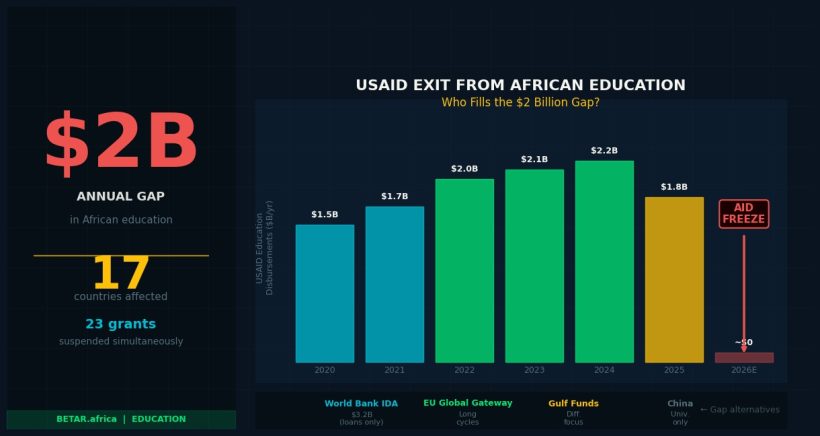
In February 2026, USAID’s active education portfolio in sub-Saharan Africa — 23 grants across 17 countries — was suspended simultaneously under the US government’s foreign aid freeze, with no transition mechanism and no successor-funding designation. The suspension affected literacy coaches in Kenya’s Northern Counties, girls’ retention programmes in Tanzania and Malawi, out-of-school children programming in Nigeria’s North East, and teacher training systems embedded in government annual operating plans across the Sahel.
This is the operational reality beneath the headline numbers. The DOGE-era dismantling of USAID confirmed cuts to approximately 85 per cent of Africa-facing education grants by end of 2025 — removing the largest single source of external, grant-funded education support across sub-Saharan Africa in a single administrative action. The World Bank estimates that USAID was disbursing between $1.8 billion and $2.2 billion annually in African education support in the period 2022–2024. No single alternative donor is positioned to replace that on anything like the current timeline.
What Is Actually Being Cut
The visible programmes — the branded initiatives with evaluation reports and congressional testimony — represent only the top layer. Below them sit dozens of embedded operational grants: reading assessment systems, teacher inspection infrastructure, school feeding linked to attendance incentives, and textbook procurement mechanisms that ministries built into their planning cycles on the assumption of continued US funding.
The most acute exposure sits in the Sahel and East Africa. In Mali, Burkina Faso, and Niger, USAID was funding between 40 and 60 per cent of all external education programme expenditure. In Ethiopia, USAID’s portfolio was running at approximately $120 million annually before the freeze, supporting literacy programmes in Amhara and Oromia where state system capacity is lowest. In Nigeria, USAID programming through the Education Crisis Response initiative reached 1.2 million out-of-school children in conflict-affected communities at its peak.
“What the aid freeze has done is remove the floor from systems that were already fragile,” said Dr. Amara Kouyaté, who directs the Regional Education Policy Centre at the Economic Community of West African States in Abuja. “Ministries in several member states had USAID-funded activities embedded in their Annual Operating Plans. Those lines have simply disappeared. There is no contingency. These were not supplementary programmes — they were load-bearing.”
The gender dimension compounds the exposure. USAID was the primary external funder of girls’ secondary education retention programmes in Tanzania, Malawi, and Zambia — covering menstrual hygiene, school-based counselling, and conditional cash transfer elements that research had consistently linked to reduced dropout rates for girls aged 12–16.
For Ghana, the abrupt termination of the USAID/Ghana Girls’ Education programme — a five-year initiative covering 3,200 schools in the Northern, Savannah, and Upper East regions — represents a particular planning challenge. “We incorporated those programme resources into our sector plan. There was every expectation of a successor grant cycle,” said Dr. Yaw Adutwum, Ghana’s Minister of Education. “We are now doing an emergency assessment of which elements can be absorbed into the domestic budget and which will simply stop.”
The Gap No One Can Fill Alone
The World Bank’s International Development Association, which lends rather than grants, has increased its Africa education envelope — IDA commitments reached $3.2 billion in fiscal year 2025. But IDA is designed for capital investment: classrooms, connectivity infrastructure, curriculum reform. It is not designed for the operational programming — reading coaches, assessment systems, girls’ retention incentives — that USAID’s grant portfolio covered. Substituting a lending instrument for grant funding also adds fiscal pressure to governments already managing constrained debt profiles.
“We can lend to governments to build the system. We cannot substitute for the operational grants that kept it running day to day,” said a World Bank education specialist in the Africa Human Development practice, speaking on background. “The gap is real and it will materialise in enrolment and learning outcomes data within two to three years.”
The European Union’s Global Gateway education framework and the AfDB’s education window represent the most credible alternatives at scale, but their disbursement timelines run on four-to-seven-year design cycles — structurally misaligned with the immediacy of the cuts. Gulf state funding from the UAE’s Abu Dhabi Fund for Development, the Saudi Fund for Development, and Qatar Fund for Development is growing in African education, particularly in Sahel and East Africa, but their operational footprint is concentrated in school construction and Islamic education, not the secular early-grade literacy and girls’ retention programming where USAID exposure is highest.
China’s education footprint — university scholarships, Confucius Institutes, and vocational training under the FOCAC framework — is expanding at the tertiary and post-secondary level. Beijing announced 50,000 annual African university scholarships at the 2024 FOCAC summit. But China does not run early-grade literacy or primary teacher training programmes in Africa. The gap between what Beijing offers and what USAID provided is not a matter of political will. It is a matter of institutional design.
The Domestic Investment Question
The USAID withdrawal arrives at the precise moment the African Union is finalising CESA 2026–2035 — the successor to a continental education strategy whose targets were missed almost across the board. BETAR’s audit of CESA 2016–2025 documented that the 26 per cent budget allocation benchmark was not met by a single continental economy, and secondary enrolment parity was missed in 21 of 33 assessed countries.
The question CESA 2026–2035 must answer — and which current drafts do not yet adequately address — is whether the new strategy incorporates a realistic financing architecture that accounts for the withdrawal of the US as a major bilateral donor. The AU’s Education ministerial meeting in Addis Ababa, scheduled for May 2026, is expected to include a session specifically on external financing resilience. Kenya’s Cabinet Secretary for Education, Julius Ogamba, told BETAR that Nairobi intends to table a paper on domestic resource mobilisation benchmarks at the summit. “We cannot keep writing strategies that assume external grant funding at 2020 levels. That world is over,” he said.
“We have been talking about domestic resource mobilisation for education for twenty years,” said Fatima Al-Rashid, Africa education director at UNICEF’s East and Southern Africa Regional Office in Nairobi. “The USAID withdrawal forces the conversation from aspiration to calculation. What does a 4 per cent GDP education spend actually look like in Ethiopia’s current fiscal position? Those are the questions ministries are now working through under pressure.”
The Ledger Does Not Balance
There is no version of the replacement funding picture — assembled from current World Bank, EU, Gulf, and China commitments — that adds up to the $2 billion annual gap on the timescale on which USAID programmes have been terminated. The honest accounting puts the structural shortfall at between $1.2 billion and $1.6 billion annually in grant-equivalent terms, concentrated in foundational and primary education, girls’ programming, and conflict-affected country operations.
That shortfall will not appear in a single headline. It will appear in the reading assessment results of children who were in Standard 1 in 2026 and will sit Standard 4 examinations in 2029. It will appear in girls’ secondary completion rates in Tanzania and Malawi in 2027. It will appear in the out-of-school children numbers from Nigeria’s North East, which had been declining and will now, absent continued programming, reverse.
The system absorbs these shocks quietly and slowly. By the time the data is available, the political moment for accountability will have passed. That lag — between funding withdrawal and measurable outcome — is what makes the USAID exit so consequential and so underreported.
This article builds on BETAR’s education series, including Africa’s Learning Poverty Crisis, CESA 2026–2035 Strategy, Francophone Africa’s EdTech Funding Gap, and African University Funding Crises. Research Desk Editor and Policy & Regulation Reporter have been flagged for cross-desk coordination.

 UphivaBETAR