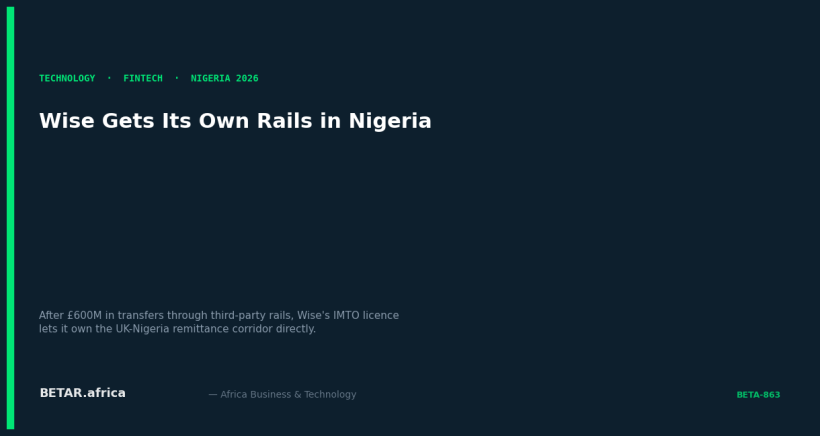

Wise has secured a long-awaited International Money Transfer Operator (IMTO) licence from the Central Bank of Nigeria — a milestone tucked inside a UK government communiqué following the UK-Nigeria Enhanced Trade and Investment Partnership ministerial dialogue on March 16, 2026. For the UK-Nigeria remittance corridor, which moves more than $3.5 billion annually, the implications are material. For the fintechs that have owned that corridor, the pressure just increased.
Wise’s situation in Nigeria before this approval was structurally awkward. The company had already facilitated transfers of nearly £600 million into Nigeria — a substantial volume — but had achieved that while operating through third-party IMTO partners who held both the regulatory licence and the payment rails. Wise was, in effect, renting access to a market it was already deeply embedded in. That arrangement constrained its ability to compete on price: the cost of third-party intermediation ate into the margin that would otherwise make Wise’s mid-market rate model compelling for Nigerian corridor users.
The IMTO licence changes that equation directly. Wise will now operate its own rails into Nigeria, removing a layer of cost and giving it the ability to price more aggressively against incumbents that have long benefited from a lack of tier-one international competition in the naira payout market.
What the CBN’s IMTO Framework Actually Requires
The Central Bank of Nigeria revised its IMTO guidelines in January 2024, introducing two consequential changes. First, it mandated that all inbound remittances be paid out in naira to bank accounts — ending the previous regime under which dollar payouts to beneficiaries were permitted. Second, it removed allowable limits on exchange rates quoted by IMTOs, in effect opening up rate competition among licensed operators.
The naira-payout requirement is the one that matters most for Wise’s entry. Wise’s product in other markets is built around recipients receiving funds in local currency — naira-denomination is the default, not a constraint. For incumbents that had previously offered dollar receipt options as a differentiator, the January 2024 rule change levelled that ground. Wise is entering a market already running on the rails it was designed for.
The IMTO licence itself requires significant capital commitment and regulatory infrastructure, which is why the approval process has stretched over years for Wise. The CBN’s minimum capital requirement for IMTO licences sits at $1 million, with ongoing reporting, compliance, and audit obligations. For a company of Wise’s scale, these are manageable. They are why smaller fintechs have often chosen to partner with existing IMTO holders rather than seek licences independently — a strategic path that Wise is now exiting.
The Competitive Implications for Chipper Cash, Flutterwave Send, and Grey
The UK-Nigeria corridor has not lacked for fintech competition. Chipper Cash, valued at over $2 billion at its peak, built its user base partly on UK-Nigeria flows. Flutterwave’s Send product benefits from the company’s ownership of underlying payment rails across the continent — an infrastructure advantage that makes it one of the fastest settlement options for Nigerian recipients. Grey Finance has carved out a distinct position serving Nigerian freelancers and remote workers who need to receive foreign currency and swap it efficiently into naira.
Each of these players has a different structural position, and Wise’s entry does not threaten all of them equally.
Chipper Cash’s exposure is highest on pure consumer remittance — the UK-based Nigerian professional sending £500 home monthly. Wise’s mid-market rate model with transparent fees, now running on its own licence, should offer a compelling alternative for this user segment. Chipper’s counter-argument has historically been speed and mobile-first UX; Wise is credible on both.
Flutterwave’s infrastructure position is more durable. Wise will compete at the consumer layer, not in the payment rails business — and Flutterwave’s Send product may actually continue to handle some of the downstream settlement even as Wise builds out its own stack. The two companies are as much potential infrastructure partners as direct competitors.
Grey’s position may be least disrupted. Its core use case — foreign accounts for Nigerians receiving international payments, not UK-based Nigerians sending home — is a different product category. A Wise IMTO licence does not address the foreign account receipt use case that Grey has built its growth on.
NALA, which secured its own CBN IMTO licence and NIBSS integration earlier this year, represents perhaps the most direct competitive parallel: a foreign-headquartered fintech that went through the full CBN licensing process and now operates its own Nigerian rails. The UK-Nigeria corridor is NALA’s primary battleground. Wise’s arrival intensifies that fight.
The Market Wise Is Entering
Nigeria’s total remittance inflows reached $23 billion in 2025 — approximately 12% of GDP — the highest level recorded in five years. The United Kingdom is the second-largest source of that inflow after the United States, accounting for an estimated $3.5 billion annually. The broader UK-Nigeria bilateral trade relationship has grown to £8.1 billion per year, with the March 2026 ETIP dialogue producing commitments across fintech, manufacturing, agriculture, and education. Wise’s licence was one of several trade outcomes announced from that meeting, alongside investments from Nigerian financial institutions and manufacturing sector partnerships.
The pricing opportunity in this corridor remains significant. Traditional transfer channels on UK-Nigeria still charge between 3% and 6% per transaction. Digital-first players have pushed average costs toward the UN SDG target of below 3%, but adoption of those cheaper options remains uneven across demographics and geographies within the UK’s Nigerian diaspora. Wise’s arrival — with its brand recognition in the UK and its reputation for fee transparency — may accelerate that adoption curve among segments that have continued to use legacy transfer services.
What Comes Next
Wise has not announced a specific go-live date for its direct Nigeria operations under the IMTO licence. The timeline between licence award and operational launch involves technical integration — connecting to NIBSS, the Nigeria Inter-Bank Settlement System, and building the compliance and KYC infrastructure for local operations. Based on NALA’s experience, which integrated with NIBSS after licence approval and began live operations within weeks, Wise’s direct launch could be measured in months rather than years.
When it does go live on its own rails, the UK-Nigeria remittance corridor will have a new price anchor. The question is not whether that will put pressure on incumbent pricing — it will. The question is which of those incumbents have built enough on top of price to withstand a well-capitalised competitor entering at the bottom of the rate stack.
— Technology Desk, BETAR.africa

 UphivaBETAR