
Africa’s Language of Instruction Crisis: Why Teaching Children to Read in the Wrong Language Drives Learning Poverty
The evidence that mother-tongue instruction improves foundational literacy is three decades old and overwhelming. Most African governments have read it and continued teaching children to read in languages those children do not understand. That choice is costing the continent its foundational learning base.
March 2026
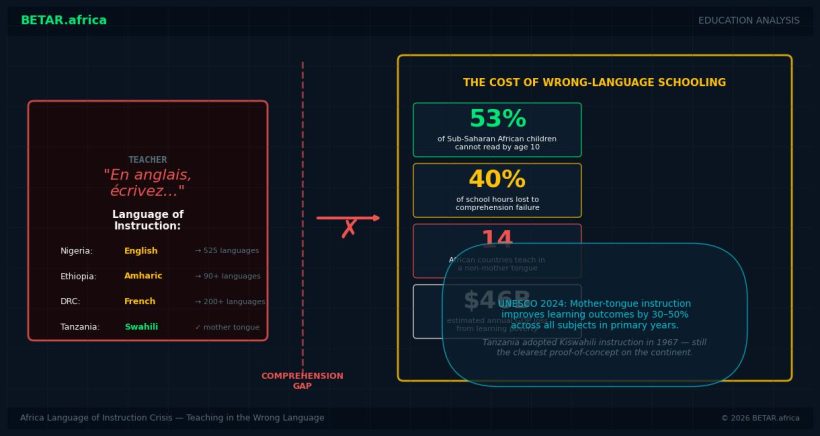
When a child in Kano State sits in a Grade 1 classroom and is handed an English primer, two things happen simultaneously. She begins learning to read. And she begins that process in a language she cannot yet hold a basic conversation in. The research on what follows is not contested: children taught to read in a language they do not speak at home read later, read slower, and demonstrate lower comprehension at every primary grade level than children taught in their mother tongue. The gap is measurable, consistent, and documented across more than 150 comparative studies spanning every inhabited continent.
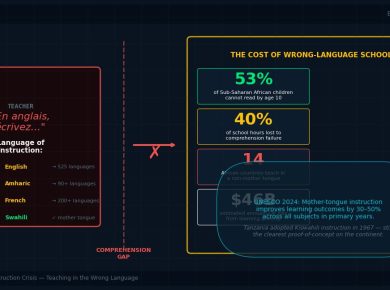
Africa is running this experiment at scale. UNESCO Institute for Statistics data from 2023 estimates that approximately 40 per cent of sub-Saharan African children attend primary schools where the medium of instruction is a language they do not speak at home — predominantly English, French, or Portuguese. In West and Central Africa the figure is higher. In Nigeria, despite a national policy mandating mother-tongue instruction in the first three years of primary, a 2022 Universal Basic Education Commission assessment found fewer than 30 per cent of sampled schools in Kano, Cross River, and Lagos delivering any early literacy component in a local language.
Rwanda’s Cautionary Case
Rwanda’s 2009 decision to switch primary instruction from Kinyarwanda and French to English is the continent’s most-studied language policy reversal. It was driven by politics — Rwanda’s pivot from the Francophone sphere toward the Commonwealth and East African Community — not pedagogy, and announced with a one-year implementation timeline. A 2014 World Bank assessment documented the result: primary completion rates and national assessment pass rates fell in the transition years; teacher surveys showed a substantial proportion of primary teachers required to instruct in English did not have adequate English proficiency to do so.
Rwanda’s learning outcomes recovered through the following decade, supported by intensive teacher development and curriculum reform. But the recovery does not rehabilitate the 2009 decision. The children who passed through primary in 2010 and 2012 bore the transition costs. The lesson is not that language switches are irreversible. It is that language policy made for political reasons imposes real and measurable costs on children who have no vote in the matter.
Ethiopia’s Counter-Evidence
Ethiopia’s federal system provides the clearest African counter-example. Primary instruction is delivered in regional languages from Grade 1 through Grade 8: Afaan Oromo in Oromia, Amharic in Amhara, Tigrinya in Tigray. English is introduced as a subject from Grade 1 but does not become the medium of instruction for other content until secondary. A 2021 comparative study by the Ethiopian Ministry of Education and the World Bank’s Human Capital Project found that Ethiopian primary students in mother-tongue instruction systems demonstrated higher reading fluency in the instruction language and comparable or better cross-linguistic literacy transfer — the ability to apply reading skills in a new language — than peers in English-medium systems in Kenya and Tanzania. The Ethiopia model is logistically demanding: standardising orthographies for 37 languages, producing textbooks in each, and deploying teachers who speak the local language. CESA 2026–2035, adopted by AU Heads of State in February 2025, includes mother-tongue instruction in the foundational learning strategic area for the first time in any continental education strategy — a direct acknowledgment that Ethiopia’s outcomes offer something worth replicating.
Tanzania, Kenya, and the Incomplete Transition
Tanzania’s experience reveals a different failure mode. Swahili is the national language and medium of primary instruction — on paper, the correct policy. Yet the 2023 National Learning Assessment found only 36 per cent of Standard 4 students at minimum literacy proficiency in Swahili. The problem is not the language choice: it is teacher supply, class sizes, and an unreformed curriculum. The paradox sharpens at secondary school, where Tanzania switches from Swahili-medium to English-medium instruction at Form 1, with no structured bridge programme. Students who managed adequately in Swahili encounter English-medium biology and history and frequently disengage. Tanzania’s government has discussed extending Swahili into secondary for a decade; the proposal has repeatedly stalled.
Kenya’s Competency-Based Curriculum reform mandates mother-tongue instruction in lower primary (Grades 1–3), with Swahili and English introduced progressively from Grade 4. The policy direction is correct; implementation is incomplete. A 2024 Kenya Institute for Curriculum Development review found that in approximately 45 per cent of sampled lower-primary classrooms in Nairobi and Mombasa, teachers were defaulting to English and Swahili because they did not speak the indigenous languages of their students. In a country with 67 indigenous languages, matching teachers to learners’ mother tongues in urban settings is genuinely difficult. The principle is sound; the system has not been built to execute it.
Why the Evidence Keeps Losing
The political economy of language-of-instruction reform is governed by incentives that consistently override the learning data. The first is parental demand. Across sub-Saharan Africa, surveys consistently show parents — including low-income parents in rural areas — prefer English-medium or French-medium instruction. The reasoning is labour market signalling: colonial language proficiency is accurately perceived as a gateway to formal employment and university entry. “Parents are not wrong that English opens doors,” said Dr. Alison Phipps, UNESCO Chair in Refugee Integration through Languages and the Arts, who has advised on multilingual education policy in East Africa. “The problem is that a child who has not yet learned to read in any language — because they were taught in English before they understood it — is not going to open that door either.”
The second constraint is sunk cost inertia. Textbook inventories, examination systems, teacher training frameworks, and school inspection protocols are built around colonial-language media. Switching requires rebuilding all of it: orthography standardisation, new textbooks, teacher retraining, redesigned assessments. Most ministries of education, operating under fiscal pressure and competing commitments, rationally defer it. The USAID exit has sharpened this constraint. USAID’s Early Grade Reading programmes — deployed in Ethiopia, Kenya, Nigeria, Tanzania, and elsewhere — were among the largest externally funded efforts explicitly supporting mother-tongue literacy instruction and local-language materials development. Their removal leaves an estimated gap exceeding $300 million in foundational reading programme funding, with mother-tongue programmes disproportionately affected.
The Cost of Deferral
CESA 2026–2035 creates an accountability frame for language of instruction that 2016–2025 lacked. The Africa FLEX 2024 pledge on eliminating learning poverty commits signatories to treating the learning poverty rate — not the enrolment rate — as the primary educational performance metric. Language of instruction sits at the centre of that commitment. The research consensus estimates that mother-tongue instruction in the first three years of primary improves early reading outcomes by the equivalent of two to three grade levels. In a continent where 89 per cent of children cannot read by age 10, that is not a marginal intervention. It is foundational.
The choice to teach a child to read in a language she does not speak is a policy decision with a documented cost — not a cultural inevitability or an administrative necessity. Africa’s education systems have been paying that cost for six decades. The research on the alternative has been available for three. The distance between those two facts is the continent’s language-of-instruction crisis.

 UphivaBETAR


 Joseph Busari