
Africa’s startup equity market recorded its most difficult quarter in five years in Q1 2026. Series A rounds were scarce. Growth-stage cheques were rare. And yet the deal trackers kept reporting transactions — because a different kind of capital was moving into the gap. Debt. Not the emergency bridge variety, deployed reluctantly when equity fails. Structured, intentional venture debt and private credit, written by a set of lenders who have been quietly building African credit books for years and who now find themselves, somewhat unexpectedly, at the centre of the continent’s startup financing story.
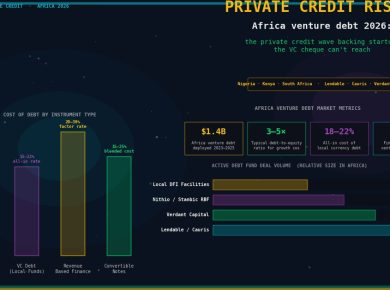
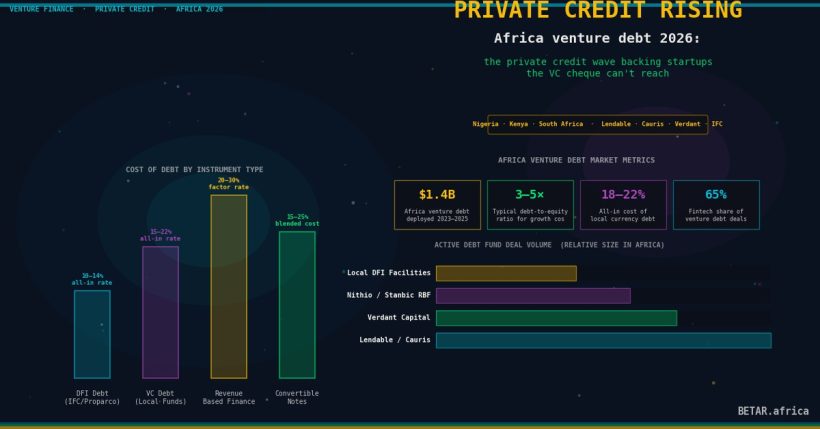
BETAR’s Q1 2026 funding tracker shows that debt deals accounted for 23 percent of all disclosed African startup transactions in the first quarter — up from 9 percent in Q1 2025. The absolute figure is not, on its own, remarkable; the velocity of the shift is.
A Four-Layer Market
The African venture debt market is not monolithic. BETAR’s Q1 2026 analysis identifies four distinct capital layers, each with different risk appetite, return expectations, and implications for the startups borrowing from them.
Layer one: Development finance institutions. DFIs remain the bedrock of structured debt to African startups, and Q1 2026 offered two headline examples. Afreximbank provided $50 million in debt financing to Spiro, the electric motorcycle manufacturer operating across four African markets, earmarked for battery swap infrastructure expansion. FMO, the Dutch development bank, wrote a $21 million facility to Lula, the South African SME lender, to extend credit to small businesses underserved by the traditional banking system.
These are not commercial deals in a pure sense — Afreximbank’s mandate is African trade and economic development, and FMO’s blended finance model means its pricing is typically below market. But they are real, deployable capital, and the companies receiving them are building businesses that need to service debt, not equity investors waiting for a liquidity event.
Layer two: Commercial banks writing structured facilities. This is the most significant shift in Q1 2026 compared to prior periods. Rand Merchant Bank (RMB) provided $94 million in structured debt to SolarAfrica, the South African commercial solar and wheeling platform, and a separate $30 million facility to GoCab, the Kenyan mobility operator. These are commercial-rate transactions from a bank with no development mandate, underwritten on asset quality and cashflow — the same criteria applied to any corporate borrower.
RMB’s presence in two high-profile African startup debt deals in a single quarter is not a coincidence. It reflects a deliberate push by South African corporate banks into the African growth-company credit space, filling a void left by the retreat of international growth equity funds from the continent.
Layer three: Specialist credit funds. Lendable, Symbiotics (via the REGMIFA vehicle), and Nithio are the most active names in what might be called the “specialist Africa credit” segment — funds built explicitly to underwrite African fintech and cleantech lending at scale. In Q1, Symbiotics and REGMIFA closed a $5.5 million facility to Fido, the Ghanaian digital lender. Nithio’s FAIR (Financing for Africa’s Innovative Resilience) facility provided $7 million to Spiro — a separate tranche from the Afreximbank deal, focused specifically on financing the end-customer purchase of electric motorcycles.
The Nithio transaction illustrates something important about where specialist credit is flowing: toward asset-backed structures where the underlying collateral (the physical motorcycle, the solar panel, the generator) provides lender protection. This is not a concession to risk aversion. It is an acknowledgement that Africa’s venture debt market has not yet developed the covenant infrastructure and exit mechanisms that make cashflow-only lending viable at scale.
Layer four: Pure venture debt. The Q1 data contains one clear example of the equity-adjacent venture debt model familiar from the US and European markets: Camber Road Advisors and Trifecta Capital jointly provided a $4.5 million venture debt tranche as part of Zeno’s recent financing round. Zeno, the Kenyan logistics-tech platform, took the debt alongside equity investment — a structure that gave founders dilution management while preserving optionality on the equity side of the round.
“The logic of combining debt and equity in a single round is compelling when you are building infrastructure that generates revenue from day one but has capital requirements that grow with the network,” said Michael Spencer, Zeno’s co-founder, in an interview with BETAR in February. “The debt services itself against the P&L; the equity funds the longer-horizon bets.”
The DFI Factor
A structural feature of Africa’s emerging venture debt market distinguishes it sharply from its US or European equivalent: the majority of Q1 2026 structured debt carries a DFI fingerprint, either directly (the lender is a DFI) or indirectly (a commercial lender is operating under a DFI risk-sharing agreement).
This matters for the companies borrowing. DFI-backed facilities typically price at 200–400 basis points below equivalent commercial debt. They often carry development covenants — requirements around job creation, financial inclusion metrics, or emissions reporting — that add reporting burden but rarely restrict operational decisions. And they are patient in ways that commercial lenders are not: Afreximbank’s facility to Spiro is structured over seven years, a tenor that would be exceptional from a commercial credit fund.
But DFI capital is not unlimited, and it is not distributed evenly across sectors or markets. E-mobility and cleantech have been the primary beneficiaries — the development mandate aligns cleanly with climate finance objectives, and the asset-backed structures reduce credit risk to manageable levels. Fintech working capital lending and pure SaaS are considerably harder cases for DFI credit committees whose mandate requires a defensible impact rationale.
Kola Aina, founding partner of Ventures Platform, described the dynamic succinctly in an interview with BETAR in March: “DFI debt has become the lubricant of African startup finance — not the engine. It gets things moving in sectors where commercial capital is too scared to go first. The question is whether commercial debt follows at scale, or whether we end up with a market permanently dependent on subsidised capital.”
Where Debt Works, and Where It Doesn’t
The deal data points to three sectors where venture debt is functioning as genuine alternative capital: electric mobility, fintech lending, and commercial cleantech infrastructure.
E-mobility is the clearest case. The asset-backed structure — debt financing the purchase of motorcycles or battery swap infrastructure, repaid from revenue as drivers earn — is almost purpose-built for debt rather than equity. The unit economics are visible from day one, the collateral is tangible, and the revenue stream is predictable. Spiro took $57 million in debt across two DFI facilities in Q1. It would be extraordinary to see that quantum raised in equity at anything close to founder-friendly terms in the current market.
Fintech working capital lending — where a platform lends to SMEs and needs capital to fund its own loan book — is the second natural home for venture debt. Lula’s $21 million FMO facility is a textbook example: FMO is, in effect, a wholesale lender to a retail credit platform. The risk is credit performance of the underlying SME portfolio, not equity valuation risk. This is a transaction that works on commercial logic regardless of the state of African venture markets.
Commercial cleantech — solar PPAs, wheeling infrastructure, off-grid energy — is the third. RMB’s $94 million SolarAfrica facility is not technically “venture” debt in the startup sense; SolarAfrica is a mature operator with long-term contracts. But the deal illustrates the direction of travel: as cleantech platforms in Africa mature and demonstrate contracted revenue, they become increasingly debt-financeable on pure commercial terms.
Where debt does not work is in consumer technology, marketplace businesses, and early-stage SaaS — models without either asset collateral or predictable near-term revenue. For these companies, the equity drought is real and unaddressed. Debt is not a substitute; it is a different tool for a different job.
Structural Shift or Structural Patch?
The 23 percent debt share of Q1 2026 African startup deals will not hold at that level permanently. As equity markets recover, as DFI capital is deployed and recycled, and as commercial lenders develop the underwriting track record needed to write African growth-company debt at scale, the composition of startup financing will shift again.
What is likely to prove durable is the category itself. African startups in asset-intensive sectors have discovered, through necessity, that debt works — that servicing a structured facility from operating revenue is not the capitulation it might once have seemed, but a rational capital allocation decision. That discovery is unlikely to be forgotten when equity markets re-open.
“The founders who have used debt well in this cycle have learned something that their predecessors in the 2021 boom never had to,” Aina said. “That capital structure matters, that dilution compounds, and that not every dollar of growth needs to be funded with equity. That is a healthy thing for the ecosystem, even if the circumstances that produced the lesson were not.”
Deal data sourced from BETAR’s Q1 2026 Africa Startup Funding Tracker. See also: BETA-561 (Africa Series A Drought and Local VC Rise), BETA-745 (Africa Q1 2026 Startup Funding Review), BETA-822 (Q1 2026 Investor League Table).


 UphivaBETAR
 Joseph Busari