
By BETAR.africa Creative Economy Desk
A 200-seat theatre. Sixty percent occupancy on a good night. A ticket priced at R150. That generates R18,000 in gross box office revenue per show. A modest three-person theatrical production — rehearsal space rental, set construction, costume, cast fees, technical crew, marketing — costs R350,000 to R700,000 to mount in the South African market. At R18,000 per show, a producer needs the show to run for nineteen to thirty-nine nights at that occupancy rate just to recover production costs. Most productions do not run for nineteen nights.
That arithmetic is the structural reality of African performing arts economics. The content is world-class; the commercial model is not.
South Africa: The Production Cost Stack
South Africa is the continent’s most developed theatrical market, with a performing arts infrastructure spanning state theatres, commercial venue chains, and an annual festival circuit. The production cost structure reflects that maturity.
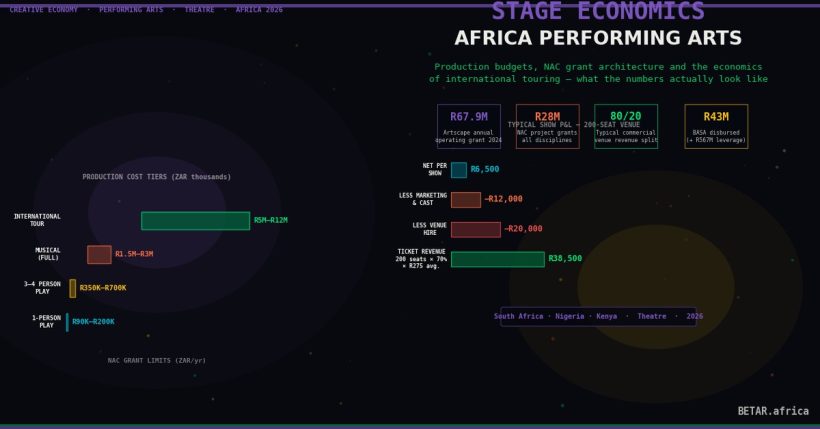
A solo or two-person fringe production — the entry point for independent producers — costs R50,000 to R200,000 to mount, covering rehearsal space hire, basic set and costume construction, technical rider, and marketing. A three-to-four person production on a larger fringe programme runs R350,000 to R700,000. A mainstage commercial production — the kind that books Teatro at Montecasino or the Joburg Theatre’s main house — operates with budgets of R500,000 to R2 million or above, depending on cast size, set complexity, and licensing fees for adapted works.
At privately operated commercial venues, producers typically work on a revenue split of 70/30 to 80/20 in favour of the producer, after venue hire costs. State venue engagements — Artscape Theatre Centre in Cape Town, the Playhouse Company in Durban, the South African State Theatre in Pretoria — offer subsidised hire rates that reduce the upfront cost burden, but subsidy levels have not kept pace with inflation. Artscape received a government operational grant of R67.9 million for 2024/25 — a 0.2% increase year-on-year against CPI running at a multiple of that rate.
The ticket price ceiling compounds the problem. South African theatre audiences will typically pay R80 to R350 per ticket depending on venue positioning and production profile. Premium commercial productions can charge R500 or above, but the majority of original work — by African writers and companies — prices at R150 to R250. The gap between that price ceiling and production cost floor requires either grant funding, corporate sponsorship, or an extended run to close.
The Grant Architecture
The National Arts Council of South Africa (NAC) functions as the primary institutional funder for companies that cannot close the commercial gap on their own. Its Arts Organisation Support Funding programme operates on a tiered structure linked to organisational maturity: Foundation Phase organisations (three to five years operating) receive up to R350,000 per year; Intermediate Phase (five-plus years) up to R550,000; Established Phase (ten-plus years) up to R1 million. Grants are three-year awards reviewed annually.
The NAC’s total annual disbursement across all creative disciplines — theatre, music, visual arts, craft — runs at approximately R28 to R30 million per funding call. No discipline-specific breakdown is published in its annual reports. The Business and Arts South Africa (BASA) Supporting Grants Programme functions as a leverage multiplier: since inception, BASA has deployed over R43 million to more than 1,700 beneficiaries, catalysing more than R567 million in private sector sponsorship — a 13:1 leverage ratio against its own disbursements. “BASA has a long-standing history of bringing together the business and the creative sectors to drive socio-economic growth and development in South Africa,” Ashraf Johaardien, BASA CEO, said in the organisation’s Supporting Grants programme communications.
In Kenya, the Kenya Cultural Centre and its Kenya National Theatre operate as publicly subsidised cultural infrastructure rather than commercial venues. Venue hire for performing companies runs KSh 20,000 to KSh 50,000 per day — accessible pricing for local companies but generating insufficient commercial revenue to sustain the facility without government subvention. KECOBO, Kenya’s copyright body, does not publish performing arts-specific royalty collection data that would allow an independent assessment of the live performance royalty economy’s scale.
Nigeria’s National Council for Arts and Culture (NCAC) administers federal arts funding, but the allocation to stage performance is not publicly disaggregated. State-level arts boards in Lagos, Abuja, and Rivers State provide project grants and venue access at rates that vary significantly by administration. The structural pattern across all three markets is the same: government funding is present, often growing in absolute terms, but insufficient relative to the cost of production at professional scale.
Festival Economics: The National Arts Festival Model
The National Arts Festival (NAF) in Makhanda — South Africa’s largest performing arts festival, now in its fifty-second year — offers the clearest window into African festival production economics. The festival presents more than 300 productions over eleven days across a curated Main Programme and an open-access Fringe. A Nelson Mandela University economic impact study of the 2024 NAF found the festival contributed R57.9 million to the economy of Makhanda and R131.8 million to the Eastern Cape economy — with 60% of producers receiving no financial sponsorship for their productions that year, and average production expenditure running at R22,167. NAF CEO Monica Newton has stated that her long-term ambition is to build financial independence: “My dream for the Festival is to develop a resilient business model, based on generating its own income, so that it can be less dependent on donor funding that in the economic climate is more insecure.”
For producers, the NAF presents a specific commercial calculus. A Fringe slot — producer-funded, no guarantee — requires covering venue deposit, technical costs, and marketing against a percentage of box office receipts. Production budgets for a NAF Fringe show typically run R50,000 to R200,000 for a compact production with a short run. The festival’s audience concentration — thousands of theatre-goers, industry professionals, and international programmers in a single location for eleven days — offers a showcase opportunity that no ordinary theatrical run replicates.
Main Programme selection carries a different economic logic: the NAF co-invests in selected productions, providing venue, technical support, and marketing in exchange for a revenue share. For companies that achieve Main Programme placement, the festival functions as a commercial development vehicle — a credentialling mechanism that generates international touring enquiries and subsequent booking contracts.
Lagos Theatre Festival, founded in 2012 and run as a Lagos State Government-supported annual event, operates on a contrasting model: predominantly free or low-cost entry, with corporate sponsorship covering production and venue costs rather than ticket revenue. The festival’s economic function is cultural infrastructure rather than commercial return. For producers participating, the festival provides platform without a financial floor — exposure in exchange for access, not income.
Nigeria’s Commercial Theatre Venues
Nigeria’s small but active commercial theatre circuit centres on two venues in Lagos. The Muson Centre on Lagos Island — a Federal Government-owned facility housing a 750-seat concert hall and smaller performance spaces — operates at rates accessible to established companies while providing acoustic and technical infrastructure that independent venues in the city cannot match. Terra Kulture on Victoria Island, a private cultural complex combining a 100-seat theatre, restaurant, gallery, and bookshop, operates as Nigeria’s most consistent commercial theatre presenter: year-round programming at ticket prices of ₦5,000 to ₦20,000 per show, targeting a corporate and upper-middle-income Lagos audience.
At ₦10,000 per ticket and Terra Kulture’s 100-seat theatre at 75% occupancy, a single performance generates ₦750,000 — approximately $470 at current exchange rates. Against production costs for a professional Lagos production running ₦5 million to ₦15 million, the revenue per show implies a run of seven to twenty nights to break even — a standard that only the most commercially durable productions achieve.
The International Touring Gap
The economics of taking an African production to international circuits — Edinburgh Festival Fringe, WOMEX, European residencies — involve a cost structure that erodes most of the commercial upside. For a ten-person production touring the UK, visa fees and legal costs alone typically run $10,000 to $30,000; air freight for set and costumes from Johannesburg or Lagos to Europe adds $15,000 to $50,000; per diem costs in European cities run $150 to $700 per performer per day. A four-week European tour with ten performers can consume $150,000 in logistics before a single ticket sale.
The booking fees that African productions command at mid-tier European venues — typically €3,000 to €15,000 per show for established companies — are structurally insufficient to cover those logistics costs without grant support. The result is that African companies that achieve international touring success are almost universally grant-funded for touring logistics, with box office covering only in-country revenue. The arts funding bodies that enable international touring — NAC, BASA, Creative Scotland’s international touring fund, various European cultural institutes — are doing the commercial work that the ticket market cannot.
The Structural Deficit
African performing arts is not commercially broken — it is structurally grant-dependent in ways that European performing arts economies were a generation ago. The conditions for change — growing urban middle classes, rising arts infrastructure investment, a proliferating festival circuit — are present. But until ticket pricing power increases relative to production costs, and until corporate sponsorship of original African work reaches the scale that equivalent markets have achieved, the performing arts economy will continue to be built on grant leverage rather than commercial earned income.
The NAF, Terra Kulture, Muson Centre, and the Kenya National Theatre are all commercially coherent institutions operating within an ecosystem that requires public investment to remain viable. That is not a failure of the market — it is the condition of performing arts economies globally. The African version of that condition is simply less well-capitalised than elsewhere.
Sources: National Arts Council South Africa — Arts Organisation Support Funding guidelines 2022–2024; NAC annual project funding disbursement 2024 (~R28–R30M across all disciplines); BASA 2023/24 Annual Report (R43M+ deployed, R567M+ private sponsorship leveraged, 1,700+ beneficiaries); Ashraf Johaardien, BASA CEO, quoted in BASA Supporting Grants programme communications (bizcommunity.com, 2023); Artscape Theatre Centre government operational grant 2024/25 (DSAC published budget); South African production cost benchmarks (About Entertainment SA; South African producing industry data); Kenya Cultural Centre venue hire rates 2023–2024 (KCC published schedule); National Arts Festival Makhanda 2024 Economic Impact Study — Nelson Mandela University (R57.9M Makhanda economy, R131.8M Eastern Cape; 60% of producers received no sponsorship; average production expenditure R22,167); Monica Newton, NAF CEO, quoted in nationalartsfestival.co.za official Q&A; NAF festival profile, visitor data, production count (NAF official communications and annual programme); Lagos Theatre Festival — programme structure and model (LTF official); Terra Kulture Lagos — venue, programming, and pricing profile (terrekulture.com); Muson Centre Lagos — venue capacity and facility data (muson.com.ng); International performing arts touring deal structures (Arts Hacker touring guide; WOMEX industry documentation); International visa and logistics cost estimates (BETAR.africa analysis based on UK Home Office visa fee schedule and air freight market rates).

 UphivaBETAR