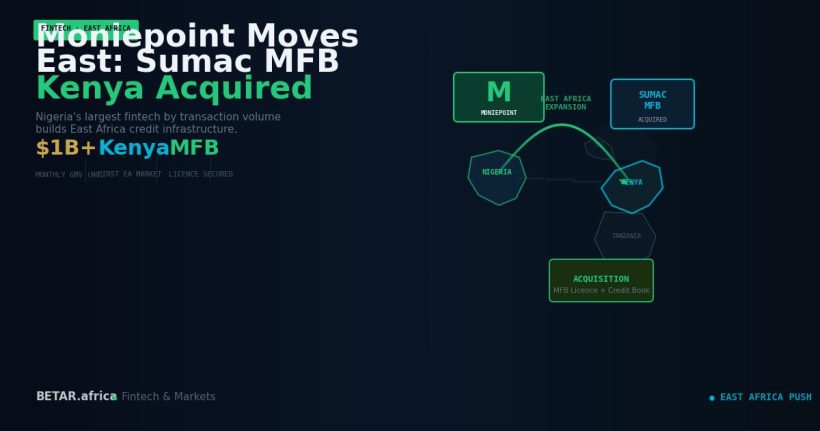

Moniepoint’s acquisition of a 78% controlling stake in Sumac Microfinance Bank Kenya, confirmed in a TechCabal report on March 26, is the most significant cross-border fintech M&A move in East Africa this year — and one of the most strategically transparent plays in the Nigerian payments company’s history.
The deal is not an experiment. It is an answer.
Moniepoint built its Nigerian business by going where the big banks would not: into the informal economy, through SME point-of-sale terminals and small-ticket business accounts that lenders treated as too expensive to serve. Sumac Microfinance Bank is the Kenyan equivalent — a regulated deposit-taking institution licensed by the Central Bank of Kenya, with an existing microfinance portfolio, a branch network, and a customer base in the SME and informal worker segment that Moniepoint knows how to monetise.
The logic is direct: acquire the licence, import the model, compete in a market where Moniepoint has no existing infrastructure but whose customer profile is nearly identical to the one it mastered in Nigeria.
Why a Bank and Not a Payment Licence
Moniepoint could have entered Kenya the way most Nigerian fintechs attempt it: applying for a CBK Payment Service Provider licence, building a payments stack, and growing from the payments layer upward. That path is slower, more crowded, and — critically — it excludes the lending capability that generates the economics Moniepoint actually wants.
Sumac gives Moniepoint something a PSP licence cannot: a deposit-taking Microfinance Bank licence. That licence authorises Sumac to accept customer deposits, disburse loans, and in principle seek a CBK upgrade to a Microfinance Bank tier 2 classification, which would expand its deposit ceiling and geographic footprint.
“The licensing shortcut is the whole point,” said one Nairobi-based banking analyst who has advised on Kenyan MFB transactions. “A new PSP entrant takes two to three years to build a meaningful lending book from scratch under current CBK supervision posture. Acquiring a regulated MFB with an existing loan book compresses that to months.”
Moniepoint declined to comment for this article. Sumac MFB’s management did not respond to a request for comment.
Sumac: What Moniepoint Is Buying
Sumac Microfinance Bank has operated in Kenya since 2010. It holds a Microfinance Bank licence from the CBK — a tier of regulation sitting above Deposit-Taking SACCOs and below full commercial banks — and has historically focused on personal and small business lending in Nairobi’s middle-income and peri-urban markets.
The bank’s publicly available financials show a loan book of approximately KES 2.3 billion (roughly $17.8 million at current rates), with a customer base estimated at 45,000 accounts. Gross non-performing loans have been elevated — a feature of most Kenyan MFBs following the Covid-era credit cycle — but within a range that a capitalised acquirer with a functioning credit-scoring stack can manage.
What Moniepoint is acquiring, above the loan book, is the regulatory permission set: the ability to take deposits, lend in Kenyan shillings, and operate as a licensed bank under CBK supervision. The 78% stake leaves a 22% minority — likely retained by Sumac’s existing shareholders — and signals a clean control acquisition rather than a strategic partnership.
The Competitive Threat to Kenyan MFB Incumbents
Kenya’s microfinance banking sector is small, competitive, and under material stress. The market is dominated by Faulu Microfinance Bank (owned by Old Mutual), SMEP Microfinance Bank, Kenya Women Microfinance Bank (KWFT), and Century Microfinance Bank. Several smaller MFBs — including U&I Microfinance — have lost their licences or been placed under CBK administration over the past three years.
Moniepoint’s entry changes the competitive calculus in two ways.
First, it introduces Nigerian fintech product design and engineering into a sector that has been slow to modernise. Kenyan MFBs operate largely on legacy core banking systems — often Temenos or local-build variants — and have struggled to deploy merchant-facing products, real-time account management, or SME lending APIs at the speed that mobile-first users now expect. Moniepoint’s product stack in Nigeria — particularly its merchant terminal network and business banking interface — is substantially more advanced than anything currently deployed at scale in the Kenyan MFB segment.
Second, and more immediately threatening, Moniepoint’s capitalisation advantage is enormous. Nigerian fintechs backed by international growth equity — Moniepoint raised $110 million in its 2023 Series C — are entering East African markets with significantly more deployment capital than local MFBs can access. If Moniepoint recapitalises Sumac to support a large loan book expansion, smaller Kenyan MFBs will face pricing pressure they cannot match from a cost-of-funds perspective.
“Faulu and KWFT will not feel this immediately,” said a Nairobi-based VC who has invested in Kenyan financial services. “But Sumac at full Moniepoint capitalisation is a different bank in twelve months. The SME lending segment is the battleground.”
The CBK Pathway
Under current CBK regulations, Microfinance Banks are categorised into three tiers based on minimum capital requirements. Sumac, as a licensed MFB, operates under the deposit cap applicable to its current tier. An upgrade — requiring a written application, CBK supervisory review, and a capital injection — would expand both deposit-taking authority and geographic licensing.
Moniepoint’s acquisition announcement does not specify a planned licence upgrade, but the strategic logic is clear: a company that built a $2 billion business in Nigeria by achieving wide geographic coverage in the informal economy is not acquiring a single-city MFB to stay single-city.
CBK has in recent years signalled support for capitalised, well-governed MFBs seeking tier upgrades — particularly where the acquirer brings technology infrastructure and a demonstrable supervisory track record. Moniepoint’s CBN regulatory history in Nigeria, while not directly applicable to CBK supervision, provides a reference point for regulatory dialogue.
The practical CBK pathway for Sumac’s upgrade would likely require a minimum capital level of KES 1 billion (approximately $7.7 million) at tier 2, and KES 8 billion ($61.5 million) for a full commercial bank licence. Moniepoint’s balance sheet makes both levels achievable in principle; the question is whether the company chooses aggressive licence escalation or a deliberate slow build.
What This Means for East Africa Fintech M&A
Moniepoint is not the first Nigerian fintech to acquire a Kenyan regulated entity — but it is the most capitalised and the most operationally disciplined to attempt it. The acquisition signals that East Africa is now formally on the acquisition map for well-funded West African fintechs seeking geographic diversification and a second credit market.
The parallel Paystack acquisition of Ladder Microfinance Bank in Nigeria — announced in the same week — means that Africa’s two most watched fintech exits from the 2021–2023 vintage are simultaneously moving toward banking status. That convergence is not coincidental. The economics of payments alone, in a compressed-fee environment, do not justify unicorn-level valuations. Lending does.
For East African fintech founders, the M&A signal is worth reading carefully: if Moniepoint can acquire a regulated Kenyan bank for an undisclosed but presumably modest premium to book value, the acquisition bar for East Africa’s own fintech consolidation wave has been formally established.
The deal terms for the Sumac acquisition — including total consideration, the valuation multiple against book, and any earn-out provisions — have not been disclosed. BETAR has requested this information from Moniepoint’s investor relations team.
BETAR Assessment
Moniepoint’s Sumac acquisition is the most credible East Africa expansion by a Nigerian fintech to date — and the first to lead with a regulated banking licence rather than a payments foothold.
The strategic logic is sound. The execution risk is real: integrating a Kenyan MFB into a Nigerian-designed product stack, managing CBK regulatory expectations while simultaneously building a merchant terminal network, and retaining Sumac’s existing staff through the transition requires an operational playbook that Moniepoint will be writing in real time.
But the downside scenario — Moniepoint acquires a small MFB, grows it modestly, and does not achieve the tier upgrade — is recoverable. The upside scenario — Sumac becomes the regulatory foundation for a full-scale East Africa expansion, backed by Moniepoint’s capital and product capabilities — represents a material competitive shift in one of Africa’s highest-potential credit markets.
This is a calculated bet. And Moniepoint, based on its Nigerian track record, knows how to calculate.
Sources: TechCabal (March 26, 2026); Central Bank of Kenya MFB licensing framework; CBK Microfinance Banks Sector Report 2025; BETAR reporting on BETA-1063 (Moniepoint/Sumac, Paystack/Ladder cross-desk flag, March 2026). Moniepoint and Sumac MFB declined or did not respond to comment requests. Deal valuation terms not disclosed at time of publication.
Related BETAR coverage: BETA-1069 — Africa Banks Are Buying the Fintechs They Could Not Build | BETA-1063 — Fintech M&A Surge: Moniepoint Kenya Entry + Paystack Banking Licence Play | BETA-1054 — Africa PE Has $10B It Cannot Exit
— Business Desk Editor, BETAR.africa


 UphivaBETAR


 Joseph Busari