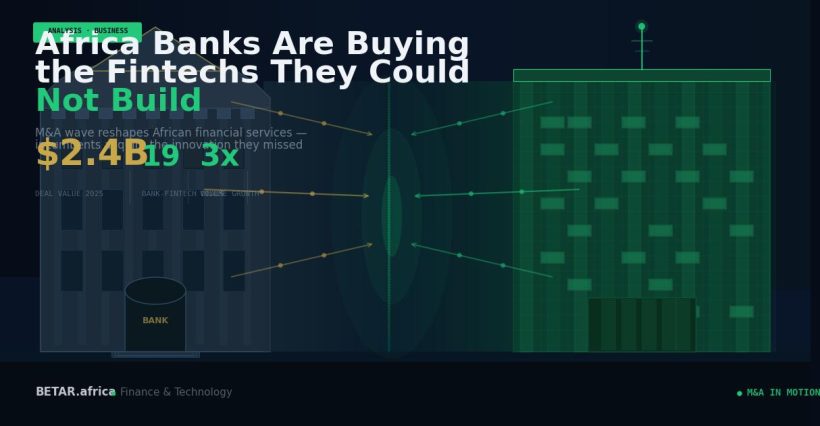

Two deals landed in Africa’s fintech industry in the same week of March 2026 and told the same story from opposite ends of the table. Moniepoint, the Nigerian payments giant, acquired a 78% stake in Sumac Microfinance Bank — its first move into East Africa, executed through a banking licence rather than an organic product launch. Days later, Paystack confirmed it had acquired Ladder Microfinance Bank, adding a deposit-taking licence to its existing payments infrastructure in Nigeria.
Both companies are fintechs. Both are buying banks. And both transactions perfectly illustrate the structural reality that has come to define Africa’s financial services M&A in 2026: the walls between banks and fintechs have collapsed, and the traffic is now flowing in both directions.
But there is a parallel story — quieter, less celebrated, and strategically more consequential — running the other way. Africa’s tier-one banks are acquiring fintech capabilities that, for a decade, they believed they could build themselves. They could not. And now, with fintech valuations compressed, VC funding scarce, and the regulatory cost of operating an independent payments or lending business rising sharply, the acquisition window has arrived.
The Thesis: Why Banks Are Buying Now
The conditions for a bank-to-fintech acquisition wave have been building since 2022, when global interest rates rose and VC capital began its retreat from African markets.
BETAR’s Q1 2026 analysis, documented in this series, shows that equity financing to African startups fell from $333 million in early 2025 to $209 million in the same period of 2026 — a 37% contraction in real venture capital deployment. The fintechs that raised at peak-market valuations in 2021 and 2022 — multiples of 15–25x annual recurring revenue were not unusual for Series B African fintech rounds at that moment — have spent the intervening years burning cash, rebuilding unit economics, and discovering that their next equity round, if it comes at all, will value them far below the numbers on their previous term sheets.
That compression is a purchasing window for any institution with a long balance sheet and a digital strategy gap. Africa’s tier-one banks qualify on both counts.
The banks’ digital strategy gap is not subtle. Between 2014 and 2022, Nigerian fintechs alone processed transaction volumes that exceeded the combined retail throughput of the three largest commercial banks. Equity Group’s mobile banking subsidiary, Finserve — built internally through enormous investment — processed more mobile transactions by 2023 than Equity Bank’s entire branch network. The lesson was not that banks should give up. It was that the infrastructure to run competitive digital financial services requires product velocity, engineering culture, and compliance architecture that most incumbent banks could not generate organically.
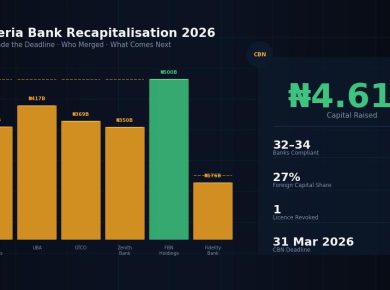
Three forces are now converging to make acquisitions the preferred answer. First, the CBN’s bank recapitalisation directive — requiring commercial banks to raise minimum capital to N500 billion by March 2026 — has pushed boards toward deal-making as a capital-accretive strategy. Acquiring a fintech with an active customer base and recurring revenue diversifies income streams and can support valuation uplift in a recapitalisation equity raise. Second, the regulatory environment for standalone fintechs has tightened significantly — compliance costs, licensing requirements, and mandatory reporting to the FCCPC and CBN have increased the operating burden on small and mid-size fintechs in ways that favour either acquisition or consolidation. Third, the price is right.
What Banks Are Acquiring
The acquisition thesis divides cleanly into three categories.
Licence plays. The fastest-moving category involves banks acquiring microfinance banks, merchant banks, or payment service providers to obtain regulatory permissions they do not already hold — or to block competitors from doing the same. Access Bank’s established pattern across the continent — the bank has completed more than forty transactions over its institutional history — reflects an explicit philosophy: acquire the licence first, integrate the customer base second, rationalise the technology third. The bank’s expansion into markets including Mozambique, Zimbabwe, and South Africa followed this template with bank-to-bank transactions; the same logic now applies to fintech licences within Nigeria and across East Africa.
Product plays. Several Nigerian and Kenyan banks have been acquiring, or acquiring significant minority stakes in, payment infrastructure companies — the settlement rails, switching technology, and merchant acquiring platforms that sit beneath the consumer-facing product layer. These are not consumer-facing acquisitions; they are infrastructure bets, oriented toward capturing interchange economics and reducing dependence on third-party processors. The attraction is straightforward: a bank that owns its payment stack does not pay another company’s margin on every transaction it processes.
Customer plays. The highest-risk category, and the most controversial. A small number of commercial banks have acquired or absorbed fintech companies primarily for their active customer bases — digital-native users who arrived through consumer finance or savings products and who have no existing banking relationship with the acquirer. Integration success in this category depends entirely on whether the acquired product survives post-transaction. Historically, on the African continent, the rate of product survival post-bank-acquisition is not encouraging.
The Multiples Question
The financial logic is not subtle. In 2021, a Nigerian fintech raising a Series B could expect to negotiate at 15x to 25x annualised recurring revenue — sometimes higher for companies with embedded lending or insurance. By late 2024, comparable companies in acquisition discussions were transacting at 2x to 5x revenue, and in some cases below book value where bad debts or CBN compliance exposure had clouded the balance sheet.
For banks with strategic intent and patient capital, the maths is compelling. A payments company processing ₦50 billion in monthly transaction volume that would have cost ₦4 billion to acquire in 2021 might transact today at ₦800 million — provided the acquirer can absorb the compliance remediation and technology integration costs. Those costs are real and consistently underestimated. But even accounting for a 30–50% post-acquisition cost addition, the acquisition-era multiple remains substantially below what a bank would pay if valuations returned to their 2021 range.
AVCA data shows that the average enterprise value multiple paid in Africa financial services M&A transactions completed in 2025 — which includes bank-to-bank deals as well as fintech acquisitions — was 1.8x book value, compared with 3.2x book value at the 2021 peak. For fintech-specific transactions, the compression is steeper because the book value of a payments company is mostly intangible. Buyers are paying for ARR, customer volume, and regulatory permissions — not for hard assets.
Integration Reality
The deal is the easy part. Integration is where Africa bank-fintech M&A historically breaks down.
Equity Group’s Finserve — a case study examined across this series — represents the most successful model, but Finserve was built internally. Its engineers shared an institutional culture with Equity Bank from day one; its product roadmap was approved through the same governance process as the bank’s branch expansion plan. The integration problem did not exist because there was nothing to integrate.
The acquired model generates different outcomes. Access Bank’s history of acquisitions reveals a consistent pattern: the bank has been genuinely effective at absorbing banking licences and branch networks — the physical infrastructure of banking — but has struggled to retain the product velocity and talent density that made the acquired fintech valuable in the first place. Fintech talent does not migrate to bank culture easily. Engineers who joined a payments startup for its speed and flat hierarchy find that the bank’s compliance-first operating model, governance structure, and salary bands are incompatible with the environment they were hired into. Key personnel departures within twelve to eighteen months of acquisition close are not an exception; they are the rule.
The product velocity problem compounds this. A fintech operating independently can push a product update in forty-eight hours. Inside a bank, the same update requires security review, legal clearance, compliance signoff, and board-level IT approval. The product that was attractive enough for the bank to acquire progressively becomes indistinguishable from the bank’s own legacy product. By the time integration is complete, the differential value that justified the acquisition premium has been largely consumed.
The banks most likely to solve this problem are those that have structured acquired fintechs as operationally independent subsidiaries — keeping them off the bank’s procurement and HR systems, preserving their brand, and protecting the engineering team from the host institution’s cost-reduction pressure. This structure requires genuine conviction from the board. Most bank boards lack it.
The Founder Calculus
For founders considering a bank acquisition offer in 2026, the trade-offs are transparent and largely unfavourable from a product perspective, but increasingly rational from a personal financial standpoint.
Three structural realities define the calculation. First, the equity alternative may not materialise. With Series A capital scarce and growth-stage equity effectively absent from African markets, a bank acquisition offer — even at a compressed multiple — may be the only exit that returns capital to investors within a reasonable horizon. Second, regulatory cost is accelerating. The cost of maintaining CBN, FCA, or RBA compliance as a standalone company has increased materially since 2023, and the enforcement posture of African regulators has shifted from monitoring to active sanction. Paystack’s N250M CBN fine for Zap, imposed simultaneously with its Ladder MFB acquisition announcement, illustrates precisely the risk of operating in grey zones that a banking licence resolves. Third, bank distribution is genuinely valuable. A fintech with 200,000 active users that is acquired by a bank with 10 million retail customers has access to a distribution advantage that no VC cheque can replicate.
The founders who have navigated bank acquisitions most successfully are those who negotiated explicit product autonomy provisions into their acquisition agreements — agreed operational firewall periods, retained brand identity, and embedded performance-linked earn-out structures that gave the bank an incentive to preserve rather than absorb. That governance architecture is harder to extract from a Nigerian commercial bank board than from a venture capital term sheet. But it is not impossible.
BETAR Assessment
The Africa bank-fintech M&A wave is real, structurally motivated, and will intensify over the next eighteen months as the 2021 and 2022 fintech vintage approaches the point where founders and investors must make decisions about their exit options.
The question is not whether banks will acquire fintechs. They will. The question is whether those acquisitions will generate the product innovation that justifies the thesis — or whether they will follow the historical pattern of banking M&A on the continent, which has absorbed businesses without sustaining them.
The data from this capital markets series points to a broader convergence. Fintechs are acquiring banking licences. Banks are acquiring fintech product stacks. The two categories are colliding at precisely the moment when the VC funding model that kept them separate has withdrawn. What emerges from that collision — a genuinely hybrid financial services sector, or simply a larger banking sector wearing fintech branding — will define the next decade of African consumer finance.
Chapter 5 of this series will examine Africa’s IPO pipeline: whether the companies built through this turbulent capital cycle are approaching public-market readiness, and what the exchange infrastructure actually needs to absorb them.
Sources: AVCA African Private Capital Activity Report 2025; BETAR Q1 2026 Funding Tracker; CBN Bank Recapitalisation Framework (2024); Equity Group Holdings Annual Report 2025; Access Bank Group Annual Report 2024; BETAR reporting on BETA-1072 (Moniepoint/Sumac MFB Kenya, March 2026) and BETA-1073 (Paystack/Ladder MFB + CBN Fine, March 2026).
Related BETAR coverage: Africa’s Series A Desert: Local VCs Rising | Venture Debt: The Private Credit Wave Backing Startups the VCs Stopped Funding | Africa PE Has $10B It Cannot Exit | Africa Q1 2026 Investor League Table

 UphivaBETAR


 Joseph Busari