
Africa’s EV Charging Infrastructure Gap: A $5B Market, 200 Public Chargers, and the Structural Crisis No One Is Solving
Africa’s electric vehicle market is growing at 32% annually toward a $20 billion valuation by 2031. The charging infrastructure to support it barely exists. The reasons are structural — and they differ sharply by vehicle segment.
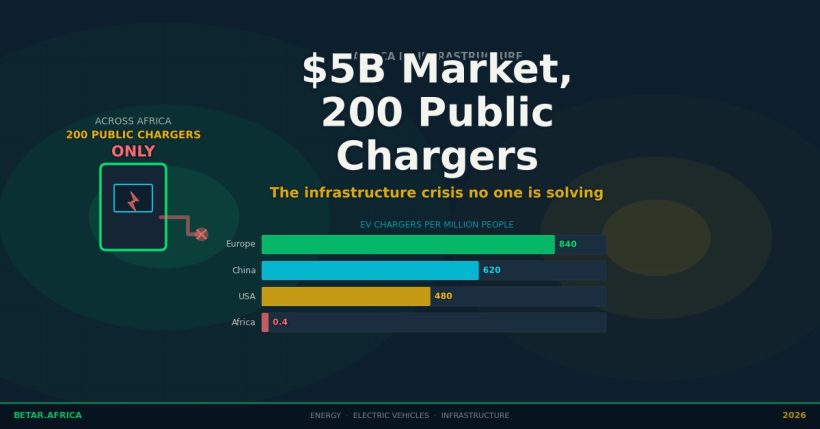
Measure Africa’s EV market by investment interest and it looks like a growth story. Measure it by charging infrastructure and it looks like a missing market. The continent has approximately 200 public EV chargers serving 1.4 billion people across 54 countries. Only 17% of African nations have more than 10 public charging stations. These are not early-stage figures for a nascent technology — they are infrastructure failure figures for a market that analysts at Research and Markets valued at $5 billion in 2025, projected to grow to $20 billion by 2031.
The gap is not accidental. It is the product of three structural forces that discourage charging infrastructure investment in Africa even as EV adoption accelerates: grid unreliability, unit economics that do not work at African electricity tariffs, and a capital allocation mismatch that funds vehicle hardware while ignoring the infrastructure hardware required to run it.
Three Markets, Three Structural Problems
Africa’s EV ecosystem is not one market — it is at least three, each with fundamentally different infrastructure requirements and business model constraints.
The two-wheeler segment is the most developed and the most structurally distinct. Companies including Spiro and ARC Ride have built commercially viable electric motorcycle businesses in East and West Africa by bypassing public charging infrastructure entirely. The battery-swap model — where riders exchange depleted battery packs for charged ones at swap stations — removes the charging wait time that makes AC charging impractical for motorcycle-dependent delivery and ride-hailing workers. Spiro’s $50 million debt facility announced in early 2026 is specifically structured around expanding its battery swap network across Africa.
The swap model works because two-wheeler operators use their vehicles commercially: a delivery rider in Lagos or a boda-boda driver in Nairobi puts 80 to 120 kilometres on a motorcycle daily. The economics of battery swap hold up at that utilisation rate. The lesson for policymakers is that infrastructure investment must match usage patterns — and two-wheeler swap infrastructure is fundamentally different from the high-power DC fast chargers that European passenger EV markets have standardised around.
The e-bus segment has a different logic again. BasiGo in Kenya and Ampersand in Rwanda have demonstrated that electric bus operations are viable when routes are fixed, distance-per-day is predictable, and buses can charge at a depot overnight. This is depot-charging infrastructure, not public network infrastructure. The capital requirement is significant — depot-level chargers cost $30,000 to $80,000 per unit depending on power output — but the business case can be modelled because bus operators control their charging schedule.
The passenger vehicle segment is where the infrastructure gap becomes most acute, and most intractable. Private car owners need public fast-charging access for intercity travel, building confidence that charge anxiety will not leave them stranded. Without a public charging network, private EV adoption stalls. Without private EV demand to support utilisation rates, public charging networks cannot pencil out economically. This is the classic infrastructure chicken-and-egg problem — and Africa has it worse than most regions because of what lies beneath it: the grid.
Grid Unreliability Is Not a Side Condition — It Is the Central Problem
“You cannot build a charging business on a grid you cannot rely on,” said Mutua Musyimi, founder of Kenya-based EV infrastructure consultancy Greenlink Mobility, in a March 2026 interview. “Every charger needs a backup power solution in most African markets, and that doubles or triples your capital expenditure per unit before you’ve charged a single vehicle.”
In Nigeria, the grid delivers power for an average of 12 hours per day in the best-served urban areas. In South Africa, despite 335 consecutive days without loadshedding as of early 2026, the underlying infrastructure remains fragile enough that commercial operators are reluctant to build charging networks without battery-backed power systems. In much of sub-Saharan Africa, effective grid uptime is far lower.
A standard 50kW DC fast charger in a reliably-powered European market costs approximately €25,000 to €35,000 installed. The same unit in Lagos or Dar es Salaam, when equipped with the battery storage and backup generation required to operate during grid outages, costs $65,000 to $90,000 — a 2.5 to 3x cost premium before any land tenure, permitting or network installation costs are factored in.
This is not an engineering problem with a near-term solution. It is a capital allocation problem. The additional investment required to de-risk charging infrastructure against grid unreliability must be financed by someone — and neither commercial operators nor development finance institutions have moved to fill the gap at scale.
The Capital Allocation Mismatch
Development finance institutions have committed hundreds of millions of dollars to African EV manufacturing and procurement: the IFC’s facilities for off-grid solar and battery storage, AfDB’s Mission 300 energy access targets, the US-backed infrastructure commitments announced at the 2026 Powering Africa Summit. Morocco’s Gotion gigafactory in Kenitra, backed by Moroccan sovereign investment and international DFI debt, is building the first large-scale EV battery manufacturing facility on the continent.
What DFIs have not done is direct comparable capital toward the public charging networks that would make passenger EVs viable for African consumers. The investment thesis for charging networks is harder to structure: revenue depends on utilisation rates that cannot be guaranteed before vehicles arrive, land rights in dense urban areas are complex, and the grid backup requirements inflate capital costs. These are exactly the conditions where DFI credit enhancement and concessional debt are designed to be deployed — but the deal structures have not been developed.
“The financing architecture for EV manufacturing has been worked out. The same work has not happened for charging networks,” said Dr Adaeze Nwosu, an infrastructure finance analyst at Lagos-based advisory firm Frontedge Capital. “You need a public guarantee or a concessional layer at the project level to make the unit economics work at current utilisation rates. That product doesn’t exist yet for African charging networks at any scale.”
The 10,000-station-by-2030 targets cited in African Union and national EV strategy documents imply an investment of $650 million to $900 million — assuming $65,000 to $90,000 per installed unit including grid backup — across the continent over five years. The IFC, AfDB, AIIB and bilateral DFIs collectively deployed more than $1.5 billion into African energy infrastructure in 2025 alone. The capital exists. The financing structures do not.
What Would Change the Equation
Three structural shifts would materially alter the charging infrastructure economics in Africa.
First, grid improvements driven by solar mini-grid expansion and utility-scale solar-plus-storage projects reduce the grid reliability premium on charging infrastructure. As South Africa demonstrated with its Eskom stabilisation, 335 loadshedding-free days changes commercial risk calculations. If Mission 300 hits its targets and 300 million additional Africans gain reliable electricity access by 2030, the addressable market for charging infrastructure expands significantly.
Second, standardisation of charging protocols across African markets would reduce the hardware fragmentation that increases deployment costs. East Africa has moved further on this than West Africa, but a continental standard — aligned with the IEC 62196 type combinations already used in South Africa — would allow hardware procurement at scale and drive unit costs down.
Third, blended finance vehicles specifically designed for charging network deployment are needed. A structure where DFI concessional debt covers the grid-backup capital premium, combined with revenue guarantees tied to national EV adoption targets, would make the unit economics viable for commercial operators and attract the private capital currently sitting on the sidelines.
Until those conditions are met, the charging infrastructure gap will widen even as the EV market grows. Africa will produce electric motorcycles, manufacture batteries in Morocco, run electric buses on fixed routes in Nairobi — and still have 200 public chargers for 1.4 billion people.
This article is part of BETAR.africa’s Energy & Climate Tech coverage. Related: Spiro’s $50M Battery Swap Expansion | Morocco’s Gotion Gigafactory: Africa’s First EV Battery Manufacturer


 UphivaBETAR
 Joseph Busari