
Africa’s families are spending an estimated $5.8 billion a year on private tutoring — a market that public school failure built, VC-backed EdTech ignored, and no continental business publication has ever properly mapped.
Every evening in Lagos’s Surulere district, weekend mornings in Cairo’s Nasr City, and on Saturdays across Nairobi’s Westlands, a parallel education system hums at full capacity. Tutors arrive at family apartments. Cramming centres fill. WhatsApp groups run live revision sessions. None of this is captured in school enrollment statistics, education ministry budgets, or the Continental Education Strategy for Africa. All of it is paid for, willingly, by families that simultaneously tell researchers they can barely afford their children’s school fees.
This is Africa’s shadow education economy: the largest unreported market in the continent’s education sector, the clearest evidence of what African families actually value, and the market that the $1.8 billion EdTech venture capital wave comprehensively failed to understand.
How Big Is the Shadow Market, Really
The available data understates the scale, but the estimates that exist are extraordinary.
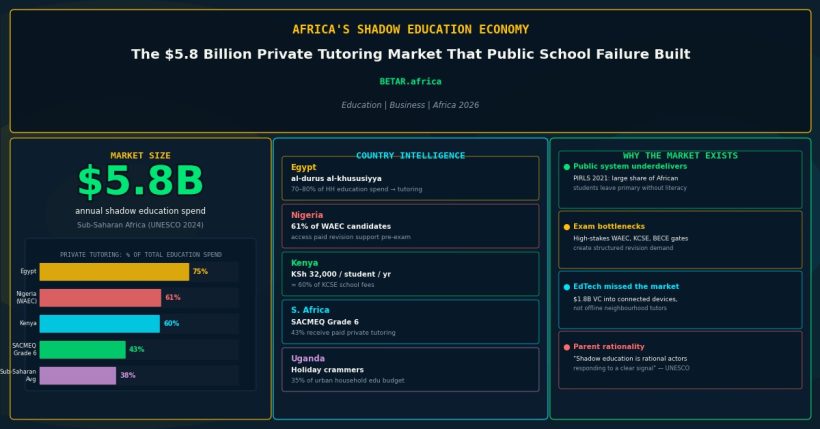
UNESCO’s 2024 Global Education Monitoring Report places informal education spending in Sub-Saharan Africa at approximately $5.8 billion annually — a figure that covers private tutoring, supplementary instruction, holiday revision programmes, and informal cramming schools. That number competes with the entire annual budget for basic education in several mid-size African economies.
Egypt presents the most extreme case study. The World Bank calculates that private tutoring accounts for 70 to 80 percent of total household education spending in Egypt — meaning that Egyptian families spend more on tutoring than on formal schooling itself. The phenomenon is so embedded that Egyptian researchers have given it its own term: al-durus al-khususiyya, private lessons, a system that effectively mirrors the formal curriculum while treating classroom instruction as the opening act.
Across Southern Africa, the SACMEQ 2023 household survey found that 43 percent of Grade 6 students were receiving paid private tutoring — a figure that cuts across income quintiles and national borders, from Zambia to Mozambique to Zimbabwe. In Kenya, the National Monitoring Assessment Survey (NASMAK) calculated that private tutoring spend per secondary student averages KSh 32,000 per year, equivalent to approximately 60 percent of the cost of KCSE school fees themselves. And in Nigeria, data from the National Examinations Council shows that 61 percent of WAEC candidates access some form of paid revision support before sitting the examination.
“Shadow education is the world’s most persistent parallel schooling system,” says Dr. Mark Bray, UNESCO Chair on Comparative Education at the University of Hong Kong and the leading global authority on private tutoring economics. “In Africa, its growth is a direct and measurable response to declining confidence in the formal system. Parents are not irrational. They are rational actors responding to a clear signal.”
That signal is underperformance. PISA for Development scores, PIRLS 2021 results, and SACMEQ reading and numeracy assessments all point toward the same structural finding: large portions of African students complete primary schooling without attaining functional literacy or numeracy. When school cannot deliver, families self-finance the gap.
Three Markets, Three Models
The shadow education economy looks different in each major market, but the underlying economics are structurally similar.
Egypt is the continent’s most advanced shadow market by absolute spend and is currently undergoing a crisis that has paradoxically accelerated its digitalisation. The Ministry of Education’s 2025 anti-tutoring decree — designed to reduce household education costs and redirect learning into formal classrooms — instead triggered the rapid creation of 14 digital tutoring platforms within twelve months of enforcement. Regulators attempted to push the market underground; the market moved to video call rooms and Telegram subscription channels. The $1.2 billion grey market the decree was meant to eliminate is now larger than before and considerably harder to track. What Egypt’s experience demonstrates is the inelasticity of tutoring demand once academic examination systems create high-stakes selection pressure.
Kenya’s tutoring market is structured around two overlapping pressures: the legacy KCSE examination system and the ongoing Competency Based Curriculum transition. Secondary students preparing for KCSE examinations fund Kenya’s most formalised tutoring economy, built around structured revision programmes, past-paper drilling, and subject specialists commanding premium hourly rates in urban areas. Meanwhile, the CBC transition — which moved Grade 10 cohorts through a new pathway structure in 2026 — has generated a second wave of tutoring demand as parents and students navigate assessment uncertainty. Industry sources in Nairobi estimate that the formal tutoring market in Kenya’s four largest counties alone exceeds KSh 4 billion annually, with informal provision multiple times larger.
Nigeria’s shadow market is the continent’s largest by estimated value — informal private tutoring is estimated to be worth over $1.1 billion annually — and is characterised by extraordinary variety. Saturday schools in Lagos operate parallel weekly curricula for primary and junior secondary students. Cramming centres cluster around examination centres in the weeks before WAEC sittings. Subject tutors at senior secondary level build personal client lists that can earn $500 to $2,000 per month in urban markets, far exceeding formal teacher salaries. “The economics of private tutoring for a skilled teacher in Lagos are significantly better than classroom employment,” one executive at a Nigerian tutoring platform told BETAR. “We are not competing with schools. We are formalising an industry that already exists.”
Why EdTech Missed This
Africa’s $1.8 billion EdTech venture wave chased the wrong market structure. Platforms built for curriculum delivery and digital classroom replacement were, in effect, attempting to disrupt the formal system — the one African families already distrust. The shadow market, where willingness-to-pay has been demonstrably established across income groups for decades, received almost no structured investment. A single paragraph in most EdTech investment theses: “supplementary learning.” It deserved its own sector.
Who Is Now Formalising the Market
Several operators are attempting to capture the tutoring economy at scale. Prepclass, a Lagos-based marketplace that connects students with vetted tutors across subjects, has built a catalogue of more than 5,000 tutors in Nigeria alone and is piloting expansion into Ghana. Malawian-founded Edves provides school management infrastructure used across eight African countries — but its fastest-growing module is the parent-facing supplementary learning portal. In Kenya, emerging platforms are targeting the CBC transition anxiety gap, offering structured competency-mapping sessions for Grade 9 and 10 parents.
The business logic is different from consumer EdTech’s failed subscription thesis. Tutoring marketplaces earn per-session commissions or tutor verification fees. The consumer is motivated, the transaction is discrete, and price points are set by existing market rates rather than platform-imposed subscription structures. The total addressable market at even 30 percent formalisation of current informal spend exceeds $1.7 billion annually.
What CESA 2026-2035 Got Wrong
The Continental Education Strategy for Africa 2026-2035, adopted under the African Union’s education framework, does not reference shadow education or private supplementary tutoring once in its core text. Its financing assumptions are built entirely around public expenditure, multilateral disbursement, and public-private partnerships in the formal school infrastructure sense. The $5.8 billion that African families are already spending, every year, outside the formal system — demonstrating willingness-to-pay that no formal education economist has managed to elicit at scale — is not visible in CESA’s architecture.
This is not a minor oversight. If CESA 2026-2035 is serious about learning outcomes, it is in competition with a parallel system that already has African families’ money. The most effective education policy on the continent may not be one that adds more public spending into a system families have stopped trusting — it may be one that recognises the shadow market as revealed preference data, and asks what quality and accountability structures could allow it to serve more children more effectively.
Africa’s shadow education economy is not the symptom of educational failure. It is the market that family rational choice built when the formal system stopped delivering. Anyone with a serious interest in African human capital — investors, policymakers, or the next generation of EdTech founders — should start here.
 UphivaBETAR
 Joseph Busari