
COMESA’s WhatsApp Case Just Crossed a Threshold. What Happens to Meta Next
The COMESA Competition Commission’s stakeholder submission window closed on March 16. Africa’s most ambitious digital antitrust case now enters its evidence-weighing phase — and Meta’s exposure is larger than most observers have priced in.
By Technology Reporter | BETAR.africa | 22 March 2026
On March 16, 2026, the COMESA Competition Commission (CCC) closed the stakeholder submission window in its investigation into Meta Platforms over WhatsApp’s restrictions on third-party AI providers. No announcement followed. No ruling was published. No statement was issued by Meta.
That silence should not be mistaken for inaction. It marks the end of the first investigative phase and the beginning of the harder one — the period in which the commission weighs the evidence, decides whether Meta’s conduct constitutes abuse of dominant position across 21 African markets, and determines what remedy, if any, to impose.
For the African AI ecosystem, the March 16 milestone matters less as a moment of resolution than as a structural inflection point. The CCC now holds a complete evidential record. What it does with that record will define how seriously Africa’s emerging digital competition apparatus is taken — by platforms, by regulators elsewhere on the continent, and by the startups that built their businesses on the assumption that WhatsApp would remain an open channel.
What March 16 actually was
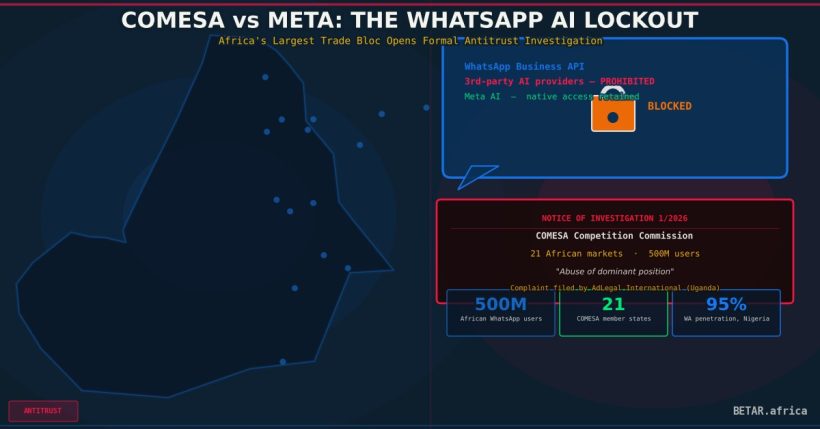
The CCC opened formal proceedings on February 17, 2026, issuing Notice of Investigation 1 of 2026 following a complaint by AdLegal International, a Ugandan campaign group. The complaint alleged that Meta’s October 2025 changes to the WhatsApp Business Platform terms — which banned general-purpose AI providers from the channel while allowing Meta’s own AI assistant to operate freely — constituted abuse of dominant position within the COMESA common market.
The March 16 date was the deadline for parties to submit evidence, expert opinions, and formal responses to the commission’s investigative framework. It is, in procedural terms, the close of pleadings in a judicial proceeding. The commission cannot reach a finding without it, but its closure does not trigger an immediate outcome. CCC proceedings under the 2023 Competition Regulations move through investigation, notification of findings, an opportunity to respond, and only then a final determination or consent order.
In straightforward cases, this process takes months. In cases involving global platforms with complex technical evidence, it can take considerably longer.
The enforcement tools available
The CCC is not limited to waiting for a final determination. Under its enabling regulations, it holds two classes of interim power that have not yet been exercised in this investigation and that would represent a significant escalation if invoked.
The first is the power to issue interim relief orders — effectively injunctions that require a party to stop or modify conduct before a final ruling. The EU precedent is instructive: when the European Commission moved against Apple under the Digital Markets Act, interim measures allowed regulators to freeze conduct while the full investigation ran its course. COMESA’s framework contains analogous provisions. An interim order requiring Meta to restore WhatsApp API access for third-party AI providers while the investigation proceeds would be a landmark exercise of that power.
The second is document production authority — compelled disclosure of internal Meta communications, pricing models, and technical specifications relevant to the AI access restrictions. No public indication exists that the CCC has yet used this tool, but it would be standard procedure in any serious competition investigation at this stage.
On the penalty side, COMESA’s maximum sanction is 10 percent of annual turnover within the common market — not global revenue. Meta does not disclose Africa-specific revenue in granular terms, but analyst estimates place the COMESA-region figure in the range of $200 million to $400 million annually, based on regional advertising revenue proxies. A 10 percent fine on that range would be $20 million to $40 million — material but not existential for Meta at its current scale.
The more consequential remedy would be a structural conduct order: a requirement that Meta restore equivalent API access for third-party AI providers on commercially equivalent terms to those available to Meta AI. That is the outcome the complainant, the affected AI startups, and several of the consumer groups that submitted evidence during the window are seeking. It is also the outcome that Meta’s legal team will fight hardest to prevent.
Africa’s enforcement architecture is thickening
The COMESA case does not exist in isolation. It is one piece of a rapidly assembling African digital competition enforcement framework that has no single centre but is gaining coherent shape.
South Africa’s Competition Commission is pursuing the Media and Digital Platforms Market Inquiry, which produced a preliminary report in 2024 recommending binding conduct codes for platforms with significant market power — including Meta’s WhatsApp. The Tribunal has since issued a consent agreement with Google over search advertising that included R688 million in local content investment commitments, a structural remedy rather than a pure monetary fine.
Nigeria’s Federal Competition and Consumer Protection Commission has an open investigation into Google’s Play Store billing policies — a separate conduct complaint but one that similarly tests whether African competition authorities can produce binding outcomes against global technology companies, not merely recommendations.
Kenya’s Competition Authority is developing its own digital markets framework, with a consultation process that explicitly references both the EU DMA and the COMESA proceedings as reference models.
Each of these bodies is building enforcement muscle independently. What makes the COMESA case structurally distinct is its geographic scope: a finding from the CCC carries legal weight across 21 member states representing approximately 600 million people and $1 trillion in combined GDP. It is the most geographically ambitious digital antitrust action anywhere in the Global South.
The WhatsApp commerce question
The stakes extend beyond AI market access. WhatsApp occupies a structural position in African digital commerce that has no close parallel in any other region. It reaches an estimated 95 percent of Nigerian internet users and operates as the primary channel for informal sector commerce, fintech customer service, and small-business client management across East and Southern Africa.
For African AI startups — the cohort most directly affected by the October 2025 API changes — WhatsApp was not merely a distribution channel. It was, in many cases, the entire addressable market. Building a general-purpose AI assistant that could not access WhatsApp in Nigeria, Kenya, Ethiopia, and Uganda meant building a product that could not reach the majority of the continent’s digitally active population.
The CCC’s investigation was filed on exactly this basis: not that Meta’s changes harmed an abstract market, but that they foreclosed a specific and irreplaceable competitive channel for a class of African technology businesses at the precise moment that the AI application layer was becoming commercially viable.
What a credible outcome looks like
Competition law scholars who track African digital regulation generally identify three markers of a credible outcome from this investigation.
First, timeliness. The EU’s DMA enforcement moved from formal investigation to binding order on Apple in under 18 months. COMESA has no formal timeline obligation, but an investigation that runs beyond 2027 without interim measures will face legitimate questions about institutional capacity.
Second, structural remedy. A monetary fine without a conduct requirement would be widely read as a face-saving outcome that leaves Meta’s API restrictions intact. The credibility of COMESA’s digital competition framework depends on whether it can secure behavioural change, not just extract a payment.
Third, pricing terms. Even if API access is restored, the economics of WhatsApp-based AI in Africa depend heavily on per-message costs. At the API pricing tier Meta offered before October 2025, the unit economics for a Nairobi-based AI startup serving informal sector customers at scale were already marginal. Any remedy that restores access at punitive pricing will be a technical win with limited practical effect.
The CCC has indicated no timeline for next steps. The commission did not respond to a request for comment from BETAR.africa before publication. Meta Africa’s communications team also did not respond.
The absence of statements from either party is, in its own way, informative. The investigation is live. The record is closed. The next move belongs to the commission.
BETAR.africa sought comment from the COMESA Competition and Consumer Commission, Meta Africa, and AdLegal International. No responses were received before publication. BETA-590 (COMESA opens investigation, March 13 2026) provides detailed background on the original probe and the WhatsApp API changes that prompted it.
BETA-1029 | Technology Desk | 22 March 2026
 UphivaBETAR
 Joseph Busari