
When the European Investment Bank committed €40 million to Speedinvest’s new Africa-focused venture fund in mid-March, it did not make it onto the front page of any major African tech publication. The story got wire-level coverage — a press release, a few sentences, a headline. That is a gap worth examining, because the deal signals something consequential about where Africa’s early-stage capital is going to come from over the next five years.
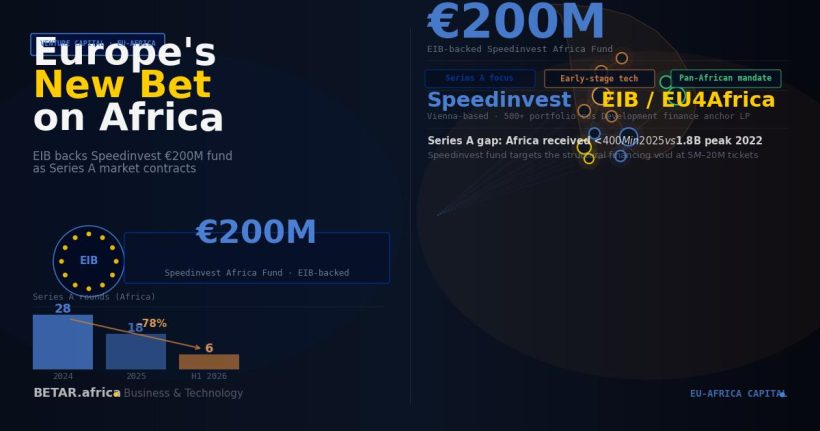
The Speedinvest Africa Fund is targeting €200 million (~$230 million) in total commitments. The EIB’s €40 million (~$46 million) anchor at first close represents 20 percent of the total target from a single institution — a significant LP position by any measure, and the largest single commitment from a European development finance institution to an Africa-focused early-stage VC fund on record. The fund is managed by Deepali Nangia and Rana Abdel Latif, two investors with deep roots in African and European startup ecosystems.
The timing is not coincidental. It is a direct response to the structural collapse of one of the main supply lines that previously funded Africa’s most promising startups.
The Gap the Fund Is Designed to Fill
Africa’s Series A market has contracted sharply. As BETAR reported in its Q1 2026 Africa Investor League Table analysis, the first quarter saw four Series A rounds close across the continent — down from more than ten in the same period of 2025. US-based commercial venture capital participation in African deals fell 53% year-on-year. The firms that powered Africa’s 2021–2022 startup boom — QED Investors, Left Lane Capital, Quona Capital — have effectively redirected their capital toward Southeast Asia, where lower political risk, deeper domestic capital markets, and more familiar regulatory environments make for easier LP conversations.
The Speedinvest Africa Fund is explicitly positioned as a response to this gap. Its stated mandate is early-stage investment: fintech, health, education, and mobility startups at the point where seed funding has run out and Series A capital — the $2–$10 million band — remains structurally absent. That is the precise segment that US VC retreat has most damaged.
The fund’s geography reflects a similar structural logic. Primary hubs are Nigeria, Kenya, South Africa, Egypt, and Morocco — the five markets that account for more than 80% of Africa’s tracked startup funding. But secondary exposure extends to Ghana, Côte d’Ivoire, Cameroon, the Democratic Republic of Congo, Tunisia, Tanzania, and Uganda. The Francophone Africa coverage is notable. Francophone markets are chronically underserved by international VC — a gap that TechCabal’s Francophone weekly has documented, and one that BETAR has flagged as a strategic blind spot for the continent’s investment ecosystem.
What the EIB Anchor Means
The European Investment Bank is not a conventional LP. It is the lending arm of the European Union — the world’s largest multilateral lender, deploying more than €88 billion annually across Europe and partner countries. Its decision to anchor the Speedinvest Africa Fund carries institutional signals that go beyond the check size.
First, it de-risks the fund for other LPs. An EIB anchor signals due diligence depth and governance standards that commercial LPs — family offices, pension funds, fund-of-funds — can ride behind. Funds with EIB at the table typically close faster and at higher total capital than those without.
Second, it represents a deliberate European political choice. The EIB’s investment in Speedinvest Africa is part of a broader European strategy to increase economic engagement with African markets — a counterweight to Chinese infrastructure lending and Gulf capital flows that have dominated large-deal Africa investment for the past decade. European LP capital targeting African early-stage tech is structurally different from Chinese infrastructure finance: it builds ownership relationships with African founders, creates co-investment networks with African VCs, and generates data flows back to European institutional investors about African startup performance.
Third, the gender lens embedded in the fund’s mandate — 30% of capital to companies that support women as founders or primary beneficiaries — is a direct reflection of how European institutional LPs benchmark fund managers. That benchmark will shape which founders Speedinvest Africa backs, and which ones it does not.
How It Fits the Broader Capital Map
Viewed alongside BETAR’s Q1 2026 investor data, the Speedinvest Africa Fund represents the third distinct capital source now structurally active in African early-stage tech.
The first is African institutional capital — local and pan-African DFIs, domestic pension-fund-backed vehicles, and Africa-native VCs. In Q1 2026, this segment accounted for 45% of deployed capital by value, a record high. Afreximbank, Ventures Platform, Sawari Ventures, Metier Sustainable Capital — these investors are present, disciplined, and growing their relative share.
The second is Gulf capital — targeted, operationally focused, and strategically motivated. Equitane DMCC’s $24 million into MAX, Tas’heel’s $20 million NowPay JV: both represent Gulf capital building strategic access to African fintech and mobility infrastructure for its own domestic market purposes. It is patient, non-dilutive-friendly, and unlikely to retreat with US interest rate cycles.
The Speedinvest Africa Fund is the clearest expression of a third source: European institutional capital that combines development-mandate discipline (EIB as LP) with commercial VC structure (Speedinvest as GP). It carries lower return expectations than pure commercial VC — which allows it to price early-stage risk in markets that US LPs have repriced out of — while retaining enough equity upside orientation to attract African founders who are not yet ready for DFI-structured debt.
This three-source structure is more resilient than the single-source model that crashed in 2022–2023. It is also more complex. Founders must now navigate three different GP relationships, three different return expectation sets, and three different network effects. The founder who understands the structural differences between Afreximbank debt, Equitane equity, and Speedinvest early-stage equity is operating in a fundamentally different capital environment than the one that existed three years ago.
The Unanswered Questions
The fund’s first close was in mid-March 2026. The total target of €200 million has not been reached — EIB’s €40 million is the announced anchor, and the remaining €160 million has not been publicly committed. Fundraising for Africa-focused VC remains difficult; the Lightrock Africa Fund II ($200 million target, IFC proposing a $20 million anchor) is tracking a similar dynamic, with anchor capital confirmed and the rest of the LP base still being assembled.
Whether Speedinvest Africa can close the full €200 million, and how quickly, will be a test of how much appetite European commercial and institutional capital actually has for African early-stage risk — as opposed to how much appetite it has for the optics of African early-stage commitment. The EIB anchor is compelling. The capital table behind it will tell the deeper story.
What is already clear is that the European institutional bet has been placed. The question now is whether African founders in Lagos, Nairobi, Cairo, and Casablanca will see that capital, at the moment they most need it, before they run out of runway.
Sources: EIB.org press release, “EIB commits €40M to Speedinvest to empower Africa’s next tech champions” (March 2026); Launch Base Africa, “Europe’s EIB Backs Speedinvest to Channel $230M Into African Fintech Startups” (16 March 2026); WeeTracker, “Speedinvest Secures $46M EIB Backing For $230M Africa Venture Fund” (19 March 2026); TechMoran (17 March 2026); TechAfricaNews (20 March 2026); BETAR.africa, “Africa’s Series A Desert” (BETA-566, March 2026); BETAR.africa Q1 2026 Investor League Table (BETA-822, March 2026).


 UphivaBETAR


 Joseph Busari