
Nigeria’s Bank Recapitalisation: Who Made the Deadline, Who Merged, and What Comes Next
By BETAR.africa Business Desk | 29 March 2026
On 28 March 2024, the Central Bank of Nigeria issued a circular that would set the Nigerian banking sector on its most consequential restructuring in two decades. Commercial banks with international licences had 24 months to hold a minimum of ₦500 billion in paid-up capital and share premium. National-licence banks needed ₦200 billion. Regional lenders required ₦50 billion. The deadline: 31 March 2026.
That date arrives in three days.
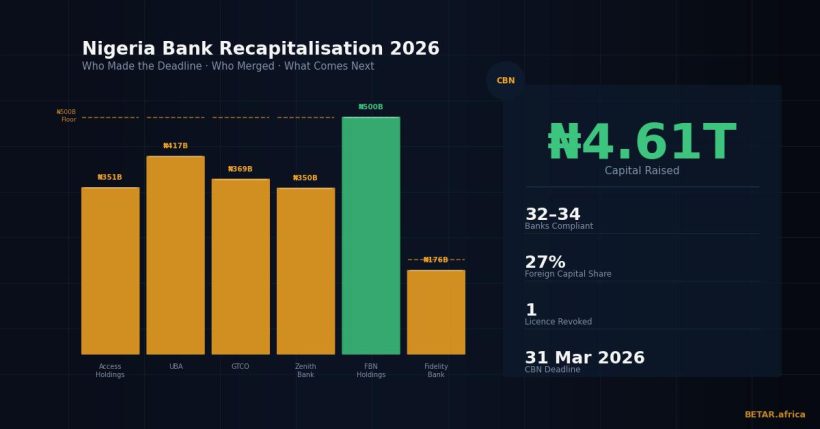
Two years on, the numbers are striking. Nigerian banks have collectively raised ₦4.61 trillion in fresh capital — a figure CBN Governor Olayemi Cardoso confirmed last week. Approximately 32 to 34 banks are now compliant. The sector has been reshaped: one bank lost its licence before the process even formally began, one merger created Nigeria’s ninth-largest bank, and at least three institutions remain in regulatory intervention as the clock runs down.
This is what happened, who made it, and what the sector looks like on the other side.
The Scale of What Was Demanded
The previous minimum capital requirements for most commercial banks sat at ₦25 billion — a figure set in 2004 under the Soludo-era consolidation. The new directive represented a 20-fold increase at the international tier. For the roughly 26 commercial banks operating in Nigeria at the time, the instruction was blunt: raise capital, merge, downgrade your licence, or face the consequences.
The composition rule made it harder still. Capital had to come from paid-up equity and share premium only. Retained earnings — the cushion many banks had quietly relied on — did not count. Banks needed to go to markets, to shareholders, or to new investors.
Most chose the market. The result was two years of rights issues and public offers that transformed the Nigerian Exchange Group into one of Africa’s most active equity fundraising venues in the post-pandemic era.
Who Made It — and How Much They Raised
Access Holdings, the parent of Access Bank, moved first and fastest. Its rights offer — priced at ₦19.75 per share — raised ₦351 billion by August 2024, making Access Bank the first institution to cross the ₦500 billion international threshold. Zenith Bank followed with a hybrid rights and public offer that raised ₦350.46 billion in September 2024; the public offer was 160% oversubscribed.
GTCO, the holding company for GTBank, raised ₦369 billion across two tranches — a domestic public offer on the Nigerian Exchange and an international offering on the London Stock Exchange targeting foreign institutional investors. UBA raised approximately ₦417 billion across two separate rights issues. FBN Holdings raised ₦150 billion in a first tranche and received shareholder approval for a further ₦350 billion raise to anchor its capital base above ₦730 billion.
Among national-licence banks, Fidelity Bank raised ₦175.85 billion. Wema Bank raised ₦147.8 billion. Sterling Financial Holdings completed recapitalisation for both its Sterling Bank and AltBank subsidiaries, receiving final CBN approval in January 2026. FCMB Group raised ₦167.67 billion.
The aggregate is substantial. Eight major listed banks collectively raised over ₦2 trillion through the Nigerian Exchange in 2025 alone. The sector’s combined market capitalisation rose to ₦16.14 trillion by year-end. Foreign investors contributed approximately ₦1.25 trillion — 27% of the total — drawn by the combination of a higher-yielding naira environment and the structural improvement that recapitalisation implied.
Heritage Bank: The Warning Shot Came Early
Before the formal compliance period had produced its first completed raise, the CBN made an example that the sector would not forget.
On 3 June 2024, the CBN revoked Heritage Bank’s licence. The grounds: breach of Section 12(1) of the Banks and Other Financial Institutions Act 2020. The bank’s board and management had failed to improve its financial performance despite supervisory intervention. The CBN concluded it had no reasonable prospects of recovery and appointed the Nigeria Deposit Insurance Corporation as liquidator.
Heritage Bank was not the first small institution to lose its licence. But the timing — just months after the recapitalisation directive — sent an unambiguous message. The CBN would act. Depositor protection via NDIC insurance (up to ₦5 million per customer) was in place, but shareholders would be wiped out. For banks already struggling with their capital bases, Heritage Bank’s fate concentrated minds.
The Merger That Created Nigeria’s Ninth-Largest Bank
Not every institution could raise capital independently. For Unity Bank, the arithmetic was always going to require a different solution.
In August 2024, the CBN approved a merger between Unity Bank and Providus Bank. The combined entity — created through a court-sanctioned scheme of arrangement — holds ₦5.3 trillion in assets as of mid-2025, operates approximately 230 branches, and ranks as Nigeria’s ninth-largest bank. To smooth the transition, the CBN approved a ₦700 billion bail-out loan over 20 years at a concessionary rate of the monetary policy rate minus 11%, with a five-year moratorium.
Unity Bank shareholders voted in favour at a court-ordered extraordinary general meeting in September 2025: 293 of 295 present approved the merger. Providus, a fast-growing digital-first bank that had built strong technology infrastructure but lacked the branch network to compete at scale, found in Unity a complementary set of assets. The merged entity counts as compliant under the ₦200 billion national licence threshold.
The Unresolved Cases
As of this week, three institutions remain in a status the CBN calls “regulatory intervention” — a designation that effectively places them outside the standard March 31 framework.
Polaris Bank has been in discussions with prospective acquirers and investors since at least 2025. With a reported capital base of ₦50.43 billion as of its last publicly available figures, the gap to the ₦200 billion national minimum is significant. No acquisition or merger has been confirmed.
Keystone Bank has drawn investor interest — including from foreign parties — but also without a confirmed outcome. Both Polaris and Keystone were described by senior CBN officials as “special cases” that would be resolved through bespoke frameworks rather than automatic revocation.
Union Bank presents the most complex situation. On 25 March — just six days before the deadline — a Federal High Court in Lagos nullified the CBN’s January 2024 dissolution of Union Bank’s board, ruling that the regulator had acted beyond its powers under BOFIA 2020. The case was brought by Titan Trust Bank, Luxis International, and Magna International, the core shareholders who lost control when the CBN intervened. The court restrained the CBN from proceeding with recapitalisation under CBN-appointed management and ordered the reinstatement of the original board. The CBN filed a notice of appeal on 26 March and publicly assured depositors that Union Bank “is fully capable of meeting its obligations.” Operations continue unchanged pending the appeal — but Union Bank’s recapitalisation status is, in effect, in legal suspension until a higher court rules.
CBN Governor Cardoso has been explicit on one point: the March 31 deadline will not be extended. Banks in regulatory intervention are not exempt — they are on separate resolution tracks. Revocation remains the ultimate sanction.
What This Means for Nigeria’s Financial System
Fitch Ratings has said that Nigerian bank recapitalisation “outpaces Sub-Saharan peers” — a rare compliment for a financial system that has faced repeated periods of stress. The agency’s assessment is that tier-1 and tier-2 banks are largely through the process with capital well above minimums. The consolidation story centres on the tier-3 institutions, where M&A and licence downgrades will continue beyond March 31.
S&P Global noted in a November 2024 analysis that higher capital provides Nigerian banks with the firepower to finance larger transactions — expanding single-obligor lending limits and enabling project finance at scale. If the macro environment cooperates, a better-capitalised banking sector could finally channel more credit into Nigerian infrastructure and productive enterprise rather than managing the perennial constraints of thin capital cushions.
There are caveats. Market observers have flagged the risk that capital adequacy ratios do not automatically translate into improved governance or credit culture. A Punch editorial captured the concern bluntly: “Recapitalisation without transformation is a risk Nigeria cannot afford.” Meeting the threshold is a necessary condition for resilience. It is not a sufficient one.
The second concern is concentration. Fewer, stronger banks create a more stable financial system in theory. In practice, market power shifts upward. Smaller businesses, rural borrowers, and sectors that the large banks find unattractive may find themselves further underserved. The tier-3 casualties of this process — however necessary from a regulatory standpoint — are, in many cases, the banks that were serving the credit gaps the major institutions never filled.
The Bottom Line
Nigeria’s banking sector enters April 2026 materially stronger than it entered 2024. ₦4.61 trillion in fresh equity is a real capital injection, not an accounting exercise. The major banks — Access, Zenith, GTCO, UBA, First Bank, Fidelity — are better positioned to absorb shocks, fund large transactions, and compete regionally.
The unresolved cases — Polaris, Keystone, Union Bank — are a reminder that recapitalisation is a process, not a finish line. The CBN’s resolution frameworks for these institutions will be the next test of its regulatory credibility.
For investors, the signal is clear: Nigeria’s systemic banks have passed a capital stress test that most African peers have never been asked to sit. That matters for ratings, for correspondent banking relationships, and for the medium-term outlook for Africa’s most important financial market.
The deadline arrives on Tuesday. The harder work — of translating capital into credit, and credit into growth — starts on Wednesday.
Related reading: Africa Bank-Fintech M&A 2026: Banks Are Buying the Fintechs They Could Not Build | Paystack Acquires Ladder MFB: Building for Regulation Before Being Caught By It

 UphivaBETAR

 Joseph Busari